你的浏览器版本过低,可能导致网站不能正常访问!
为了你能正常使用网站功能,请使用这些浏览器。

【安富莱——DSP教程】第13章 SupportFunctions的使用(一)

[复制链接]
baiyongbin2009 发布时间:2015-3-24 11:08
本帖最后由 baiyongbin2009 于 2015-3-24 11:13 编辑 ) S: d+ n% V/ H6 }" ]
. m+ x9 N' f# v  j  Z! \
特别说明:完整45期数字信号处理教程,原创高性能示波器代码全开源地址:链接
2 G  z) G: M8 I; f0 V
第13章 SupportFunctions的使用(一)
; |6 b- B. A# k* X
    本期教程主要讲解支持函数中的数据拷贝,数据赋值和浮点数转换为定点数。
    13.1 数据拷贝 Copy
    13.2 数据填充 Fill
    13.3 浮点数转定点数 Float to Fix
    13.4 总结

9 }9 M$ }1 b, }9 X% A8 E3 e" y2 T13.1 数据拷贝Copy
这部分函数用于数据拷贝,公式描述如下:
    pDst[n] = pSrc[n];   0 <= n < blockSize.   
13.1.1 arm_copy_f32
函数定义如下:
    void arm_copy_f32(float32_t * pSrc, float32_t * pDst, uint32_t blockSize)
参数定义:
    [in]   *pSrc     points to input vector   
    [out]  *pDst    points to output vector   
    [in]   blockSize length of the input vector   
13.1.2 arm_copy_q31
此函数的使用比较简单,函数定义如下:
    void arm_copy_q31(q31_t * pSrc, q31_t * pDst, uint32_t blockSize)
参数定义:
     [in]   *pSrc     points to input vector   
     [out]  *pDst    points to output vector   
     [in]   blockSize length of the input vector         
13.1.3 arm_copy_q15
函数定义如下:
    void arm_copy_q15(q15_t * pSrc, q15_t * pDst, uint32_t blockSize)
参数定义:
      [in]   *pSrc     points to input vector   
      [out]  *pDst    points to output vector   
      [in]   blockSize length of the input vector  
13.1.4 arm_copy_q7
函数定义如下:
    void arm_copy_q7(q7_t * pSrc, 7_t * pDst, int32_t blockSize)
参数定义:
     [in]   *pSrc     points to input vector   
     [out]  *pDst    points to output vector   
     [in]   blockSize length of the input vector         
13.1.5 实例讲解
实验目的:
    1. 学习SupportFunctions中的数据拷贝
实验内容:
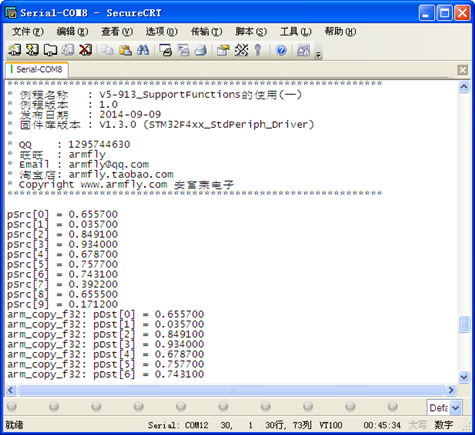
    1. 按下按键K1, 串口打印函数DSP_Copy的输出结果
实验现象:
    通过窗口上位机软件SecureCRT(V5光盘里面有此软件)查看打印信息现象如下:
13.1.png
程序设计:
  1. /*
    5 t  |" k7 |( R' c
  2. *********************************************************************************************************
    / S& L6 Q4 \% }: H
  3. *        函 数 名: DSP_Copy
    6 s; b, `9 U2 W! I
  4. *        功能说明: 数据拷贝
    ( T7 w4 D# G9 V, Q! e
  5. *        形    参:无, R3 l( c; ?2 V. |& j( c7 Q. B
  6. *        返 回 值: 无6 ?5 b5 s% k" Y7 d1 E% n
  7. ********************************************************************************************************** k  ?9 p1 C9 i8 J. a9 v7 ^4 j
  8. */
    3 U( @; n9 _( o0 z4 ?/ z
  9. static void DSP_Copy(void)
    8 y: z& U0 {4 M& R( W3 A
  10. {
    8 o4 Y/ L; e0 B- I/ v& K7 l
  11. float32_t pSrc[10] = {0.6557,  0.0357,  0.8491,  0.9340, 0.6787,  0.7577,  0.7431,  0.3922,  0.6555,  0.1712};; v* r7 n& r1 i4 f- V
  12. float32_t pDst[10];- T3 ]9 ^& p- A" W% n* k: W. t5 w1 j
  13. uint32_t pIndex;; [7 _  `- d- x1 o  {1 ~; @
  14. q31_t pSrc1[10];: e) }: r- I0 I: `' X7 m0 N
  15. q31_t pDst1[10];" [6 ?; K  d) X, |: m& ]+ @% n
  16. q15_t pSrc2[10];
    ) v1 y/ s7 k$ ~# x
  17. q15_t pDst2[10];& J* z' [6 T: M+ P8 ~
  18. q7_t pSrc3[10];, h& Z; Y% k# M" Q* s( B  r
  19. q7_t pDst3[10];
    " V' _! Z! E9 I: O) Q! m
  20. for(pIndex = 0; pIndex < 10; pIndex++). i$ f8 B; r, s1 j0 b, D# q2 B& A8 P
  21. {7 m. i1 o( j' s" R9 [7 a$ U
  22. printf("pSrc[%d] = %f\r\n", pIndex, pSrc[pIndex]);
    7 f' l4 A1 ], k7 x
  23. }
    7 N$ W/ U7 E6 l+ a" g, T" s7 z+ b
  24. arm_copy_f32(pSrc, pDst, 10);
    7 y8 y7 T- s$ \7 q9 f' A0 Q+ |
  25. for(pIndex = 0; pIndex < 10; pIndex++)8 O8 O$ S+ }6 i/ P0 g# d
  26. {7 D- `# N0 l1 }) b
  27. printf("arm_copy_f32: pDst[%d] = %f\r\n", pIndex, pDst[pIndex]);
    - u7 D$ x+ k+ j( ?4 V
  28. }
    ! I9 ^4 r9 X% N1 e! A( @$ L9 u. Z

  29. " X3 r5 p4 M! a1 h
  30. /*****************************************************************/
    & X1 }7 V: Y4 e, D2 |1 G
  31. for(pIndex = 0; pIndex < 10; pIndex++)
    * R0 w3 b6 y& P: {
  32. {
    $ G, Q' {$ x( k( X% b+ o+ i) J" Y
  33. pSrc1[pIndex] = rand();
    3 _; P  \9 \  |  F, S
  34. printf("pSrc1[%d] = %d\r\n", pIndex, pSrc1[pIndex]);; [+ ^5 J' o6 a4 }/ k
  35. }
    & [% s4 G; v  W  g4 u
  36. arm_copy_q31(pSrc1, pDst1, 10);
    8 T; M. {& _) ]/ I
  37. for(pIndex = 0; pIndex < 10; pIndex++)( s7 d, M' Q# N- H! ^2 W1 T6 Z
  38. {
      u( B: @7 i6 q! z; u9 l& T
  39. printf("arm_copy_q31: pDst1[%d] = %d\r\n", pIndex, pDst1[pIndex]);
    % y% h9 ]9 M9 i! j+ H2 N
  40. }0 ]1 {' U/ [4 A8 h  h! G
  41. /*****************************************************************/: W* w5 ~% P$ F2 ^2 ]% e
  42. for(pIndex = 0; pIndex < 10; pIndex++): y3 F, [, W1 U% F( x( R6 o- L) t1 s
  43. {
    # A$ `' C( |# _% W9 f
  44. pSrc2[pIndex] = rand()%32768;  H- M1 [2 i3 u0 M! M
  45. printf("pSrc2[%d] = %d\r\n", pIndex, pSrc2[pIndex]);
    ( a. Q  q* K5 \# B
  46. }, D8 b6 d" ^% C" V* D* T  x
  47. arm_copy_q15(pSrc2, pDst2, 10);9 K2 z5 x. u1 h3 e3 `9 Y) P# h9 v: A3 @
  48. for(pIndex = 0; pIndex < 10; pIndex++)
    ' N* y+ q& L, B# y
  49. {4 s5 W( Z* p( q$ t; M
  50. printf("arm_copy_q15: pDst2[%d] = %d\r\n", pIndex, pDst2[pIndex]);
      B' W" y" M0 R. Z
  51. }2 d- c* h1 F7 g( e7 A# n
  52. /*****************************************************************/
    3 r$ L; w1 |- k& x- ]4 ~
  53. for(pIndex = 0; pIndex < 10; pIndex++)
    , p. z' I9 a5 a% I( G
  54. {
    8 u* K4 g2 U; E
  55. pSrc3[pIndex] = rand()%128;
    % l& X3 S; J) D- e- C; R
  56. printf("pSrc3[%d] = %d\r\n", pIndex, pSrc3[pIndex]);
    " {- N/ w0 y; K1 \' D7 {
  57. }, B3 @' e9 J& y- }  u' _
  58. arm_copy_q7(pSrc3, pDst3, 10);2 E8 I: Y& Y: ^: e8 ~/ [
  59. for(pIndex = 0; pIndex < 10; pIndex++)/ k8 e$ k  Q& `( N6 t9 k
  60. {
    4 [3 G! a. c( |$ }) x
  61. printf("arm_copy_q7: pDst3[%d] = %d\r\n", pIndex, pDst3[pIndex]);4 X. t/ ~% `* O( a8 r
  62. }
    : K) b! I9 `' \, o3 Z9 ^% c. A
  63. /*****************************************************************/3 X2 @  l1 b/ f
  64. printf("******************************************************************\r\n");% G0 V# F0 h$ W( @
  65. }
复制代码

4 {8 W. f1 Q" G# j7 v) K4 ~0 O  `& b. h
赞 收藏 评论5 发布时间:2015-3-24 11:08

举报

5个回答
baiyongbin2009 回答时间:2015-3-24 11:11:05
13.2 数据填充Fill
这部分函数用于数据填充,公式描述如下:
    pDst[n] = value;   0 <= n < blockSize.  
13.2.1 arm_fill_f32
函数定义如下:
    void arm_fill_f32(float32_t value, float32_t * pDst, uint32_t blockSize)
参数定义:
     [in]       value input value to be filled   
     [out]      *pDst points to output vector   
     [in]       blockSize length of the output vector   
13.2.2 arm_fill_q31
此函数的使用比较简单,函数定义如下:
    void arm_fill_q31(q31_t value, q31_t * pDst, uint32_t blockSize)
参数定义:
     [in]       value input value to be filled   
     [out]      *pDst points to output vector   
     [in]       blockSize length of the output vector   

' p+ l& N* L4 O+ N+ E/ h
13.2.3 arm_fill_q15
函数定义如下:
    void arm_fill_q15(q15_t value, q15_t * pDst, uint32_t blockSize)
参数定义:
     [in]       value input value to be filled   
     [out]      *pDst points to output vector   
     [in]       blockSize length of the output vector   

. v* K1 Z- B, E/ i
13.2.4 arm_fill_q7
函数定义如下:
    void arm_fill_q7(q7_t value, q7_t * pDst, uint32_t blockSize)
参数定义:
     [in]       value input value to be filled   
     [out]      *pDst points to output vector   
     [in]       blockSize length of the output vector   

' ]( c' l; Q2 B, f: {
13.2.5 实例讲解
实验目的:
    1. 学习SupportFunctions中的数据填充
实验内容:
    1. 按下按键K2, 串口打印函数DSP_Fill的输出结果
实验现象:
    通过窗口上位机软件SecureCRT(V5光盘里面有此软件)查看打印信息现象如下:
13.2.png
程序设计:
  1. /*  d( t; l% B/ o( H& L
  2. *********************************************************************************************************
    : C9 Y  o1 o  ]
  3. *        函 数 名: DSP_Fill
    & o4 I& x* P6 \  I3 k' ?8 Y7 _' C
  4. *        功能说明: 数据填充
    / F) L# j' b& x2 W7 Z
  5. *        形 参:无
    & K1 I4 j5 s! J, i' V
  6. *        返 回 值: 无
    ) F, P( a% k, H! t4 B9 l1 h- I
  7. *********************************************************************************************************, |) e! t  S8 Q3 ]/ A4 `; P
  8. */
      j$ `+ i8 f* k- f# _
  9. static void DSP_Fill(void)* }! ?# X& d7 o. _" Z
  10. {) M  M( x0 a4 N: l" P5 X* _
  11. float32_t pDst[10];
    ; ?9 o" T: z6 H' H
  12. uint32_t pIndex;' t4 W' c$ M. S
  13. q31_t pDst1[10];
    0 U$ o, l. R; C" u0 ?' b
  14. q15_t pDst2[10];
    3 D* c$ ]5 z" ?/ F: Z+ ^2 i
  15. q7_t pDst3[10];6 Y. w. I. @6 I3 u( b" t6 t
  16. # `1 @7 D) C: C, n) a2 X% @
  17. arm_fill_f32(3.33f, pDst, 10);
      I4 x: U, H8 R" @% L3 x, J9 _
  18. for(pIndex = 0; pIndex < 10; pIndex++)% B$ B3 _9 Y, O4 G! ^0 P8 |& \
  19. {, I7 K) {8 Z' z& L
  20. printf("arm_fill_f32: pDst[%d] = %f\r\n", pIndex, pDst[pIndex]);0 P% i* d& h, |5 N9 B. |
  21. }
      \+ t+ o9 c. W% f# O' ]4 ~( R) j

  22. 7 j* z  N8 \4 Y4 P: E- f
  23. /*****************************************************************/
    ( @$ y; @5 z  h5 B7 R( T8 `# m
  24. arm_fill_q31(0x11111111, pDst1, 10);8 Y/ E1 r9 x! h
  25. for(pIndex = 0; pIndex < 10; pIndex++)) q* `+ f: F& @
  26. {, ?& G' H' a9 k
  27. printf("arm_fill_q31: pDst1[%d] = %x\r\n", pIndex, pDst1[pIndex]);
    - U2 O, f3 q7 W) q1 K& M
  28. }6 f( J& E5 Q) _9 U& X
  29. /*****************************************************************/* U# o( \, V! Y
  30. arm_fill_q15(0x1111, pDst2, 10);
      S/ ]4 ?* g# n, {( c, c
  31. for(pIndex = 0; pIndex < 10; pIndex++)2 ]0 X' \! O; h, f9 k
  32. {* S2 C& F  c1 [7 U" e# N
  33. printf("arm_fill_q15: pDst2[%d] = %x\r\n", pIndex, pDst2[pIndex]);6 W; ~/ u" n. d7 L- g
  34. }2 U5 w) H7 W: k
  35. /*****************************************************************/
    7 M$ I) B- C, S" Y
  36. arm_fill_q7(0x11, pDst3, 10);& ~  M7 h* p% d) m7 E
  37. for(pIndex = 0; pIndex < 10; pIndex++)
    0 L- J$ l4 v; }" }
  38. {4 l$ c0 r' E' B) R  n+ C! K
  39. printf("arm_fill_q7: pDst3[%d] = %x\r\n", pIndex, pDst3[pIndex]);
    + W2 w+ G6 Q2 H* Q) r
  40. }' W0 X+ K) c; G- t) h0 [5 y
  41. /*****************************************************************// R1 b* _# Q+ }- v2 K) v
  42. printf("******************************************************************\r\n");
    4 V6 S& A4 s+ H7 {
  43. }
复制代码

9 o0 z3 ~/ e+ F' C# O/ @& S
# [7 ^+ J0 N4 p0 M" Z  p
baiyongbin2009 回答时间:2015-3-24 11:12:38
13.3 浮点数转定点数Float to Fix 13.3.1 arm_float_to_q31
公式描述:
    pDst[n] = (q31_t)(pSrc[n] * 2147483648);   0 <= n < blockSize
函数定义如下:
    void arm_float_to_q31(float32_t * pSrc, q31_t * pDst, uint32_t blockSize)
参数定义:
    [in]    *pSrc     points to the floating-point input vector   
    [out]  *pDst     points to the Q31 output vector   
    [in]    blockSize length of the input vector
注意事项:
    1. 这个函数使用了饱和运算。
    2. 输出结果的范围是[0x80000000 0x7FFFFFFF]
13.3.2 arm_float_to_q15
公式描述:
    pDst[n] = (q15_t)(pSrc[n] * 32768);   0 <= n < blockSize.   
函数定义如下:
     void arm_float_to_q15(float32_t * pSrc, q15_t * pDst, uint32_t blockSize)
参数定义:
    [in]    *pSrc     points to the floating-point input vector   
    [out]  *pDst     points to the Q15 output vector   
    [in]    blockSize length of the input vector
注意事项:
    1. 这个函数使用了饱和运算。
    2. 输出结果的范围是[0x8000 0x7FFF]
13.3.3 arm_float_to_q7
公式描述:
    pDst[n] = (q7_t)(pSrc[n] * 128);   0 <= n < blockSize.   
函数定义如下:
    void arm_float_to_q7(float32_t * pSrc, q7_t * pDst, uint32_t blockSize)
参数定义:
    [in]    *pSrc     points to the floating-point input vector   
    [out]  *pDst     points to the Q7 output vector   
    [in]    blockSize length of the input vector
注意事项:
    1. 这个函数使用了饱和运算。
    2. 输出结果的范围是[0x80 0x7F]
13.3.4 实例讲解
实验目的:
    1. 学习SupportFunctions中的浮点数转定点数
实验内容:
    1. 按下按键K3, 串口打印函数DSP_FloatToFix的输出结果
实验现象:
    通过窗口上位机软件SecureCRT(V5光盘里面有此软件)查看打印信息现象如下:
13.3.png
程序设计:
  1. /*+ O! M+ [( ^& _$ x4 x4 `7 d1 B
  2. *********************************************************************************************************
    8 z6 H! I) u4 [! l
  3. *        函 数 名: DSP_FloatToFix- \$ r7 b3 Y7 b0 G' `
  4. *        功能说明: 浮点数转定点数  K7 }3 Y' s- P9 l8 |9 N/ }
  5. *        形 参:无- y* v; g: `# |0 \
  6. *        返 回 值: 无
    8 M, P3 w# f0 H& g7 k, u% J
  7. *********************************************************************************************************
    3 E* U9 T% z, P& ?5 I
  8. */
    $ n/ v+ z' q. l( h; g
  9. static void DSP_FloatToFix(void)
    6 E* ~5 G/ B; {. b1 n& \; {
  10. {4 X- k5 k6 h8 s5 z6 H# P
  11. float32_t pSrc[10] = {0.6557, 0.0357, 0.8491, 0.9340, 0.6787, 0.7577, 0.7431, 0.3922, 0.6555, 0.1712};
    4 A( X, ^: v" L2 _3 n
  12. uint32_t pIndex;
    5 Z6 q! e0 k! Q' }
  13. q31_t pDst1[10];* L6 a7 f' t' N3 C( W+ _
  14. q15_t pDst2[10];) o7 P  l/ P$ |, S- z2 A8 [
  15. q7_t pDst3[10];/ e4 |: \7 s* w* H% z# m! Y
  16. for(pIndex = 0; pIndex < 10; pIndex++)* o0 e8 l+ m" o+ e
  17. {+ t; L8 Z1 r  H
  18. printf("pSrc[%d] = %f\r\n", pIndex, pSrc[pIndex]);6 S7 J+ J4 b( N; B5 l! O$ q
  19. }
    3 ?  M- p6 t/ _0 Z( _8 P
  20. /*****************************************************************/
    % D) z# P+ |* w: c) C/ i
  21. arm_float_to_q31(pSrc, pDst1, 10);
    ( ^* ], E: n) v, O& b% a# E
  22. for(pIndex = 0; pIndex < 10; pIndex++), I: L. l1 j/ f
  23. {
      L. Y5 c# J! M; {
  24. printf("arm_float_to_q31: pDst[%d] = %d\r\n", pIndex, pDst1[pIndex]);
    / \) H" `* h  M8 h" r, _
  25. }
    1 x' F" J! }, a! F' K4 {% ]
  26. /*****************************************************************/
    ' k+ Q# c9 g7 ^: h
  27. arm_float_to_q15(pSrc, pDst2, 10);* R% ?& ?' y. M0 e/ e/ Q  [/ Q
  28. for(pIndex = 0; pIndex < 10; pIndex++)( E6 \! t, z8 f% U8 G0 Y3 Z& z
  29. {
    8 o; B4 ?* n: U0 D
  30. printf("arm_float_to_q15: pDst1[%d] = %d\r\n", pIndex, pDst2[pIndex]);, A) `+ @# B! y% f' [2 L& J- {
  31. }
    ( N: J' Z( D- U% s  x! P. f8 ?" f
  32. /*****************************************************************/2 M5 c2 _: p) b# c$ z0 t; J4 R6 t
  33. arm_float_to_q7(pSrc, pDst3, 10);% z: R- q* b, Z# I, n: [  J
  34. for(pIndex = 0; pIndex < 10; pIndex++)
    7 p& r* l* W. D: y6 z
  35. {7 _; e/ Z5 m1 |
  36. printf("arm_float_to_q7: pDst2[%d] = %d\r\n", pIndex, pDst3[pIndex]);4 N2 ?5 t) R) E( a; S0 w
  37. }
    $ {1 z0 T" K2 ^2 b% F' \/ O" `/ [
  38. /*****************************************************************/
    $ R2 o2 W1 g* G8 \& v0 J
  39. printf("******************************************************************\r\n");
    + }$ {( z3 o" \
  40. }
复制代码
13.4 总结
    本期教程就跟大家讲这么多,有兴趣的可以深入研究这些函数源码的实现。

0 c, S0 V* ]; c* ^
kqh1120 回答时间:2015-3-24 11:31:32
3.gif 学习了啊
小蚂蚁快溜跑 回答时间:2015-3-24 13:18:04
不懂,帮顶
wamcncn 回答时间:2015-3-24 17:34:40
谢谢分享
关于
我们是谁
投资者关系
意法半导体可持续发展举措
创新与技术
意法半导体官网
联系我们
联系ST分支机构
寻找销售人员和分销渠道
社区
媒体中心
活动与培训
隐私策略
隐私策略
Cookies管理
行使您的权利
官方最新发布
人形机器人运动控制、感知与智能配电
半导体创新技术与应用方向
EE架构与软件定义汽车
12V/48V 汽车智能配电(SPD)
区域控制单元(ZCU)与分区架构
关注我们
st-img 微信公众号
st-img 手机版