本帖最后由 freeelectron 于 2016-3-29 23:43 编辑
+ c9 x/ C5 X: G6 D& W4 ]/ W; P( B B9 ?! [
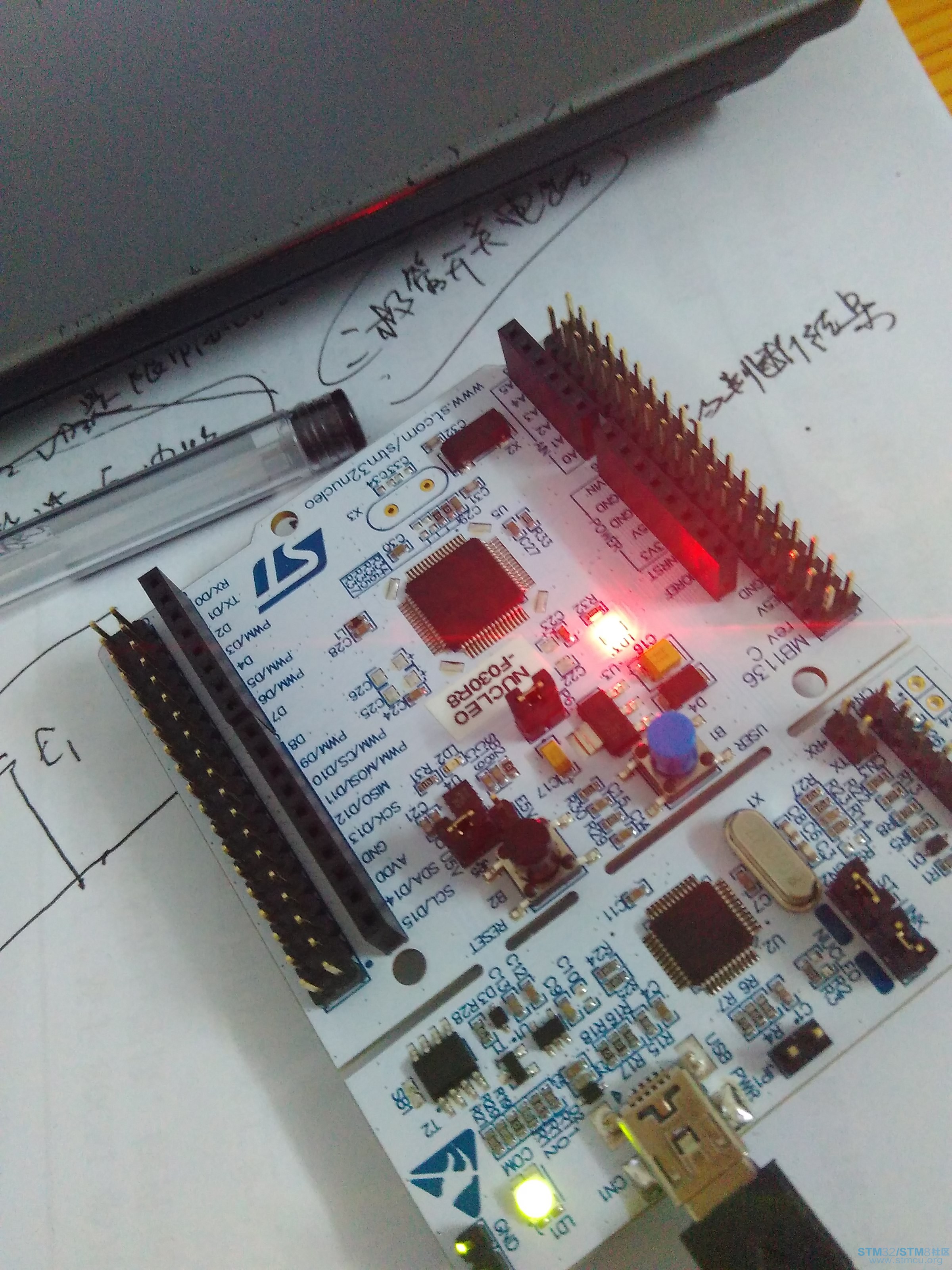
写在前面的话,去年在社区领到Nucleo-F030开发板,一直没时间去研究,近来有时间,也觉得该为社区贡献点东西!
1 v( R! {) U+ T# ^
. v8 R' E# L- n; ^1.网上关于103的资料比较多,主要是中文资料比较多,包括库函数,寄存器什么的等等,都有中文,而其他系列貌似资 料就比较少;
) f S6 D* z' |3 F5 u2.现在看来用库函数开发是一种趋势,或者说,可以借助别人写的库函数,或者说,自己将寄存器操作封装成库函数,这样就比较简单,也易读。
5 D7 z) E8 E/ f3 a3.每个系列对应的库函数的定义也不尽相同。
1 V% d: A/ _. O) G, r2 \: M1 b4 ^% d3.刚好前阵看到有人在找库函数,我们都知道,在用官方库函数的时候,会有.c文件和.h文件,那么.c文件里面肯定就是函数原型了,.h文件里面肯定就是对应的函数声明了,那么我们查看库函数的时候,只需打开某个外设对应的.h文件就行了,.h文件里面有很详细的描述,以Nucleo-F030为例说明,其实也就是整个F0系列的库函数。; _8 K1 [1 {3 r, C- C0 |1 z) R
我们以最常用的外设GPIO为例说明:; s* I8 z5 D" \
当然f0系列,GPIO的库函数定义就是stm32f0XX_gpio.c和stm32f0XX_gpio.h了
7 m( w V: i# Q2 ]" Z! \% U- /* Function used to set the GPIO configuration to the default reset state *****/
% T- {: u$ a* m+ F - void GPIO_DeInit(GPIO_TypeDef* GPIOx);
- /**1 b; u% @7 c* x# p6 q% V8 r6 V. R
- * @brief Deinitializes the GPIOx peripheral registers to their default reset ' D" z( A& n& h+ x s7 T
- * values.
8 k: L! Y# w* r+ X! V4 B - * @param GPIOx: where x can be (A, B, C, D, E or F) to select the GPIO peripheral.
2 e' X5 I& f- R8 z3 O6 }( \& q - * @note GPIOE is available only for STM32F072.$ m3 u; w* o8 ?" D1 i8 s$ b1 G4 p& h
- * @note GPIOD is not available for STM32F031. 3 N5 u: R% [9 B% p
- * @retval None7 @" ]& N) C9 q9 C0 i
- */
. N& K, s1 D# B& M) \8 K - void GPIO_DeInit(GPIO_TypeDef* GPIOx)3 v$ Z5 [/ B* ~- n/ w: @
- {
8 \0 h9 n/ m3 w0 e+ M7 }( z. K% x - /* Check the parameters */! {/ }+ O: W& X) a3 H/ u1 U+ ~
- assert_param(IS_GPIO_ALL_PERIPH(GPIOx));
" l9 E4 I( E2 C+ y3 s3 P - 1 M0 @0 L; p6 X
- if(GPIOx == GPIOA)
5 a, F* d; ~' j0 y5 U, P - {
- x6 I5 O3 U: b; `9 V, o - RCC_AHBPeriphResetCmd(RCC_AHBPeriph_GPIOA, ENABLE);
1 y6 s( M. P+ U& o' ] A: [ - RCC_AHBPeriphResetCmd(RCC_AHBPeriph_GPIOA, DISABLE);
+ @1 h+ m& _" h - }. x A1 j' w3 ^( U
- else if(GPIOx == GPIOB)5 x/ u* f; K5 ?
- {: t5 ^) K3 A. g2 e+ Q, `1 _
- RCC_AHBPeriphResetCmd(RCC_AHBPeriph_GPIOB, ENABLE);2 r& ?3 ]# {: `3 Q$ A1 K
- RCC_AHBPeriphResetCmd(RCC_AHBPeriph_GPIOB, DISABLE);2 s& h) o1 l; O1 Y9 s- W. F1 w
- }8 L @8 @ X$ D
- else if(GPIOx == GPIOC)3 L* f: w2 w% x4 b
- {3 \# f, I* [( s9 e9 r% R7 f
- RCC_AHBPeriphResetCmd(RCC_AHBPeriph_GPIOC, ENABLE);8 \0 z; k8 ]' X( r
- RCC_AHBPeriphResetCmd(RCC_AHBPeriph_GPIOC, DISABLE);) ]: [8 x0 w7 c% D; r. `- s6 ~
- }
, w; V0 U" \0 K2 n6 F, M+ c - else if(GPIOx == GPIOD)' Z* c; Y' Q( _7 O9 A) _
- {
L% u, h9 Y8 g0 j - RCC_AHBPeriphResetCmd(RCC_AHBPeriph_GPIOD, ENABLE);% O+ K2 s. z" t1 k9 W
- RCC_AHBPeriphResetCmd(RCC_AHBPeriph_GPIOD, DISABLE);# } S! c2 [" O7 P% j' U
- }
: e7 z; |& a$ l6 \* w" }" T/ b( a: I: c - else if(GPIOx == GPIOE)
3 ]% g; K' Z3 W, H( N/ Q. f - {
+ C k s3 a9 m" _8 J/ Q - RCC_AHBPeriphResetCmd(RCC_AHBPeriph_GPIOE, ENABLE);4 e ~9 n% P" q o) ^0 D, K
- RCC_AHBPeriphResetCmd(RCC_AHBPeriph_GPIOE, DISABLE);8 J j1 x4 e y% C& O% c+ c
- }% h8 l/ @& J2 d. |1 e# q
- else4 ^" v* {8 o' ]9 l3 p6 b
- {: Q# [+ b7 E, w* v# e* k- A& k
- if(GPIOx == GPIOF)
8 e$ p# Q! K7 Q1 p" i5 @ - {: X0 @' E* n& T$ `1 `7 o
- RCC_AHBPeriphResetCmd(RCC_AHBPeriph_GPIOF, ENABLE);
1 F1 o( O% a* Y3 h- w! {# S - RCC_AHBPeriphResetCmd(RCC_AHBPeriph_GPIOF, DISABLE);
8 B& P3 A) l0 I3 m/ S0 G% |1 w - }
- t; z$ ~( Q! _7 k3 k: c [6 D0 ^ - }, |5 ]* [' E' b/ b/ _3 S3 u. r
- }
" W0 g' c& K: v4 A( C% N
- /* Initialization and Configuration functions *********************************/
- `& I+ Z# H S( ?8 Q. I - void GPIO_Init(GPIO_TypeDef* GPIOx, GPIO_InitTypeDef* GPIO_InitStruct);. |2 p* L% s" O$ f
- void GPIO_StructInit(GPIO_InitTypeDef* GPIO_InitStruct);
& C" r( x6 ~5 A6 e' F) o0 b - void GPIO_PinLockConfig(GPIO_TypeDef* GPIOx, uint16_t GPIO_Pin);) _0 H- k: g) e' `. d
* v5 Q8 I+ r& t. Q$ U p3 e" Z- /* GPIO Read and Write functions **********************************************// L+ C, R' k* Z1 @
- uint8_t GPIO_ReadInputDataBit(GPIO_TypeDef* GPIOx, uint16_t GPIO_Pin);
- X& u, K- e( U( \& C - uint16_t GPIO_ReadInputData(GPIO_TypeDef* GPIOx);
- w8 c1 u( t- j5 C - uint8_t GPIO_ReadOutputDataBit(GPIO_TypeDef* GPIOx, uint16_t GPIO_Pin);
3 L" o+ l! W" B9 i9 |$ F - uint16_t GPIO_ReadOutputData(GPIO_TypeDef* GPIOx);
3 ^( F0 f6 l, p Y6 r2 b - void GPIO_SetBits(GPIO_TypeDef* GPIOx, uint16_t GPIO_Pin);
) } j4 v5 y8 g2 M2 }! ^ - void GPIO_ResetBits(GPIO_TypeDef* GPIOx, uint16_t GPIO_Pin);0 v' Z% F# v6 t# i; h2 M
- void GPIO_WriteBit(GPIO_TypeDef* GPIOx, uint16_t GPIO_Pin, BitAction BitVal);
5 w6 n' U* Q1 b( \/ \. X ~+ { - void GPIO_Write(GPIO_TypeDef* GPIOx, uint16_t PortVal);
; A( i1 j2 t" Y7 {: J r* Y - ( K* J$ x) `6 i
- /* GPIO Alternate functions configuration functions ***************************/9 V& t; _6 f0 I @6 o3 [6 b/ j
- void GPIO_PinAFConfig(GPIO_TypeDef* GPIOx, uint16_t GPIO_PinSource, uint8_t GPIO_AF);
其他的外设就不再赘述。. Z1 z0 R1 F5 a! q, J, }0 V1 f
结束语:不管是f0、f1、f2、f4、甚至f7,库函数的使用基本都是这个方法,希望对大家有用。
6 r2 @8 j; P/ R- `& n' q6 y3 y最后,上传一个库函数点灯,(延时用的官方的systick代码,写得不错)。/ m8 a' ?; u! j# N7 }
7 h0 v4 T& a5 B4 t4 {+ X0 D觉得有用,请留下脚印,或者赏个金币。# Q+ ]# i1 |$ \/ Z9 r3 J& N$ S
# O6 e, t% V& m. T& ~
) X$ B& D( W" }* I% _: b; P4 W
. E+ \/ y% T3 C6 _: G$ D& A |







 . d' A9 d" e* G+ [, N6 m' G4 e

 微信公众号
 手机版