相信使用过MFC编程的朋友对CString这个类的印象应该非常深刻吧?的确,MFC中的CString类使用起来真的非常的方便好用。但是如果离开了MFC框架,还有没有这样使用起来非常方便的类呢?答案是肯定的。也许有人会说,即使不用MFC框架,也可以想办法使用MFC中的API,具体的操作方法在本文最后给出操作方法。其实,可能很多人很可能会忽略掉标准C++中string类的使用。标准C++中提供的string类得功能也是非常强大的,一般都能满足我们开发项目时使用。现将具体用法的一部分罗列如下,只起一个抛砖引玉的作用吧,好了,废话少说,直接进入正题吧!+ O. T$ a8 L7 G) H. L3 W' R
& E0 i; _* N$ F3 G9 m7 {# z
. L6 P# }) A1 g7 i
要想使用标准C++中string类,必须要包含
* @: O) ]: w2 F: S% G' \" p% F#include <string>// 注意是<string>,不是<string.h>,带.h的是C语言中的头文件4 U# ?6 L d; _0 G# E
using std::string;! w) p3 b) P8 L! A
using std::wstring;
1 h# \+ ~/ Q8 D! G或; f) g1 U! h0 p9 @0 F
using namespace std;& i: [6 n6 o" u! Z- t4 b- r
/ Q7 ` {# {$ M, M! Z U5 s0 K$ O9 G
) i- t$ v. T) u# Q2 h3 F ?3 @( r下面你就可以使用string/wstring了,它们两分别对应着char和wchar_t。; P4 l+ i; y- v
0 Z3 l J- ]5 ^0 J$ A
! T* U" ?& D0 a* G) j3 @string和wstring的用法是一样的,以下只用string作介绍:' i y) Q V6 d
2 d9 T$ G0 v$ t H v0 G
; z3 K) W8 `4 ]& W& e/ Z {- P构造函数(Constructors), @" _% {& {; ~
1 O: E/ o6 E! F) r. F( H
& B w3 z* f$ c8 t6 l& [语法:
) y7 l& \/ l K2 j$ A0 r+ w* M string();
- v+ U. A! e0 X, f) {+ U/ |6 e string( size_type length, char ch );1 L6 I. C) [: ?" S# E. C
string( const char *str );
5 ~6 w& b* l+ J) g& l+ f% m2 K string( const char *str, size_type length );
) T i, t, f; q | string( string &str, size_type index, size_type length );' `7 T1 C& B% A/ q9 }
string( input_iterator start, input_iterator end );
2 r; O3 ?7 N7 w9 Y& D- J+ E) { |
字符串的构造函数创建一个新字符串,包括:- 以length为长度的ch的拷贝(即length个ch)
- 以str为初值 (长度任意),
- 以index为索引开始的子串,长度为length, 或者
- 以从start到end的元素为初值.; F( L8 B) A+ X6 X
例如, string str1( 5, 'c' );
& H. v& E! G1 ] string str2( "Now is the time..." );
% i3 ?" b' X u- w* r string str3( str2, 11, 4 );" Y. E+ }4 \4 z( w) n
cout << str1 << endl;# O$ c0 z4 j; @2 v! L
cout << str2 << endl;
2 F+ G( Z' T# k" z: H( u cout << str3 << endl;
$ L" T# B& R4 U2 L4 O+ {' y, F6 ^显示 ccccc$ C7 B* N% t( ?6 S; _& n8 y
Now is the time...
+ j8 u! r8 q, J0 m* ~$ p' ` time+ @5 M A$ H% d e
0 H, A/ q6 ~5 C) @' c
操作符(Operators)
; |0 G& P1 V8 N/ x; C Y# G语法:
% k3 M# @, G* z9 H7 w7 T& d! a ==
$ X& \; B( _% u1 N! U. G >
; J" y6 F0 `- c( R" P' N. o </ ]" m8 H, r% B
>=! @5 l; k- i# ?2 ]
<=$ i: M# V0 S) y% H; }' w6 V3 n
!=
4 I7 N4 |7 Z8 \ +5 B9 k, L$ ^, V. [# H
+=
- j) n! i7 c/ k []
6 J6 [# G5 L) j+ n7 Y |
你可以用 ==, >, <, >=, <=, and !=比较字符串. 可以用 + 或者 += 操作符连接两个字符串, 并且可以用[]获取特定的字符.; `' l: x. D; i/ L4 s
/ M/ U+ M B( q3 c相关主题:+ p& c9 l1 ~5 {; H7 Q; K( M! b3 I
, l- a1 }# \% H2 m. `at(), compare().
添加文本(append)
- a# v3 _1 O, g语法:
# u0 r2 e# U$ {0 `$ y basic_string &append( const basic_string &str );+ V) W& l2 |3 ]) l2 i; X. V3 E
basic_string &append( const char *str );
4 j7 s5 m l3 G8 r) @7 U basic_string &append( const basic_string &str, size_type index, size_type len );
4 ]0 E$ u1 N9 k1 @/ d basic_string &append( const char *str, size_type num );: s& g* t; ~8 _4 A' L
basic_string &append( size_type num, char ch );6 j/ l; |" x, S' C+ G# V
basic_string &append( input_iterator start, input_iterator end );' K# {- n$ i8 ^* n
|
append() 函数可以完成以下工作:- 在字符串的末尾添加str,
- 在字符串的末尾添加str的子串,子串以index索引开始,长度为len
- 在字符串的末尾添加str中的num个字符,
- 在字符串的末尾添加num个字符ch,
- 在字符串的末尾添加以迭代器start和end表示的字符序列.) V' V1 g* C! j1 U' Q5 I
例如以下代码: string str = "Hello World";
" w* D: W j& }, v3 V str.append( 10, '!' );
% }) o! X+ a2 A% N7 D/ d5 m cout << str << endl;& l V8 D) o: H8 b: K' d
显示 Hello World!!!!!!!!!!
7 }. L6 j( \# s( J+ U相关主题:
- e- G. a9 p( @* l, H2 i+ 操作符
赋值(assign)
0 C* X& i; F! r6 O3 B语法:( W, x0 M% m: i6 M, N
basic_string &assign( const basic_string &str );0 L d/ l5 }6 X/ C4 y( R1 ~
basic_string &assign( const char *str );: [9 N' W; a3 J% i/ ]5 t
basic_string &assign( const char *str, size_type num );% t5 I. v# I% \9 f. @0 I; ]+ K% s
basic_string &assign( const basic_string &str, size_type index, size_type len );
9 W$ A7 A, [: y3 t6 r basic_string &assign( size_type num, char ch );
$ N* l2 i8 D; y& Y& r2 z, ^* v |
函数以下列方式赋值:- 用str为字符串赋值,
- 用str的开始num个字符为字符串赋值,
- 用str的子串为字符串赋值,子串以index索引开始,长度为len
- 用num个字符ch为字符串赋值.5 \% e, ~# m1 D1 U* b6 o
例如以下代码: string str1, str2 = "War and Peace";
% |) j* c! t% u' {- }: j, a str1.assign( str2, 4, 3 );
. X* z7 _4 c0 F+ Y cout << str1 << endl;
% u( F3 ^+ `+ ?7 Q显示 and
2 |! Z- o1 y. m4 Q0 b; u6 ~7 @# l 6 _( \, J. ~0 g, L- _5 W5 m
at8 y3 z! Y& ] O
语法:
; t% [( S7 O' Y& @8 C4 k8 p2 ?$ O7 o reference at( size_type index );
7 J I# f7 y- w+ b8 p$ F6 l4 { |
at()函数返回一个引用,指向在index位置的字符. 如果index不在字符串范围内, at() 将报告"out of range"错误,并抛出out_of_range异常。比如下列代码: string text = "ABCDEF";& n, @8 |2 T1 Y: p& h0 O
char ch = text.at( 2 );( }3 {& Q$ \6 R: z# V
显示字符 'C'.相关主题:
# y' i; Y& z- D$ R8 k[]操作符
begin0 L" e) ?" E" E, v- j
语法:
# ^6 N# S4 M9 i2 j! U6 W1 l iterator begin();. O/ }( E- f' s: v2 Q2 ]8 b
|
begin()函数返回一个迭代器,指向字符串的第一个元素.相关主题:
O) }+ s2 I" jend()
c_str
* y+ k, |! v) F0 H2 {; W# r+ a) H语法:
5 v% y3 H$ n9 u$ b: q const char *c_str();
/ y7 m6 i4 ^! x, K: l- j4 L3 y- K( K( r) x |
c_str()函数返回一个指向正规C字符串的指针, 内容与本字符串相同.相关主题:) R# @% _% H$ O! x% g+ j
[] 操作符
容量(capacity)( A+ Q1 \7 A8 K. Y- d# G7 E
语法:( J1 M" ~/ q" P/ ^* ^
size_type capacity();
4 y G; ^+ }: i& k2 M% d4 E |
capacity()函数返回在重新申请更多的空间前字符串可以容纳的字符数. 这个数字至少与 size()一样大.相关主题:9 Y7 g2 e7 y% |' _9 w
max_size(), reserve(), resize(), size(),
比较(compare)% [1 E6 [0 U( {+ n8 s2 z/ x5 A
语法:3 F3 T5 l0 x& @
int compare( const basic_string &str );
8 {: [! E' G2 x# B& W; a b" x int compare( const char *str );+ h* _) { Q$ p, g3 D3 s( [
int compare( size_type index, size_type length, const basic_string &str );8 y. n* t7 O9 K Y, i
int compare( size_type index, size_type length, const basic_string &str, size_type index2,7 L2 F, I( X ^4 ?9 o" A
size_type length2 );1 {& s' h: ]# X" J
int compare( size_type index, size_type length, const char *str, size_type length2 );
/ D" Z, }1 T% E0 c1 R$ m |
compare()函数以多种方式比较本字符串和str,返回:
( V: n6 o4 q3 M9 Z6 V# t" G返回值
% r% a$ o1 S& w' {$ ] t情况
; k6 t0 P6 ^: e, q b9 Z+ Z8 o5 P+ \
|
1 Z2 k# V9 y/ u+ u: D* X6 Q | | 小于零 | this < str | | 零 | this == str | | 大于零 | this > str |
不同的函数:- 比较自己和str,
- 比较自己的子串和str,子串以index索引开始,长度为length
- 比较自己的子串和str的子串,其中index2和length2引用str,index和length引用自己
- 比较自己的子串和str的子串,其中str的子串以索引0开始,长度为length2,自己的子串以index开始,长度为length
9 b; z4 l% x0 f& b! J% d
相关主题:
) m" ~6 t# c+ L; D5 R# C操作符
拷贝(copy)
) m7 I3 @$ H$ ~6 L6 c$ G语法:
" O" A# G! F0 h size_type copy( char *str, size_type num, size_type index );- Z* r) E4 C, }$ U: g4 k
|
copy()函数拷贝自己的num个字符到str中(从索引index开始)。返回值是拷贝的字符数
data语法: const char *data();
9 ]3 G, `- X! r% [; M3 C2 X# n |
data()函数返回指向自己的第一个字符的指针.相关主题:
0 m* W% k( y& r. k1 ]c_str()
empty' E, }( g% M9 D6 b
语法:
6 ~/ Z! o0 g+ A1 H- Q0 Z* U bool empty();
" ~( ]% d0 p% b0 Z |
如果字符串为空则empty()返回真(true),否则返回假(false).
end
, g' D0 A" n U4 Y# S( X语法:
- t2 O; |4 C. M8 h& t, P iterator end();; x' P2 o+ v3 N A5 k* ?
|
end()函数返回一个迭代器,指向字符串的末尾(最后一个字符的下一个位置).相关主题:7 x8 u: K$ V5 o
begin()
删除(erase)
8 y' w) t% l8 {语法:1 A: G5 d$ k& I4 ^9 f/ M
iterator erase( iterator pos );1 C. `$ s8 b$ q* c* `2 i
iterator erase( iterator start, iterator end );
3 N% j0 d1 ^ `$ a" _ basic_string &erase( size_type index = 0, size_type num = npos );3 A1 J0 S& y; } F
|
erase()函数可以:- 删除pos指向的字符, 返回指向下一个字符的迭代器,
- 删除从start到end的所有字符, 返回一个迭代器,指向被删除的最后一个字符的下一个位置
- 删除从index索引开始的num个字符, 返回*this.7 Q& Y6 T+ t; o# {
参数index 和 num 有默认值, 这意味着erase()可以这样调用:只带有index以删除index后的所有字符,或者不带有任何参数以删除所有字符. 例如: string s("So, you like donuts, eh? Well, have all the donuts in the world!");
" T% t* H( ]1 n cout << "The original string is '" << s << "'" << endl;
4 y0 U3 O3 i$ i/ P
8 s, l/ P' h: d6 J7 |* F* F s$ f! F s.erase( 50, 14 );
; a' L$ j: r" B7 W, _ cout << "Now the string is '" << s << "'" << endl;& {" X! q d% x' ^' n' f. M
& I* d& ^0 M9 a% s# g1 D, n s.erase( 24 );
4 o/ C( i" A+ d) ]% L cout << "Now the string is '" << s << "'" << endl;: ]9 i! W1 x# x$ K+ m. r
1 _6 k+ m6 U+ |7 s1 e7 G s.erase();" v4 ]! e& [; G
cout << "Now the string is '" << s << "'" << endl;) l* N8 P; Z \& _# ]& g6 Z
将显示 The original string is 'So, you like donuts, eh? Well, have all the donuts in the world!'
3 L4 K' D: k0 [/ t; I Now the string is 'So, you like donuts, eh? Well, have all the donuts'/ ?2 o/ U& Y3 m. F6 l+ F! \* F
Now the string is 'So, you like donuts, eh?'4 \4 t3 ?. W! M( l5 Q7 M
Now the string is ''
7 W: J! q0 p4 }5 q+ ^+ a# L
查找(find)
9 U- N. J" d8 ^/ Y4 {7 i5 d% O语法:0 L+ n# b$ S5 S( _$ U+ p! Y# C
size_type find( const basic_string &str, size_type index );/ v! X2 @: l# u+ c
size_type find( const char *str, size_type index );
2 h7 U( X% M+ s* G9 h- l2 E size_type find( const char *str, size_type index, size_type length );$ E9 o' a* X8 ~$ @
size_type find( char ch, size_type index );
6 i3 }( P1 x) O5 u) @ |
find()函数:- 返回str在字符串中第一次出现的位置(从index开始查找)。如果没找到则返回string::npos,
- 返回str在字符串中第一次出现的位置(从index开始查找,长度为length)。如果没找到就返回string::npos,
- 返回字符ch在字符串中第一次出现的位置(从index开始查找)。如果没找到就返回string::npos- G% V% B7 `- D- L# P
例如, string str1( "Alpha Beta Gamma Delta" );: G* j6 ? s6 k3 ]
unsigned int loc = str1.find( "Omega", 0 );
" Q) [& ]! y+ i) g if( loc != string::npos )
3 v% K( F% J3 c4 z cout << "Found Omega at " << loc << endl;
( l% n/ u5 ?# n6 V else
, ^% t; Y4 B2 X& R! t4 R5 M8 o cout << "Didn't find Omega" << endl; U; ]0 }! Y4 K1 j
" L' M ~- G t% v 8 [* E8 z8 V/ p0 g2 C6 k
find_first_of
% V" U) ^5 ^/ M4 D9 |语法:9 {4 B: K7 ]" C, Q
size_type find_first_of( const basic_string &str, size_type index = 0 );
, R6 F9 q0 B, h; { size_type find_first_of( const char *str, size_type index = 0 );" ~+ [! |- g/ t8 w; L
size_type find_first_of( const char *str, size_type index, size_type num );1 A" G5 k ?1 ~$ f
size_type find_first_of( char ch, size_type index = 0 );
* L, k! q- c- K) b7 e" F |
find_first_of()函数:- 查找在字符串中第一个与str中的某个字符匹配的字符,返回它的位置。搜索从index开始,如果没找到就返回string::npos
- 查找在字符串中第一个与str中的某个字符匹配的字符,返回它的位置。搜索从index开始,最多搜索num个字符。如果没找到就返回string::npos,
- 查找在字符串中第一个与ch匹配的字符,返回它的位置。搜索从index开始。
# P8 v, V5 ]4 R) d4 ?: i
相关主题:
* I Y5 e9 c5 M& `* ]! m% mfind()
find_first_not_of
. K; R' `1 T" t: @- B# G' V" H语法:
! K5 U* W# M2 A* `+ z size_type find_first_not_of( const basic_string &str, size_type index = 0 );
% i6 g1 S# K0 q# M# v* y% { size_type find_first_not_of( const char *str, size_type index = 0 );
3 A, d! g4 K$ r8 J9 v size_type find_first_not_of( const char *str, size_type index, size_type num );
5 Q% {1 Y R8 B/ x size_type find_first_not_of( char ch, size_type index = 0 );
+ M8 W; n9 Q$ \1 M |
find_first_not_of()函数:- 在字符串中查找第一个与str中的字符都不匹配的字符,返回它的位置。搜索从index开始。如果没找到就返回string::nops
- 在字符串中查找第一个与str中的字符都不匹配的字符,返回它的位置。搜索从index开始,最多查找num个字符。如果没找到就返回string::nops
- 在字符串中查找第一个与ch不匹配的字符,返回它的位置。搜索从index开始。如果没找到就返回string::nops
" Y) [5 l' ?# p8 I2 M
相关主题:5 N6 f* h8 `* E7 e* c* M) r
find()
find_last_of' R# M0 K* r3 `+ z' O4 ^) X1 J
语法:
9 Z% _9 m3 B8 M1 V1 S size_type find_last_of( const basic_string &str, size_type index = npos );
6 X8 u9 [& v3 s$ P size_type find_last_of( const char *str, size_type index = npos );
' Z4 [' [+ ` F size_type find_last_of( const char *str, size_type index, size_type num );+ G3 ^+ I! D& A: q2 V# N5 W; i& ^, U
size_type find_last_of( char ch, size_type index = npos );7 M, o9 z& h; c
|
find_last_of()函数:- 在字符串中查找最后一个与str中的某个字符匹配的字符,返回它的位置。搜索从index开始。如果没找到就返回string::nops
- 在字符串中查找最后一个与str中的某个字符匹配的字符,返回它的位置。搜索从index开始,最多搜索num个字符。如果没找到就返回string::nops
- 在字符串中查找最后一个与ch匹配的字符,返回它的位置。搜索从index开始。如果没找到就返回string::nops
k' s$ ^" V' W+ z3 Z
相关主题:: ~ o3 Q/ n. n+ [5 { T
find()
find_last_not_of/ W5 P4 X5 g% i2 I+ p1 U- X4 E
语法:' o/ }8 x2 `; b/ w/ f
size_type find_last_not_of( const basic_string &str, size_type index = npos );
) q; D$ H" ^$ x q& M3 B size_type find_last_not_of( const char *str, size_type index = npos);
7 S* ~9 |, E/ r; K$ J- s" [ size_type find_last_not_of( const char *str, size_type index, size_type num );+ x8 K; w8 s Y5 e) Y4 r t
size_type find_last_not_of( char ch, size_type index = npos );
) C, o7 c9 B) w2 o9 o: E5 P1 | |
find_last_not_of()函数:- 在字符串中查找最后一个与str中的字符都不匹配的字符,返回它的位置。搜索从index开始。如果没找到就返回string::nops
- 在字符串中查找最后一个与str中的字符都不匹配的字符,返回它的位置。搜索从index开始,最多查找num个字符如果没找到就返回string::nops
- 在字符串中查找最后一个与ch不匹配的字符,返回它的位置。搜索从index开始。如果没找到就返回string::nops
4 R+ d( W9 }+ I6 J" O1 }& [$ c
相关主题:7 }8 ~( }" O9 T
find()
get_allocator
* M# N: b& {# f/ X* Y! R+ O# Q. L: O语法:8 V1 r" @: m N# o
allocator_type get_allocator();
7 g, M% L- ^3 u) p' ~6 Z8 C |
get_allocator()函数返回本字符串的配置器.
插入(insert)
, i0 q2 y9 t% V1 u, f语法:
0 Z- F7 d! D8 _ iterator insert( iterator i, const char &ch );/ S, m- Q/ D6 b9 W9 W3 t( \
basic_string &insert( size_type index, const basic_string &str );* @8 F$ C/ o: B+ F3 f) E
basic_string &insert( size_type index, const char *str );4 L9 s) }4 }# z6 [6 |9 [6 R
basic_string &insert( size_type index1, const basic_string &str, size_type index2, size_type num );1 W# ?7 ?& ^9 G1 ?8 L1 h- e" M- H
basic_string &insert( size_type index, const char *str, size_type num );3 d3 ~2 l' C3 |1 Y/ [: D
basic_string &insert( size_type index, size_type num, char ch );
9 s4 @/ V6 U$ y6 c i9 Y& t void insert( iterator i, size_type num, const char &ch );$ m8 O0 o3 L7 c& N, W
void insert( iterator i, iterator start, iterator end );" T% g1 I2 q+ Q; T7 `9 P( o/ b0 w
|
insert()函数的功能非常多:- 在迭代器i表示的位置前面插入一个字符ch,
- 在字符串的位置index插入字符串str,
- 在字符串的位置index插入字符串str的子串(从index2开始,长num个字符),
- 在字符串的位置index插入字符串str的num个字符,
- 在字符串的位置index插入num个字符ch的拷贝,
- 在迭代器i表示的位置前面插入num个字符ch的拷贝,
- 在迭代器i表示的位置前面插入一段字符,从start开始,以end结束.
4 Z) @# F' q8 @$ U
相关主题:
: _+ o8 L5 [: J# a& u# ^, jreplace()
长度(length)
: A) s0 v6 w2 k3 Z: |* ~9 _4 N7 c语法:
; ]9 Q7 Y. @; V. Z size_type length();" w4 ^( ~" P5 a8 L' }( z
|
length()函数返回字符串的长度. 这个数字应该和size()返回的数字相同.相关主题:
+ L% o1 q( K' Msize()
max_size5 T3 @; v. w( }& i
语法:
5 D/ r( p( A- H3 F7 u size_type max_size();9 J4 D* a% l2 L+ D+ s5 `! ^( f
|
max_size()函数返回字符串能保存的最大字符数。
rbegin, I* k S: O) }
语法:
3 W" r j" G3 {& `( S const reverse_iterator rbegin();
: i; S' [: x" U: G3 D8 a+ H- g |
rbegin()返回一个逆向迭代器,指向字符串的最后一个字符。相关主题:" k5 P+ P2 E# ^! o& {+ Q
rend()
rend1 r1 y" s! c5 V+ P, k
语法:' M8 Q* t4 n, `0 J
const reverse_iterator rend();; T$ D+ h2 l7 p7 U$ B6 y5 a# w* j
|
rend()函数返回一个逆向迭代器,指向字符串的开头(第一个字符的前一个位置)。相关主题:
, \! F, ?' c* M D' p% W, P0 Crbegin()
替换(replace)5 J* h3 H9 z% a& D! | c5 y
语法:
4 ~8 `3 q' m! d, P basic_string &replace( size_type index, size_type num, const basic_string &str );; p; X5 X9 a3 h
basic_string &replace( size_type index1, size_type num1, const basic_string &str, size_type index2,4 E: N; m4 n, g# h3 {
size_type num2 );
6 @' H/ v" }9 z9 s; |: z" R/ B" Y$ t basic_string &replace( size_type index, size_type num, const char *str );8 V# Y% V2 G" T0 t$ K0 e# w
basic_string &replace( size_type index, size_type num1, const char *str, size_type num2 );
9 U( I* V1 V, c6 z) F- Q basic_string &replace( size_type index, size_type num1, size_type num2, char ch );
" b# O7 s* P5 j c, w$ c) c5 D basic_string &replace( iterator start, iterator end, const basic_string &str );
b9 d; P- ]6 D( i4 u' U, V$ J- v basic_string &replace( iterator start, iterator end, const char *str );
8 m, t% y" Y W7 k& ^; A- @1 d6 _ basic_string &replace( iterator start, iterator end, const char *str, size_type num );/ t8 r/ t1 t# M
basic_string &replace( iterator start, iterator end, size_type num, char ch );" R$ U: O' _4 x+ L
|
replace()函数:- 用str中的num个字符替换本字符串中的字符,从index开始
- 用str中的num2个字符(从index2开始)替换本字符串中的字符,从index1开始,最多num1个字符
- 用str中的num个字符(从index开始)替换本字符串中的字符
- 用str中的num2个字符(从index2开始)替换本字符串中的字符,从index1开始,num1个字符
- 用num2个ch字符替换本字符串中的字符,从index开始
- 用str中的字符替换本字符串中的字符,迭代器start和end指示范围
- 用str中的num个字符替换本字符串中的内容,迭代器start和end指示范围,
- 用num个ch字符替换本字符串中的内容,迭代器start和end指示范围.
6 ~" f2 t" c+ G
例如,以下代码显示字符串"They say he carved it himself...find your soul-mate, Homer." string s = "They say he carved it himself...from a BIGGER spoon";
6 G+ a$ S$ H$ w* n, C& q string s2 = "find your soul-mate, Homer.";# x& U# G* M2 L' f6 n7 B. k- A
7 q+ g" p* J( _
s.replace( 32, s2.length(), s2 );
) t' e3 k0 a4 w7 N
: Z* M0 s/ B. y cout << s << endl;! S- q+ v) @/ n
相关主题:( L; m6 q& K$ o' s6 `6 M3 i" y
insert()
保留空间(reserve)
* s8 V* k$ e+ h4 { \" _语法:; \$ N& ?* z0 w+ d) p
void reserve( size_type num );
+ A9 |5 T1 y# _, u5 `& P1 ^ |
reserve()函数设置本字符串的capacity 以保留num个字符空间。相关主题:
& `: c+ z& a, h/ ncapacity()
resize
0 h k7 S! j* _" b语法:
' q' ?- s* I. x- p$ n4 O# v" O6 y void resize( size_type num );
1 q; Q3 _+ h' b8 ~7 ~ void resize( size_type num, char ch );
, e" ~2 |% l& Y& b% l: s |
resize()函数改变本字符串的大小到num, 新空间的内容不确定。也可以指定用ch填充。
rfind- P8 v- Q3 G2 m; l) s- g5 S# O" L
语法:
|6 w+ d5 q7 o$ z, d) Z! \! M( C/ t size_type rfind( const basic_string &str, size_type index );* c' Q D$ w% H/ S
size_type rfind( const char *str, size_type index );! m. R, j! @( j1 c6 [
size_type rfind( const char *str, size_type index, size_type num );
: ^& r1 X2 P! { size_type rfind( char ch, size_type index );
1 G% u4 J9 P2 Z& ?# I$ T3 t |
rfind()函数:- 返回最后一个与str中的某个字符匹配的字符,从index开始查找。如果没找到就返回string::npos
- 返回最后一个与str中的某个字符匹配的字符,从index开始查找,最多查找num个字符。如果没找到就返回string::npos
- 返回最后一个与ch匹配的字符,从index开始查找。如果没找到就返回string::npos
4 \( ^( z! f: U9 ]) ?7 n5 ]
例如,在下列代码中第一次调用rfind()返回string::npos,因为目标词语不在开始的8个字符中。然而,第二次调用返回9,因为目标词语在开始的20个字符之中。 int loc;2 F9 j9 u5 q6 n6 l" m& } \/ x
string s = "My cat's breath smells like cat food.";5 A& f# G8 P) b2 R. _ u4 D
9 g+ D; a; o4 U- S loc = s.rfind( "breath", 8 );
2 W ~3 M9 S% q( ?' ^2 w* R cout << "The word breath is at index " << loc << endl;
$ v7 b% v) L5 l! L2 K+ j$ B, ^* j/ H5 k! c _( R5 S
loc = s.rfind( "breath", 20 );: |3 V/ F- F: V9 j0 R) t/ f: b. n
cout << "The word breath is at index " << loc << endl;
5 g7 Q S! l6 J t9 P9 U 相关主题:
% V- |& Q4 i/ |# V" Xfind()
size# P/ i/ x. N" c+ v6 Y
语法:, T; X, o. s, M4 n. l
size_type size();- ]& R! R1 i, s
|
size()函数返回字符串中现在拥有的字符数。相关主题:. W, p* Q6 z* ]& k3 R, v0 R1 j7 T: }5 j
length(), max_size()
substr5 ?) B; y. ^7 F8 D) k$ I
语法:. X; r- C. o5 R; d% x: U
basic_string substr( size_type index, size_type num = npos );- ^% K1 Q+ w. b& ]4 j6 e
|
substr()返回本字符串的一个子串,从index开始,长num个字符。如果没有指定,将是默认值 string::npos。这样,substr()函数将简单的返回从index开始的剩余的字符串。例如: string s("What we have here is a failure to communicate");/ S) {5 S* U; W6 d) O/ T5 Z% ?
- |$ y N) @6 O( M+ a, M% G2 V string sub = s.substr(21);9 e) |* M* f {* l: D! {
5 m3 u% x9 @* g
cout << "The original string is " << s << endl;
% Z- l. Y& B X3 X9 C* ~1 z% B cout << "The substring is " << sub << endl;4 @6 ~6 I5 Q; O8 \. r+ K0 }
显示: The original string is What we have here is a failure to communicate; ^/ c: X4 y8 N! d& e. `; U9 s1 {
The substring is a failure to communicate
: a- C! B4 e' ^$ y8 s! I: t
交换(swap)
, O: K8 O3 }' e2 |3 W' {# u% Y语法:$ g- e( L6 {4 o1 N" l
void swap( basic_string &str );2 s3 q; j$ h5 ^. ~$ ]
|
swap()函数把str和本字符串交换。例如: string first( "This comes first" );4 \+ J4 E. [ h6 n# L. r3 [
string second( "And this is second" );
1 ]4 l+ g+ b0 P: j4 z& i1 @9 b5 g& R first.swap( second );
( f6 i7 S3 v' `$ x- E cout << first << endl;
4 y' e; B- w! o3 `* j) v9 x cout << second << endl;
( ^' Z5 [5 f( V. r显示: And this is second
& M3 ^: W5 i' c: k5 T: q# j This comes first以上就是对C++ string类的一个简要介绍。用的好的话它所具有的功能不会比MFC中的CString类逊色多少,呵呵,个人意见!最后要介绍如何在Win32 应用程序中引用MFC中的部分类,例如CString。& `5 K& `5 Q2 ?9 j. f
1.在工程目录下右键选择"Properties”--->"Configuration Properties”--->“General”--->"Use of MFC"--->"Use MFC in a Static Library", 默认的是:"Use Standard Windows Libraries",如下图:
7 i2 i, P: X1 \5 n! J
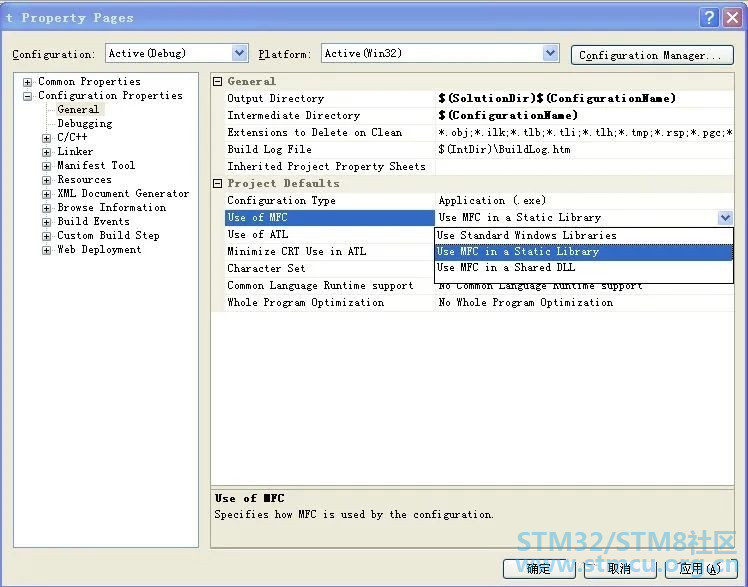 ' Q, p9 s7 F7 o5 o8 m8 i2 E
2.在你所用的所有头文件之前包含#include <afxwin.h>,例如:可以在stdafx.h文件的最前面包含#include <afxwin.h>头文件,这样在你的源代码中就可以使用 CString类了,不过这样也有一个缺点,就是编译出来的程序要比原来的大很多。我试过一个小程序,选择"Use Standard Windows Libraries" 编译出来 的Release版本大概92kb,使用"Use MFC in a Static Library"编译出来的Release版本大概192kb,足足大了100kb,这个就个人考虑了......
7 c6 }& {: m1 l8 I. L8 w! ]7 \3 ^# u# S
|





 微信公众号
 手机版


