你的浏览器版本过低,可能导致网站不能正常访问!
为了你能正常使用网站功能,请使用这些浏览器。

【安富莱——DSP教程】第9章 BasicMathFunctions的使用(二)

[复制链接]
baiyongbin2009 发布时间:2015-3-19 11:05
特别说明:完整45期数字信号处理教程,原创高性能示波器代码全开源地址:链接+ |( L7 H' a) P, y' k( X( k
第9章 BasicMathFunctions的使用(二)
. |9 n" S* C8 E) A' M
    本期教程主要讲基本函数中的相反数,偏移,位移,减法和比例因子。
    9.1 相反数(Vector Negate)
    9.2 求和(Vector Offset)
    9.3 点乘(Vector Shift)
    9.4 减法(Vector Sub)
    9.5 比例因子(Vector Scale)
    9.6 BasicMathFunctions的重要说明
    9.7 总结
& m* w0 X, _7 D( ?' {0 h9 y
9.1 相反数(Vector Negate)
    这部分函数主要用于求相反数,公式描述如下:
     pDst[n] = -pSrc[n],   0 <= n < blockSize.   
    特别注意,这部分函数支持目标指针和源指针指向相同的缓冲区。
9.1.1 arm_negate_f32
    这个函数用于求32位浮点数的相反数,源代码分析如下:
  1. /**          K! A+ u1 |5 ?
  2. * @brief  Negates the elements of a floating-point vector.        
    ( j; X" X7 s  N4 f
  3. * @param[in]  *pSrc points to the input vector        ' D# P3 M. j( M& [4 O8 [
  4. * @param[out]  *pDst points to the output vector        
    , O# J$ v" a0 Q: x
  5. * @param[in]  blockSize number of samples in the vector        3 b6 ^/ w5 i% s( G! K
  6. * @return none.        ; q# @" j3 s/ L+ J4 D! x
  7. */
    , @  s. A: Z+ P7 ?0 M

  8. + z' Y. @6 Q9 Y% I
  9. void arm_negate_f32(
    $ e$ f$ Z/ @; B/ L+ @
  10.   float32_t * pSrc," @& J3 C3 N- ^: g3 Q% r# w% m/ Q, _
  11.   float32_t * pDst,, {! O1 P* N& X
  12.   uint32_t blockSize)" N8 N0 S7 d5 n0 `# B0 w
  13. {
    9 F& Z# C" Y1 @* h7 K$ z
  14.   uint32_t blkCnt;                               /* loop counter */
    6 Z7 l0 e" F& ?8 l4 Z; t. S- s: S
  15. % d1 y+ D* Z+ }* M0 Y
  16. ( K8 j, t+ K+ ^4 ~) s
  17. #ifndef ARM_MATH_CM0_FAMILY
    ) Q$ ^  z; j& U6 M6 S
  18. ; T, n5 d: d  I! q2 P/ }: C6 E9 l  ~, K+ g
  19. /* Run the below code for Cortex-M4 and Cortex-M3 */. ?. z% _4 v$ K9 v1 m) d6 `2 V0 }
  20.   float32_t in1, in2, in3, in4;                  /* temporary variables */
    " }2 C) `7 j2 D  B( Q' ]3 r3 J! s
  21. % ^" G' s* d, r5 R" s
  22.   /*loop Unrolling */8 ~6 R# I& Q1 T+ j2 h% m
  23.   blkCnt = blockSize >> 2u;1 o! ~  E, d( Z. l  Z- S

  24. 5 M( T6 [4 o% Q( Z: d# m
  25.   /* First part of the processing with loop unrolling.  Compute 4 outputs at a time.        9 t, D5 R0 E, a& }' h
  26.    ** a second loop below computes the remaining 1 to 3 samples. */
    3 }$ P3 S+ k" E
  27.   while(blkCnt > 0u)2 s5 T! Z& r$ y8 @0 q: b  B' J
  28.   {3 C3 \# X! b1 `! D2 W2 O
  29.     /* read inputs from source */
      C; f3 r7 a9 n0 h+ l8 P
  30.     in1 = *pSrc;6 R: b7 R- @1 t1 ?
  31.     in2 = *(pSrc + 1);
    4 c4 f$ T* g' ?- ~3 l
  32.     in3 = *(pSrc + 2);
    5 ~/ h2 p+ R: p7 e0 y
  33.     in4 = *(pSrc + 3);
    + `) a5 K$ J  ?0 G; o& }$ C" R
  34. # ]! E7 k7 b! A
  35.     /* negate the input */                                                                            (1): d& V& S# q& S$ a8 X9 H
  36.     in1 = -in1;
    / q' U% @: `: c8 D% l3 T
  37.     in2 = -in2;( v; j  O# B9 C3 b2 ]" |4 u
  38.     in3 = -in3;% P3 ~) n' v' P) R/ U$ e
  39.     in4 = -in4;
    2 u2 c* b9 `1 f. h- C& I
  40. . [* `7 O* \8 T" F4 |
  41.     /* store the result to destination */( x0 q9 d& `, j: m9 i
  42.     *pDst = in1;
    + T& G* _$ [  K2 |" O
  43.     *(pDst + 1) = in2;: l2 c0 O9 @0 o% L
  44.     *(pDst + 2) = in3;' }2 j9 s. p; c! h. ^
  45.     *(pDst + 3) = in4;5 u9 P7 W/ B& u' o! A
  46.   L/ N* L  V  _7 N' P+ U9 _
  47.     /* update pointers to process next samples */1 @. o$ K5 u1 `# V2 E# o  Y, Y/ T
  48.     pSrc += 4u;9 Y) x% Q* M5 e9 c2 e4 V
  49.     pDst += 4u;$ K7 h9 C0 X) ?* o

  50. 5 H( f7 v. j- k0 ?# L: I0 W8 k3 E
  51.     /* Decrement the loop counter */
    / u$ Q% K/ _5 n: z$ [
  52.     blkCnt--;
      O9 }: x& g2 t5 L0 L
  53.   }
    " }- `8 D! `4 l; i! E
  54. 7 P: g0 Q! w9 ]( \( o9 v/ Y
  55.   /* If the blockSize is not a multiple of 4, compute any remaining output samples here.          y  u: }6 `  [( m$ I
  56.    ** No loop unrolling is used. */( u4 P1 l6 g( `* c
  57.   blkCnt = blockSize % 0x4u;
    $ A8 `: m6 B" Q9 e; e/ v8 s0 O! ^9 q

  58. ; ~1 J' D% W" d3 v2 ^
  59. #else
    : \, T, v! }) L2 S( ^1 i/ Q

  60. 8 @" h- d- R& U5 O
  61.   /* Run the below code for Cortex-M0 */- R) N" d. c! j2 V7 _6 a3 P

  62. 2 D/ v( B- w. e4 @
  63.   /* Initialize blkCnt with number of samples */; d9 U$ D- Q2 n* O) f7 I
  64.   blkCnt = blockSize;) H6 J7 j+ V4 ?  f: |

  65. 9 X: N5 X% z; a3 }
  66. #endif /* #ifndef ARM_MATH_CM0_FAMILY */
    # y0 V/ D# z7 I7 P% J  V

  67. # X+ K: f* \4 n- B
  68.   while(blkCnt > 0u)
    ( U; O4 v& b4 t. r2 e
  69.   {. z" ^" |; C3 ^: B5 O
  70.     /* C = -A */3 a& v4 L, K( M: S( D1 Z  }0 w* o& T
  71.     /* Negate and then store the results in the destination buffer. */! _. R; F7 }6 ^7 ]7 Q/ G! p9 O5 u
  72.     *pDst++ = -*pSrc++;! }3 A9 S* ?9 h" T

  73. 0 C" y4 |* l, W% K5 z0 u' c
  74.     /* Decrement the loop counter */
    1 N0 ^; O* s0 c5 c+ c/ W5 D; y5 P
  75.     blkCnt--;% T0 N4 x: x, x+ f; W
  76.   }
    6 L( C1 ^- [' J2 ]. w5 A) c
  77. }
复制代码
1. 浮点数的相反数求解比较简单,直接在相应的变量前加上负号即可。

. o/ U; `/ K' e2 }1 ]
9.1.2 arm_negate_q31
    这个函数用于求32位定点数的相反数,源代码分析如下:
  1. /**    5 u8 F2 I5 J* U+ n. o
  2. * @brief  Negates the elements of a Q31 vector.    4 Z" u/ @0 p3 v' R0 E( m
  3. * @param[in]  *pSrc points to the input vector   
    2 u" u( ]- f% [0 ^* |2 y0 n+ a: ]
  4. * @param[out]  *pDst points to the output vector    1 [# s; x) b- u) X6 _. D
  5. * @param[in]  blockSize number of samples in the vector   
    7 K6 b4 G2 w& l: M  f3 c
  6. * @return none.    , H$ p3 X; m" w1 n& V; v
  7. *    - _: t* j# L' x. p
  8. * <b>Scaling and Overflow Behavior:</b>                                                             (1)
    ! W2 E) y# K5 }4 E6 r! |1 I, J9 J
  9. * \par   
      ]1 R$ U8 F9 X' z9 x5 f
  10. * The function uses saturating arithmetic.   
    + F) v9 g$ z1 g: D
  11. * The Q31 value -1 (0x80000000) will be saturated to the maximum allowable positive value 0x7FFFFFFF.    5 I7 V( I, E# K$ x/ f
  12. */
    : _+ l  x" F( t2 \' h% q

  13. 8 g% v# K2 G) q' ]) X- y& J
  14. void arm_negate_q31(
    . }( q& }# t0 e7 S8 u; ]1 k
  15.   q31_t * pSrc,  z' \8 O& u/ S/ T% H' U
  16.   q31_t * pDst,* O" z; e# r) w: h4 {; f
  17.   uint32_t blockSize)2 x. z& A) [2 i! q5 L3 `; k
  18. {
    . W# r6 S2 ^6 a' d7 S
  19.   q31_t in;                                      /* Temporary variable */( h- B4 q2 w* e1 O8 z3 D3 R
  20.   uint32_t blkCnt;                               /* loop counter */
    % F4 G: ^6 O1 c; u" t0 u; y2 a

  21. - o* d" q1 y0 S  ]/ n
  22. #ifndef ARM_MATH_CM0_FAMILY# i9 c$ \6 d% I" T0 _. i- L

  23. ' A" B, t- E1 j$ Y) \" V' z7 w
  24. /* Run the below code for Cortex-M4 and Cortex-M3 */
    5 t- S% q+ Y+ d$ }
  25.   q31_t in1, in2, in3, in4;
    ! F$ r$ q) a4 ?
  26. ' @$ g. O# j* @7 ?0 ]# s) v$ t
  27.   /*loop Unrolling */
    7 f: W4 w. u2 X( Y1 Q  c0 U
  28.   blkCnt = blockSize >> 2u;1 |5 R6 f; ?9 @& X$ B

  29. 8 Z( D  V1 K9 |5 ?2 _
  30.   /* First part of the processing with loop unrolling.  Compute 4 outputs at a time.    ; C- w1 F6 C+ w
  31.    ** a second loop below computes the remaining 1 to 3 samples. */. J+ \2 |! Y/ d- m1 F
  32.   while(blkCnt > 0u); K0 ^( `+ V' j) H
  33.   {
    / X% Q% t5 F  B# _  ~
  34.     /* C = -A */, Q3 [" R( S" b: E2 w
  35.     /* Negate and then store the results in the destination buffer. */
    & d( N( v- y, S- O) S
  36.     in1 = *pSrc++;
    : c2 T* h" f" r" z0 B5 I. [. p
  37.     in2 = *pSrc++;% E* H: x2 q' Z" i7 _: P! o( p2 H% P
  38.     in3 = *pSrc++;
    # T6 ]) z& l# M5 h" @5 @& m9 ?
  39.     in4 = *pSrc++;8 f5 a4 i# e; X2 n
  40. 9 C( H! g3 U/ s3 _
  41.     *pDst++ = __QSUB(0, in1);                                                                      (2)
    # k/ g1 _7 C" H/ Y& y
  42.     *pDst++ = __QSUB(0, in2);5 g% m$ g# x& N$ ]( V/ |6 g
  43.     *pDst++ = __QSUB(0, in3);1 r# E4 `4 ^  z
  44.     *pDst++ = __QSUB(0, in4);
    4 c! S% `, E  s! c

  45. ! x# {9 V. J, x7 v; B- q
  46.     /* Decrement the loop counter */6 {" }! r" k4 Z4 a" ]' ]% S; O* b
  47.     blkCnt--;/ q" G5 ]! `; T$ q( s/ y* m
  48.   }
    " t" l6 O; w% M+ a; M9 h

  49. 9 y7 v7 F3 u: O4 u# W4 p; H
  50.   /* If the blockSize is not a multiple of 4, compute any remaining output samples here.    # ^9 G9 ^2 ]! ~5 R2 u
  51.    ** No loop unrolling is used. */
    5 B  U. d  ~; c0 _( Q
  52.   blkCnt = blockSize % 0x4u;* v% S2 M+ L+ {, b0 A/ l

  53. # J; J; ]# _& c' Q2 k2 h
  54. #else) _- J- A. v; t& S5 O# c* m
  55. 0 [. Z+ @: x0 g; a6 X
  56.   /* Run the below code for Cortex-M0 *// x# O% v4 D; }; ?# a

  57. ( b1 h% Z5 ^! K# |% Q) E; |3 p/ d& [
  58.   /* Initialize blkCnt with number of samples */5 e: S- a- G* q: o
  59.   blkCnt = blockSize;% |& q+ N6 H+ m, y  J) F) T$ i

  60. . ^) r* J+ `6 D) |$ c
  61. #endif /* #ifndef ARM_MATH_CM0_FAMILY */
    5 U. H, A3 Q' {; e0 ?, P

  62. / U9 f2 P% R7 f" k

  63. : `1 _  W! s# f4 I7 i( j
  64.   while(blkCnt > 0u)
    1 l! w( \5 s2 p. @
  65.   {
    2 F/ [" X  W+ D3 |0 u, B# ?
  66.     /* C = -A */, w1 k0 y, E3 D/ g9 d/ w4 r0 z
  67.     /* Negate and then store the result in the destination buffer. */
    ! O  f7 d7 P  E% x/ ]0 k. @9 @- c
  68.     in = *pSrc++;. T( k: U% A8 Z- Z
  69.     *pDst++ = (in == INT32_MIN) ? INT32_MAX : -in;
    . I7 ?8 a( K5 X: b
  70. - s1 Y+ H1 j; i3 ~0 [3 S4 s4 s
  71.     /* Decrement the loop counter */
    " u1 i: J. [% [2 _% X, h( H8 A/ l
  72.     blkCnt--;# b' @* r. N2 E2 }
  73.   }* Q, C- X! U9 I) N. B
  74. }
复制代码
1. 这个函数使用了饱和运算。
    饱和运算数值0x80000000将变成0x7FFFFFFF。
2. 饱和运算__QSUB我们在上一章已经详细讲述了,这就就是实现数值0减去相应的参数变量。

  N9 G, O: ?! S
9.1.3 arm_negate_q15
    这个函数用于求16位定点数的相反数,源代码分析如下:
  1. /**        
    " g; v/ a" d$ |; D
  2. * @brief  Negates the elements of a Q15 vector.        
    ; K6 o: Q: u: G7 D* t4 U
  3. * @param[in]  *pSrc points to the input vector        
    / t# g7 u% W9 W+ n6 a
  4. * @param[out]  *pDst points to the output vector        
    ' Z3 [+ r; r) M! T7 ~
  5. * @param[in]  blockSize number of samples in the vector        * X+ @- _( K7 p  }, n
  6. * @return none.        
    8 k, Z  X2 ?6 p
  7. *    2 ?. u& u2 f' X+ B$ I
  8. * \par Conditions for optimum performance   
    % c& o6 R$ X6 J: ~
  9. *  Input and output buffers should be aligned by 32-bit   
    + x% m, U6 |! D. E3 R0 S
  10. *   
      K2 q; D. W' i6 G$ m6 ?& l8 U0 ?
  11. *        & y) ~+ s2 `) j* Q1 h7 ^
  12. * <b>Scaling and Overflow Behavior:</b>                                                             (1)
    0 y. z& }; H* ?2 K3 V' V' k4 w
  13. * \par        + P6 b" v- V- u$ m  `0 [- c/ D  `
  14. * The function uses saturating arithmetic.        
    6 u: W0 S3 W8 u
  15. * The Q15 value -1 (0x8000) will be saturated to the maximum allowable positive value 0x7FFF.        
    ; G8 n$ h: D( _( `; u/ p) G/ Q
  16. */, c9 D  N! Y% b
  17. & J" ]3 M) T0 m% U$ N& H/ H: W
  18. void arm_negate_q15(
    ( q8 K( U  g9 R0 X6 M
  19.   q15_t * pSrc,
    2 B' u% |  I1 Q$ `( G- V$ M
  20.   q15_t * pDst,
    2 r4 r& D( e# x
  21.   uint32_t blockSize)
    / D' U9 |) l: p
  22. {- ^( _1 ^3 E3 O- p$ t
  23.   uint32_t blkCnt;                               /* loop counter */& c: W: @9 V7 s* l
  24.   q15_t in;- o- w3 {$ d9 t$ ]# M! l; N. ?( N  q

  25. : s, ?9 ~$ N  y3 a6 A8 g8 C+ c
  26. #ifndef ARM_MATH_CM0_FAMILY* s* Y1 L' M; W# A; ^5 P. B

  27. # j& x& D+ }7 O4 I  X# z$ v- M! k
  28. /* Run the below code for Cortex-M4 and Cortex-M3 */
    + Y4 V) o& K* L* |& |

  29. 6 V: p9 s' l& B' R
  30.   q31_t in1, in2;                                /* Temporary variables */: c5 f( B: V- y1 Y0 D% z. ^

  31. % O2 n9 |% N+ y" ?! K

  32. 9 Y& U8 e& u+ O7 Y8 c/ {2 h; O
  33.   /*loop Unrolling */: K0 Z4 f( L6 [; D1 S
  34.   blkCnt = blockSize >> 2u;+ [: U4 F9 s2 r: E. h5 p

  35. ' F1 L! K; J# u  _; n: X
  36.   /* First part of the processing with loop unrolling.  Compute 4 outputs at a time.        
    ) p3 G- a/ d* u- d) B
  37.    ** a second loop below computes the remaining 1 to 3 samples. */6 E1 B* M+ Y: ~! g& T4 P# Q( T
  38.   while(blkCnt > 0u)
    ( Z/ m9 ~' L- n" V; R$ P) X
  39.   {
    ; {" W6 h! r" }5 N- F: z. R
  40.     /* C = -A */
    . ~- W/ h/ o8 p: @+ g# Z
  41.     /* Read two inputs at a time */                                                                  (2)
    0 h( A' {9 b6 a
  42.     in1 = _SIMD32_OFFSET(pSrc);6 r  ]' F* @" J9 L2 F- o
  43.     in2 = _SIMD32_OFFSET(pSrc + 2);
    2 V! z  W# g1 v& Y

  44. 7 r1 T0 Z; A# E" a
  45.     /* negate two samples at a time */                                                               (3)
    * K* q% t% ?; k4 N0 y1 D/ J9 b, ]% G
  46.     in1 = __QSUB16(0, in1);, A+ P, I) ^: D& _! U* T0 C

  47. 3 ~$ F! i/ v& n$ |: G2 i
  48.     /* negate two samples at a time */
    * X& p4 }: y5 \& x# f  y
  49.     in2 = __QSUB16(0, in2);+ ?* P: `2 [# c9 ]& i: b; V

  50. 7 [1 j- @7 p" _( E' ]6 A
  51.     /* store the result to destination 2 samples at a time */                                        (4)
    3 |: K- `& k* g$ T
  52.     _SIMD32_OFFSET(pDst) = in1;8 N% R  x( G& x, h# n
  53.     /* store the result to destination 2 samples at a time */
      E8 L4 i! \! H5 W$ K
  54.     _SIMD32_OFFSET(pDst + 2) = in2;) w3 l' m9 E3 j. r/ l) A

  55. - {: R) B6 k7 Z3 \4 d& U. t; j
  56. ) r0 w4 E. L, }) K
  57.     /* update pointers to process next samples */0 |) R1 r+ m  Y7 y! F$ i4 ]
  58.     pSrc += 4u;4 b( C4 T2 Y( X7 C" T
  59.     pDst += 4u;; _# U# F7 Z2 G& T2 R* k6 c8 K6 y/ N

  60. , D- F% z% j+ ~! S% F; R- {! |1 R
  61.     /* Decrement the loop counter */+ r6 P4 H  Y8 E6 @. U* c" e
  62.     blkCnt--;
    % k' V0 J1 O- |( d. f1 ?( D1 j8 g3 [; F
  63.   }
    ! @  W* }( `/ \1 `1 y

  64. 4 d/ y( p9 d8 ~% t
  65.   /* If the blockSize is not a multiple of 4, compute any remaining output samples here.        
    , Q5 i4 Y0 K+ F$ |6 [+ Z7 d
  66.    ** No loop unrolling is used. */
    9 n8 s7 f$ ]& [, d  g2 F
  67.   blkCnt = blockSize % 0x4u;
    - p. Q. h, E% k% ]' q4 I, ^4 k  ?

  68. ) V. G$ L& X8 A8 j2 Q( S1 K
  69. #else
    ' E9 W+ X, q- q0 p; @: \  Z, s
  70. 1 l5 @. f3 `3 |+ |; z( V
  71.   /* Run the below code for Cortex-M0 */8 F) o+ ?% i6 S% o" l/ P+ D
  72. : ^) G0 [: _2 A% B0 a, T4 d& p
  73.   /* Initialize blkCnt with number of samples */
    2 u9 ?  w- R* S3 l  q8 |
  74.   blkCnt = blockSize;
    , m1 ^, e# l2 I+ C9 H5 j( a/ D! o
  75. # R5 _( s# Z  y! {
  76. #endif /* #ifndef ARM_MATH_CM0_FAMILY */0 W" p$ z% k! i3 j( N
  77. % |% x; f, e/ L
  78.   while(blkCnt > 0u)
    4 N3 Q5 }! V; P9 p  c
  79.   {
    2 P. u2 F1 H" A. ~# b5 G9 A
  80.     /* C = -A */  j# w$ V+ P0 x9 U$ T# h* S. |
  81.     /* Negate and then store the result in the destination buffer. */
    % B$ k# z+ I' }8 o7 I: |
  82.     in = *pSrc++;- c8 b1 v% y" g& U+ B7 s! j0 t' l
  83.     *pDst++ = (in == (q15_t) 0x8000) ? 0x7fff : -in;
    * S. r5 F, _5 w7 h/ `/ N- ~8 [

  84. , Z7 z9 l0 g' B3 p6 I9 D
  85.     /* Decrement the loop counter */
    : U! r: ]) R/ O$ B/ x
  86.     blkCnt--;( K/ E) S% G( p% D% m  S
  87.   }
    # q4 w! l# j+ @* k+ S! }! Z; E
  88. }
复制代码
1. 这个函数使用了饱和运算。
    饱和运算数值0x8000将变成0x7FFF。
2. 一次读取两个Q15格式的数据。
3. 由于__QSUB是SIMD指令,这里可以实现一次计算两个Q15数据的相反数。
4. 这里实现一次赋值两个Q15数据。

  d( K: |  D1 s1 }  v6 r+ W3 d
9.1.4 arm_negate_q7
    这个函数用于求8位定点数的相反数,源代码分析如下:
  1. /**   
    5 u1 m' p, p6 F
  2. * @brief  Negates the elements of a Q7 vector.    ( V; C" o; N% E! z& O
  3. * @param[in]  *pSrc points to the input vector   
    2 w& \7 _7 M" C
  4. * @param[out]  *pDst points to the output vector    # I  W  a( u/ N: F- R1 f3 H
  5. * @param[in]  blockSize number of samples in the vector   
    , s$ M$ V" y$ k$ e4 i) S# Y# N
  6. * @return none.   
    0 \( E# U9 @; M% s2 P- Y6 ~
  7. *    + e& ^- Y* k- c4 q2 N+ }* T
  8. * <b>Scaling and Overflow Behavior:</b>                                                              (1)
    6 V8 j* c" P4 ]
  9. * \par   
    & v# z6 }$ D* l, V% o% F
  10. * The function uses saturating arithmetic.   
    ! i& q5 z% S5 v" |
  11. * The Q7 value -1 (0x80) will be saturated to the maximum allowable positive value 0x7F.   
    2 Y3 G$ x) h" q
  12. */
    - d) g  F# y  n+ G" v8 [7 I

  13. $ @. V8 b; j1 u/ c& R3 F# I1 P0 M
  14. void arm_negate_q7(
    # q8 x+ p5 Q1 Z" o) u4 i
  15.   q7_t * pSrc,
    2 `; y( C: E9 E2 G6 P" m
  16.   q7_t * pDst,6 e; F' f  W$ Q# h5 b% ~  [8 U
  17.   uint32_t blockSize)4 n7 n' Y( X, r" f
  18. {# Z0 k) o( b* p$ v2 m
  19.   uint32_t blkCnt;                               /* loop counter */8 A, u% V, U" @6 f; G
  20.   q7_t in;0 l& T3 P% J5 K$ R. ~+ p* S

  21. 1 j; c# e- F* Y* D" i1 Q: j
  22. #ifndef ARM_MATH_CM0_FAMILY
    1 t! e$ R; b* T! j& {

  23. # l* Q# e" R9 D# q8 p: G3 |
  24. /* Run the below code for Cortex-M4 and Cortex-M3 */
    5 o) n" I; e4 `
  25.   q31_t input;                                   /* Input values1-4 */
    7 @$ B( ~8 j3 s9 T
  26.   q31_t zero = 0x00000000;                                                                           (2)
    * r( ^: C0 `5 w3 B
  27. 5 X  s4 z; t3 ~) ?

  28. $ Z0 O  o! s, J4 l' q
  29.   /*loop Unrolling */
      Z" n9 v- d* E% C2 a' U4 `' N
  30.   blkCnt = blockSize >> 2u;
    6 A9 t) `5 o+ E0 H
  31. , e: A" F6 `5 B1 I
  32.   /* First part of the processing with loop unrolling.  Compute 4 outputs at a time.   
    & h) K" H  E5 f
  33.    ** a second loop below computes the remaining 1 to 3 samples. */
    0 c. p5 c0 R+ V$ v
  34.   while(blkCnt > 0u)
    ! [1 U5 C/ R- ?3 ]
  35.   {
    - }* ]% l8 R1 o# K+ E% q
  36.     /* C = -A */
    0 t- J7 e) G! v! y. d0 I9 v  j% Z
  37.     /* Read four inputs */
    ! U, o( E9 X0 y0 e" e7 J
  38.     input = *__SIMD32(pSrc)++;                                                                        (3)
    + P8 Z8 T: O* O/ r: A% p- |# [% C

  39. 4 |! \: V- q8 T9 D5 ^6 T" G
  40.     /* Store the Negated results in the destination buffer in a single cycle by packing the results */% y  o6 k0 t4 T+ d- T! j
  41.     *__SIMD32(pDst)++ = __QSUB8(zero, input);                                                         (4)
    " d: s8 C3 f( g' i# N) j: z

  42. " i! j4 Q9 Z: t
  43.     /* Decrement the loop counter */
    4 `8 \+ I% U4 y! H6 M9 ?
  44.     blkCnt--;
    ! Z0 n7 z# o7 [8 y1 _
  45.   }9 ~/ B/ |' L1 K: V/ \8 {

  46. 0 k9 u  o' P6 C; b, ^
  47.   /* If the blockSize is not a multiple of 4, compute any remaining output samples here.    5 y' W8 [; u- P0 _3 u
  48.    ** No loop unrolling is used. */
    - I7 j# S9 a( d1 ~
  49.   blkCnt = blockSize % 0x4u;! I7 G  ^. |# N+ {

  50. & t. a/ ~8 |" T& m" C2 N& i3 i; i8 b
  51. #else' d: |6 c" J8 K+ j

  52. & w' i4 |9 {. m2 Y
  53.   /* Run the below code for Cortex-M0 */
    ' i' d6 p( X  _' p% c, J. Z! {( u  i
  54. 5 c# }! v. L$ {  D
  55.   /* Initialize blkCnt with number of samples */
    0 g8 t3 H9 {: s% E. c, T
  56.   blkCnt = blockSize;
    " W4 z3 }6 W8 a) h9 u( d+ }; ]

  57. ! x% G( t0 I9 b' B1 m& n
  58. #endif /* #ifndef ARM_MATH_CM0_FAMILY */
    3 M& |, P% c, R6 b. z2 M

  59. - d, [. _$ {. Y/ Z/ [  S
  60.   while(blkCnt > 0u)
    % F) D6 S/ d; y, u' K: W" O0 U. d2 |5 S4 Y
  61.   {
    6 z: t+ M; {7 S8 V9 J( q2 J
  62.     /* C = -A */
    ' y0 j1 E) c0 t: h; S4 }
  63.     /* Negate and then store the results in the destination buffer. */ \
    8 I! B5 M+ \0 _+ a9 h
  64.       in = *pSrc++;; N; M* I  Q: w7 `
  65.     *pDst++ = (in == (q7_t) 0x80) ? 0x7f : -in;
    ! v+ Q: C7 r. A8 A1 k' R

  66. ; h5 l; h) d' @
  67.     /* Decrement the loop counter */$ o  w8 ?+ g/ k6 F! N
  68.     blkCnt--;' `' F. d$ L. J8 M
  69.   }
    ; d& B/ |$ J+ z
  70. }
复制代码
1. 这个函数使用了饱和运算。
    饱和运算数值0x80将变成0x7F。
2. 给局部变量赋初值,防止默认初始值不是0,所以从某种意义上来说,给变量赋初值是很有必要的。
3. 一次读取4个Q7格式的数据到input里面。
4. 通过__QSUB8实现一次计算四个Q7格式数据的相反数。

$ h! r2 ]" P7 `4 M- [
9.1.5 实例讲解
实验目的:
    1. 四种类型数据的相反数。
实验内容:
    1. 按下K1键, 串口打印输出结果
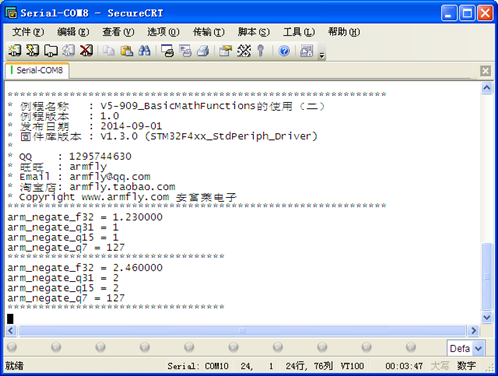
实验现象:
        通过窗口上位机软件SecureCRT(V5光盘里面有此软件)查看打印信息现象如下:
9.1.png
程序设计:
  1. /*' ~5 _2 z/ S9 S; S, z$ U
  2. *********************************************************************************************************
    0 N; q: p/ }7 S: K& g
  3. *        函 数 名: DSP_Negate
    : W: o( Q( |# x! S1 C- s/ T
  4. *        功能说明: 求相反数& `" g; q* R& R
  5. *        形    参:无6 t6 @+ W4 H, u# r& x* g
  6. *        返 回 值: 无% L9 I* b0 w# C; x' s8 a& e  |
  7. *********************************************************************************************************4 h. J2 b: W7 `2 w. D* X/ b+ Y. j
  8. */: G! c5 D! D7 W$ W
  9. static void DSP_Negate(void)
    1 ~* U* P1 W! ~% F5 e: X5 q$ w6 g
  10. {0 j/ D. {& `* U, M
  11. static float32_t pSrc;$ d  M+ c1 h$ h
  12.     static float32_t pDst;
    & @, M( }8 ~0 W. i" c
  13. static q31_t pSrc1;- x7 n* O3 A; a7 N
  14. static q31_t pDst1;
    - s! b' T9 u2 R6 T4 L5 v" \
  15. static q15_t pSrc2;
    : D2 o% n$ z- T
  16. static q15_t pDst2;, U( C- ]! O  N) R, b
  17. static q7_t pSrc3 = 127; /* 为了说明问题,在这里设置初始值为127,然后查看0x80是否饱和为0x7F */8 T) h& k. o# R! c, V/ N# G
  18. static q7_t pDst3;
    ! `' w5 Y& O6 H) V
  19. pSrc -= 1.23f;, a) `/ V+ R8 D1 a( i( s
  20. arm_negate_f32(&pSrc, &pDst, 1);; z0 a; H: ?( H- J( h
  21. printf("arm_negate_f32 = %f\r\n", pDst);
    . L0 W+ H, H" S  ?
  22. / L2 ?4 b2 A. F- C( ?3 d
  23. pSrc1 -= 1;
      \. q% W% W$ P" d% I4 v6 z+ b$ A$ {
  24. arm_negate_q31(&pSrc1, &pDst1, 1);
    $ m* f4 e7 P9 c+ O6 R0 N
  25. printf("arm_negate_q31 = %d\r\n", pDst1);% s  j/ [9 e9 S8 e
  26. / C1 I! d4 x1 P' n& R
  27. pSrc2 -= 1;
    5 f6 }" n' a9 G9 h" b! K5 q4 K/ C9 N2 R
  28. arm_negate_q15(&pSrc2, &pDst2, 1);
    * O- a. B+ D$ z+ V
  29. printf("arm_negate_q15 = %d\r\n", pDst2);) o. `  _& S4 i' B  Z- h" x. ~

  30. 5 m( I, H  A" Q0 a$ `- y% P
  31. pSrc3 += 1;
      C! \+ V. {: d9 f
  32. arm_negate_q7(&pSrc3, &pDst3, 1);
    . E7 S* w5 K4 B+ ?; d& C
  33. printf("arm_negate_q7 = %d\r\n", pDst3);
    3 k5 L% v4 `) q' \% `
  34. printf("***********************************\r\n");
    " d7 ]3 p/ w& G  {* W4 k7 b+ z( M
  35. }
复制代码

: m0 a/ c  B+ j& y3 w" h4 w* }
赞 收藏 评论10 发布时间:2015-3-19 11:05

举报

10个回答
baiyongbin2009 回答时间:2015-3-19 11:09:29
9.2 偏移(Vector Offset)
    这部分函数主要用于求相反数,公式描述如下:
     pDst[n] = pSrc[n] + offset,   0 <= n < blockSize.
        注意,这部分函数支持目标指针和源指针指向相同的缓冲区。
9.2.1 arm_offset_f32
    这个函数用于求32位浮点数的偏移,源代码分析如下:
  1. /**        
    & W; A$ L" S& ^
  2. * @brief  Adds a constant offset to a floating-point vector.        
    ! ^% D; v* t1 Q7 e/ V
  3. * @param[in]  *pSrc points to the input vector        % I/ `" @2 M- z; [$ z% Z9 Z
  4. * @param[in]  offset is the offset to be added        2 P% x) A/ g2 D
  5. * @param[out]  *pDst points to the output vector        % p+ }7 x' l1 ~& G& c2 j, |
  6. * @param[in]  blockSize number of samples in the vector        ; j1 ?! a7 ^% S8 ?; {! t: M
  7. * @return none.        ( `3 }+ t5 z% U) H. k8 ~
  8. */& |: K/ v/ J1 a7 i: y
  9. void arm_offset_f32(
    ' y4 G2 m7 m2 t" ~6 u* r
  10.   float32_t * pSrc,- H/ M: ?( j5 m/ }+ s* y
  11.   float32_t offset," l% A0 L' a, H: S. H1 R
  12.   float32_t * pDst,
    ; Y3 f$ N/ D1 T& w5 y- b" B
  13.   uint32_t blockSize)
    8 t' S) U* G! Q( S; ^+ A4 P/ |
  14. {6 P3 R2 Y& y/ v( i# ?
  15.   uint32_t blkCnt;                               /* loop counter */
    - o' R7 i! H$ y/ P9 W

  16. 4 x/ f8 A/ N. h0 f1 Q! }
  17. #ifndef ARM_MATH_CM0_FAMILY
    : Y5 ^! D- J* |, |* i# p% `

  18. ( X" D2 r1 o& {0 r6 x
  19. /* Run the below code for Cortex-M4 and Cortex-M3 */
    2 {% W) ]! t6 K$ P$ A( N' F
  20.   float32_t in1, in2, in3, in4;6 z& Y2 N1 t4 s# U; ?+ n/ @

  21. " Z( {. b8 s6 p9 \8 Z/ X0 y
  22.   /*loop Unrolling */. o# I4 C' X( A. A! l3 O* h5 b6 O
  23.   blkCnt = blockSize >> 2u;3 x: h  b7 g# s' r3 G0 l
  24. 0 X: N; F* C) E9 u5 `- a
  25.   /* First part of the processing with loop unrolling.  Compute 4 outputs at a time.        
    $ W% \$ D2 s% r* ~( m
  26.    ** a second loop below computes the remaining 1 to 3 samples. */) i/ D' Y* S$ g  e
  27.   while(blkCnt > 0u)2 a9 e  t, r" S6 q& g
  28.   {6 d2 m  L$ w7 |& A
  29.     /* C = A + offset */                                                                            (1)
    , H4 j5 l4 i4 \
  30.     /* Add offset and then store the results in the destination buffer. */' d* Y: B. j! N  J3 t- [% S" U
  31.     /* read samples from source */- _8 r0 X" Q; B. J' R
  32.     in1 = *pSrc;* ^8 \4 M% O9 w( D+ Z4 X
  33.     in2 = *(pSrc + 1);
    7 ]% w, j$ C/ z% b: \( I' ?  l: O

  34. 9 ]# v6 o5 T3 b. q# W- h
  35.     /* add offset to input */
    , H% ~# @- L) Z* _' L
  36.     in1 = in1 + offset;
    : H. l3 w! c+ q4 k
  37. 3 B  }4 j/ Q) L* `3 v5 u
  38.     /* read samples from source */
    $ S5 X: W  {) K& \8 T2 P
  39.     in3 = *(pSrc + 2);8 d  G( E, ?0 p1 n# n. q

  40. " g8 y& H$ i3 |7 H. P
  41.     /* add offset to input */
    8 W& Q! c( }0 o7 P3 R2 b8 u4 W
  42.     in2 = in2 + offset;! d, s) G# I& x# l( S7 L6 x& s5 r0 Y
  43. % w% }# v& f8 f, ?
  44.     /* read samples from source */0 x% A, Z& G7 ~$ O
  45.     in4 = *(pSrc + 3);
    7 p4 [7 }4 W! o% ]

  46. 8 g3 [+ I5 n! E% |0 q% D: C
  47.     /* add offset to input */
      z9 b/ o. b% l) k6 q) a4 ~
  48.     in3 = in3 + offset;
    . m/ ]) q7 T9 N+ {& _' P* O1 D- H

  49. ( s: o* d3 m: t* y$ a$ c# b
  50.     /* store result to destination */
    * H8 M: {% y- g/ F2 Z& z8 @6 a
  51.     *pDst = in1;' E( \* u# z9 c& g

  52. 3 R& A4 Y1 n5 P, _3 t9 a2 `2 K+ O
  53.     /* add offset to input */
    . a* S1 B- X/ D4 W8 v, h
  54.     in4 = in4 + offset;! b, f; {( E3 ?  s, D5 o2 v
  55. ' C! v# e9 j6 A. _6 ^2 b
  56.     /* store result to destination */
    " S  D2 g! i% c; D1 i
  57.     *(pDst + 1) = in2;
    ) }4 u; m3 {( ^4 J- R
  58. 5 v, c( w( ]- v, C
  59.     /* store result to destination */2 ?; U; l) ?* J; u' B' h6 A7 e" v
  60.     *(pDst + 2) = in3;
    ( m- K& f0 E0 x, T: ?
  61. ) }0 o# R) \4 `( F
  62.     /* store result to destination */
    / p+ e1 D' Q6 C
  63.     *(pDst + 3) = in4;
    ! B* [; a( _  N) {3 A; B

  64. 6 l) ~7 B3 z1 z) x: n$ x. d4 ^/ B9 w
  65.     /* update pointers to process next samples */6 d5 U+ O6 L8 k5 E1 b
  66.     pSrc += 4u;
      b" P$ {6 c1 |' l! v- P
  67.     pDst += 4u;
    0 y$ J" _8 @+ P% p5 [2 t5 R
  68.   A7 _0 e+ `8 Y. h, L/ s
  69.     /* Decrement the loop counter */, m& n  C) q* H, d% o9 U
  70.     blkCnt--;/ \+ ]0 m( M) P
  71.   }
    ( ?2 H1 G3 Y2 ?
  72. - h4 o0 g2 U! s! j" R
  73.   /* If the blockSize is not a multiple of 4, compute any remaining output samples here.        
    : H0 @/ Z( f" |* R9 i
  74.    ** No loop unrolling is used. */
    " U- L$ y, M2 Y0 {% ?
  75.   blkCnt = blockSize % 0x4u;9 y- f. z( ]$ E5 \. L& z5 X

  76. 5 k+ a% [+ |2 u. L# U. h6 O9 h
  77. #else3 s. j) K3 N$ o% {0 |3 f

  78. ! C" Q: E8 E6 I: m4 a0 u
  79.   /* Run the below code for Cortex-M0 */
    7 k% o! q0 V2 a/ w
  80. - {* k3 |( C2 E& X1 E
  81.   /* Initialize blkCnt with number of samples */6 {4 J3 Z( u0 N
  82.   blkCnt = blockSize;3 B; E5 G( _& U( `
  83. ) G! r  J. A( G  K' r: S! ~5 k7 U6 L$ w
  84. #endif /* #ifndef ARM_MATH_CM0_FAMILY */
    - a) ]% }- d+ h

  85. ) J: O( i2 E; P
  86.   while(blkCnt > 0u)
    , U$ I, o2 O# \0 h2 S
  87.   {9 y6 {! A1 a1 J9 u9 _& _: Z8 J! x
  88.     /* C = A + offset */4 }! T, ?" C$ d! N
  89.     /* Add offset and then store the result in the destination buffer. */
    6 N" k& F+ q; j( M) P( a0 s6 x. t0 l) X
  90.     *pDst++ = (*pSrc++) + offset;
    9 P4 w0 c! J9 v9 g/ M' V
  91. & S* t6 C3 f' Z
  92.     /* Decrement the loop counter */
    + b: G# g" m8 H: ?4 I" {( k7 A
  93.     blkCnt--;
    ' W/ w7 K8 C, A+ d" K2 T3 N( D3 W
  94.   }9 p4 q( L, x2 {- e3 W
  95. }
复制代码
1. 浮点数的偏移值求解比较简单,加上相应的偏移值并赋值给目标变量即可。
, @- P- U; I( g4 ~
9.2.2 arm_offset_q31
    这个函数用于求32位定点数的偏移值,源代码分析如下:
  1. /**    : d, t5 `; f$ B2 I% q- X
  2. * @brief  Adds a constant offset to a Q31 vector.    1 r. [1 W6 e- R! V  i: O* U
  3. * @param[in]  *pSrc points to the input vector    5 y1 |: T* B% R. `2 L  R
  4. * @param[in]  offset is the offset to be added   
    7 M( v( O6 y3 {3 [/ ?
  5. * @param[out]  *pDst points to the output vector   
    9 _6 Q- ^0 n; W' B. Z+ x+ N
  6. * @param[in]  blockSize number of samples in the vector   
    . o; i4 @7 u4 L3 @' \
  7. * @return none.   
    0 y2 F4 b7 x4 h, W4 b$ _. Q
  8. *    # A' s, M. s; O5 i4 L, l$ S
  9. * <b>Scaling and Overflow Behavior:</b>                                                               (1)
    ' c9 M# H# h% Q' \% `% t
  10. * \par   
    / h$ a+ @) o- m1 N  C) E
  11. * The function uses saturating arithmetic.   
    ( P8 {! G! ^1 {# k
  12. * Results outside of the allowable Q31 range [0x80000000 0x7FFFFFFF] are saturated.   
    + d) [# {$ f/ z% c
  13. */
    - t- q/ D$ I' R/ p

  14. & O' a6 F/ Y9 ]1 j. E6 m6 y2 G
  15. void arm_offset_q31(  w! ?* H1 b0 L2 M* R
  16.   q31_t * pSrc,# l3 @, t; ]8 s4 l. A
  17.   q31_t offset,
    ; S& J2 U& m5 V
  18.   q31_t * pDst,  H; P% F! @" {, B* Q. n- ?& X  O
  19.   uint32_t blockSize)" s+ S( O* u, `0 [2 a) b
  20. {) h3 T' c7 B+ O! p/ A7 H, h
  21.   uint32_t blkCnt;                               /* loop counter */
    6 G* T- Y  T5 O0 t7 p1 S* s

  22. ( b* M0 n- K8 U, A, }
  23. #ifndef ARM_MATH_CM0_FAMILY
    , J/ `% E+ x' F

  24. / H& L& T  S) D8 V) O5 V* v
  25. /* Run the below code for Cortex-M4 and Cortex-M3 */$ F4 [( E- G8 D8 t
  26.   q31_t in1, in2, in3, in4;. K. t0 ^6 j3 Z. a/ p4 D) c+ j
  27. ; |" h3 P5 a! |! E! _
  28. ! L1 p6 R  \- L6 z$ U; `- k
  29.   /*loop Unrolling */
    3 @3 |8 Q% n$ e4 K2 l
  30.   blkCnt = blockSize >> 2u;
    ( A* N& \& T, C* B

  31. 3 m$ a8 `8 }4 j. {1 {
  32.   /* First part of the processing with loop unrolling.  Compute 4 outputs at a time.    ' v+ ?" m0 i) P
  33.    ** a second loop below computes the remaining 1 to 3 samples. */  W% W5 ^. D& {
  34.   while(blkCnt > 0u)
    & p; M7 ~# m' p& |
  35.   {
    1 i; t6 q2 s/ b1 F7 D
  36.     /* C = A + offset */' C3 t7 S, L$ X+ i6 k1 [, Q
  37.     /* Add offset and then store the results in the destination buffer. */6 L! k# F2 K+ U) _
  38.     in1 = *pSrc++;
    ! |+ r; @2 l$ L( R6 [! ~
  39.     in2 = *pSrc++;
    ' d) o3 z6 X! b% x# M
  40.     in3 = *pSrc++;
    % L. D' y, C6 a/ K' U
  41.     in4 = *pSrc++;
    # x: P) `! Q* o  }' n

  42. ( z8 R6 w) M, y7 _% D. @" {. K( @
  43.     *pDst++ = __QADD(in1, offset);                                                                   (2)
    . I) v+ g2 [' r" `$ C$ b+ H
  44.     *pDst++ = __QADD(in2, offset);' S' ~% ?' h" c: [- Q: R8 P- s
  45.     *pDst++ = __QADD(in3, offset);# a1 B' m# x3 s$ @  \
  46.     *pDst++ = __QADD(in4, offset);
    : o) \# t7 g( g$ Q/ C6 J, g

  47. 7 n$ t8 N; l+ b7 `3 U
  48.     /* Decrement the loop counter */2 ^! S) p$ W4 s  \' T
  49.     blkCnt--;5 Y. [$ ^0 r" x, L9 {9 J6 \
  50.   }
    2 K2 V6 ~" Q: |# e: L% d. G/ t8 \

  51. 4 Z  z# x  N' J! A8 H
  52.   /* If the blockSize is not a multiple of 4, compute any remaining output samples here.   
    5 R- M0 s; j4 W: ]. o! n/ _9 {- @
  53.    ** No loop unrolling is used. */# N7 j9 a, F- u
  54.   blkCnt = blockSize % 0x4u;
    ! n9 C' J; \0 Y
  55. 4 y- V  Z0 c* N6 n3 z/ U% ~
  56.   while(blkCnt > 0u)
    5 B% U, a; `8 G3 ~6 S  V
  57.   {: W8 F- p" W, c2 @6 V4 a" f; i
  58.     /* C = A + offset */" C! @4 _+ L. A- a/ n
  59.     /* Add offset and then store the result in the destination buffer. */5 |) @6 {- D" N2 `% C$ D8 k
  60.     *pDst++ = __QADD(*pSrc++, offset);3 ^8 F1 F7 Z2 s6 Q

  61. ; m1 \. e+ M+ D) [" e
  62.     /* Decrement the loop counter */
    5 s5 v; E4 w1 s# T! c
  63.     blkCnt--;+ R: Y" ]/ H8 H' h, T
  64.   }# d$ H' I5 a! z- Z' Z
  65. $ t" J: r1 S# g: o- t
  66. #else: t/ q9 g. G  b% B0 t
  67.   a$ [9 g1 f8 ]- q) l  q+ Y
  68.   /* Run the below code for Cortex-M0 */
    0 K' C5 z" r& |$ q# M; W7 x  y
  69. . i' ^* E4 f+ J! w& F
  70.   /* Initialize blkCnt with number of samples */
    ( @+ F- C% R! d2 y4 n
  71.   blkCnt = blockSize;
    % S: |: R$ I  C+ i4 }

  72. 5 R: Y/ {1 o4 l# d) A
  73.   while(blkCnt > 0u)
    $ ?* r! d& E: o  ?, `1 O
  74.   {2 d+ q1 H9 s5 v+ {0 o3 @  m1 L
  75.     /* C = A + offset */
    . K  V" J, m6 @3 P1 x$ g3 E
  76.     /* Add offset and then store the result in the destination buffer. */
    3 G( S) b% g! W, q
  77.     *pDst++ = (q31_t) clip_q63_to_q31((q63_t) * pSrc++ + offset);1 G. L! Y2 I9 J7 E; c
  78. 6 O- E* M2 H1 B7 d3 j1 _: n
  79.     /* Decrement the loop counter */+ q( g/ [$ w% s+ a+ U7 A, W# c
  80.     blkCnt--;
    8 T2 v5 V! M! C( F
  81.   }
    - `, S' p  b: C1 C

  82. 2 _) t1 V. J/ r
  83. #endif /* #ifndef ARM_MATH_CM0_FAMILY */0 U. w; x& @& I1 r  O$ d* P
  84. + n8 K! e( E9 f0 a/ w
  85. }
复制代码
1. 这个函数使用了饱和运算。
    饱和运算数值0x80000000将变成0x7FFFFFFF。
2. 指令__QADD我们在上章教程中已经讲解过,这里是实现两个参数相加。
4 M$ C7 b' f- {& d3 S: t
9.2.3 arm_offset_q15
    这个函数用于求16位定点数的偏移,源代码分析如下:
  1. /**   
    0 K: C9 M+ W( O( I
  2. * @brief  Adds a constant offset to a Q15 vector.   
    - n+ _' F! J2 V' S+ Q* x, P
  3. * @param[in]  *pSrc points to the input vector   
    1 Q9 h( I3 d' C# A, h3 W( w
  4. * @param[in]  offset is the offset to be added   
    & b/ \5 q6 l& g+ b0 a. b
  5. * @param[out]  *pDst points to the output vector   
    0 v5 U2 C7 c, B/ W
  6. * @param[in]  blockSize number of samples in the vector    . u" h4 k3 t7 z) b
  7. * @return none.    5 \  Z! S2 K) ~4 u& E$ O$ b
  8. *   
    6 ?4 K4 R, E: F7 n. {9 K9 K+ i  L
  9. * <b>Scaling and Overflow Behavior:</b>                                                             (1)
    # }  c% n/ e/ ]" A+ `/ ^4 x
  10. * \par   
    , n" Q! D0 T0 V
  11. * The function uses saturating arithmetic.   
    2 [. j1 p; R/ R# j. v) N
  12. * Results outside of the allowable Q15 range [0x8000 0x7FFF] are saturated.    ( j. Q9 P! k) F0 E9 Q
  13. */
    2 m* Q- d8 w+ O) N6 R* t
  14. ) e1 ?$ e; C* C' I
  15. void arm_offset_q15(
    9 Y8 k# e  y: ]: |, ]2 R
  16.   q15_t * pSrc,2 D1 J% {: v( Q( R5 \7 }" N8 y
  17.   q15_t offset,
    % R' N& m* e) o2 p; @; ]5 H' v
  18.   q15_t * pDst,+ v$ C) _+ H, _0 p/ ]6 E$ h7 g/ ^
  19.   uint32_t blockSize)! G# ]3 X: N8 \, Z' [3 S; j
  20. {
    ( X$ d6 k, x3 ~
  21.   uint32_t blkCnt;                               /* loop counter */1 V- a0 M* `4 V+ {& o. A

  22. 0 U( u& T0 b& }8 I: g3 ]( V
  23. #ifndef ARM_MATH_CM0_FAMILY7 ~* A& t$ H4 @6 M
  24. ( i2 t/ Y/ l2 U6 F& I+ X
  25. /* Run the below code for Cortex-M4 and Cortex-M3 */* O# b, J7 u2 @3 z0 e6 N" a
  26.   q31_t offset_packed;                           /* Offset packed to 32 bit */
    6 W8 \2 G+ ~! d4 p& g

  27. : e$ R5 }2 [$ r4 {/ r( f- R; T! H% _
  28.   l, v, ~' M! E* l
  29.   /*loop Unrolling */# s. K, p( e8 r; B& z  F
  30.   blkCnt = blockSize >> 2u;' A: A, W1 w9 W

  31. 1 }- n4 f: K0 u( ?" {0 b2 W2 E( W, q
  32.   /* Offset is packed to 32 bit in order to use SIMD32 for addition */
    ' j/ _& ?; c/ l- c- [' ?7 D2 P
  33.   offset_packed = __PKHBT(offset, offset, 16);                                                       (2)
      H5 v5 S- @7 _
  34. - e5 _6 H9 I% n+ e2 _3 {" n) S+ B
  35.   /* First part of the processing with loop unrolling.  Compute 4 outputs at a time.    0 Z/ r8 f1 O) K5 f- X; z
  36.    ** a second loop below computes the remaining 1 to 3 samples. */& h  k7 m5 S+ d( X- f, X; B
  37.   while(blkCnt > 0u)
    * d) Z" w  u* X9 i' Z
  38.   {9 K+ }7 ^" N$ i, U! f
  39.     /* C = A + offset */
    8 k! h5 r/ P- h4 h) _9 f6 y
  40.     /* Add offset and then store the results in the destination buffer, 2 samples at a time. */
    9 J% P5 g& t0 S
  41.     *__SIMD32(pDst)++ = __QADD16(*__SIMD32(pSrc)++, offset_packed);                                  (3)
    ' m/ ]8 j4 O5 q& Z
  42.     *__SIMD32(pDst)++ = __QADD16(*__SIMD32(pSrc)++, offset_packed);5 T) t# S- i8 n" [
  43. 3 G8 _7 a) T4 V( r8 Q" t
  44.     /* Decrement the loop counter */
    ( Q' n3 G; Y$ V
  45.     blkCnt--;
    - W! y, W$ d2 i6 |; p
  46.   }
    1 }5 w4 m: j: N1 h% |& p5 w9 h

  47. / b+ l- A4 z2 Q+ L% ]" c* ]
  48.   /* If the blockSize is not a multiple of 4, compute any remaining output samples here.    & \: k8 v' p- x+ A! d
  49.    ** No loop unrolling is used. */
    ( v$ s1 k1 G$ f+ ?
  50.   blkCnt = blockSize % 0x4u;' K9 Z8 ]3 I0 A# V  S% p

  51. 3 i2 V4 ]- l3 H% s9 L# g: o
  52.   while(blkCnt > 0u)
    0 w2 a; t( P6 D& h" G8 T
  53.   {
      \, K1 c1 C( {' g
  54.     /* C = A + offset */
    % ]& P7 i" I5 M0 Y. [& H1 z
  55.     /* Add offset and then store the results in the destination buffer. */
    ) w! X  h% p: z, o9 R6 {
  56.     *pDst++ = (q15_t) __QADD16(*pSrc++, offset);  C8 a/ K- H( \. e0 m

  57. ' \6 Z1 @* J* N( N5 W
  58.     /* Decrement the loop counter */
    ) ~1 j5 R4 w  w' D
  59.     blkCnt--;( c8 q- \5 B2 H$ T
  60.   }
    * Z( T3 H7 `5 q3 m" N. e: K& K

  61. # w( t3 [2 Q0 U4 {, p9 Q5 U# [' ]
  62. #else
    * z/ T5 C- _$ F

  63. 3 ^3 `4 V0 M. ]
  64.   /* Run the below code for Cortex-M0 */8 p2 B7 ?8 i8 G

  65. , M* ]( k( o  I
  66.   /* Initialize blkCnt with number of samples */
    : S" F$ i. }  q1 n4 P! D& T9 {- }
  67.   blkCnt = blockSize;
    & ^3 U0 I0 y3 c. w+ B/ t, k1 h4 c  O

  68. 3 C' w$ A( K* _3 W. T  R" m
  69.   while(blkCnt > 0u)
    6 p8 Y* `& r' H% Z
  70.   {
    & R/ J$ D. O5 C" n  Y, p
  71.     /* C = A + offset */7 [& @* N7 [( A1 |2 Y5 K
  72.     /* Add offset and then store the results in the destination buffer. */
    & Y' I* L( n5 w+ F. z6 I
  73.     *pDst++ = (q15_t) __SSAT(((q31_t) * pSrc++ + offset), 16);
    . q' v9 s) k* W5 ?

  74. ; k; [+ l6 L8 I2 _# X; J
  75.     /* Decrement the loop counter */! m( O1 w# }2 Y! J  r
  76.     blkCnt--;; J" s  b$ b! @! Q1 s! P" _
  77.   }
    9 d0 J- h- J* V! r

  78. ; A1 l& D8 X+ l2 @9 P
  79. #endif /* #ifndef ARM_MATH_CM0_FAMILY */
    / p( P8 o! F( h; m- Y% A* l
  80. 7 g  w+ a4 T2 x8 b+ {
  81. }
复制代码
1. 这个函数使用了饱和运算。
    饱和运算数值0x8000将变成0x7FFF。
2. 将两个Q15格式的变量合并成一个Q31格式的数据,方便指令__QADD16的调用。
3. 由于__QADD16是SIMD指令,这里调用一次就能实现两个Q15格式数据的计算。

, }4 |5 q4 L' ?# y, O, ^$ Y
9.2.4 arm_offset_q7
    这个函数用于求8位定点数的偏移,源代码分析如下:
  1. /**    7 x. `' j3 X+ U2 L" H) L
  2. * @brief  Adds a constant offset to a Q7 vector.   
    9 q. S" l0 O; e2 y
  3. * @param[in]  *pSrc points to the input vector   
    9 g! P5 E5 q1 E. G( o" w
  4. * @param[in]  offset is the offset to be added   
    9 v# R" p* U2 E, c- P; _3 y0 M" C
  5. * @param[out]  *pDst points to the output vector    & _; T2 s8 b. B* n5 {
  6. * @param[in]  blockSize number of samples in the vector    0 H7 T2 s4 G. i5 y# z
  7. * @return none.    / {$ |6 a) ?: j0 k' `$ _" v
  8. *   
    " l3 ^+ _* e5 g' Q  m( h1 v
  9. * <b>Scaling and Overflow Behavior:</b>                                                              (1)
    ) r! C* n! D/ H4 J
  10. * \par   
    $ }) a7 A6 C9 m' F
  11. * The function uses saturating arithmetic.   
    ! ~) F, @- }5 Y. ?" U
  12. * Results outside of the allowable Q7 range [0x80 0x7F] are saturated.    $ _" ?+ Q# [. ]0 d* q& t* ?$ x4 R
  13. */
    7 z- A9 k! g+ M; y7 T

  14. " H; z- R( @+ `3 J7 ?3 ?, }7 `
  15. void arm_offset_q7(
    8 f# Z5 x+ K; @; A) @
  16.   q7_t * pSrc,; i$ ^7 i( K& K. Q3 v
  17.   q7_t offset,; J) I, M! i: u% [* ^$ O* [
  18.   q7_t * pDst,5 c3 R3 z2 H# ^; n
  19.   uint32_t blockSize)2 i& y5 a) s6 ]0 B& B  N+ ]
  20. {; U& {" m. `: B, K' \/ V$ q& O7 N
  21.   uint32_t blkCnt;                               /* loop counter */
    9 B% p6 a% |' w# z$ q5 {3 O: Y" v
  22. 0 F2 ]2 K: V  o$ _- K3 \
  23. #ifndef ARM_MATH_CM0_FAMILY  {8 R1 ?8 m. V: ~, E3 z& J
  24. " P2 P3 V' A- D  @; V% |) _# `
  25. /* Run the below code for Cortex-M4 and Cortex-M3 */
    # U/ {6 Y  U3 J: Y( @9 ?1 Y
  26.   q31_t offset_packed;                           /* Offset packed to 32 bit */
    5 V- [3 ]+ [- f3 n5 u( H( Z

  27. 3 @/ Q3 v9 n+ `  f8 V8 H7 P+ X
  28. 6 E2 a5 M  u- Q$ T& G, i3 a8 _4 Z
  29.   /*loop Unrolling */$ A7 p5 H5 R9 I! `& Y+ l4 z; |
  30.   blkCnt = blockSize >> 2u;
    ; J" N6 G* I, \' e9 t2 n# m

  31. % X4 R3 N, i7 {9 |
  32.   /* Offset is packed to 32 bit in order to use SIMD32 for addition */                               (2)
    7 @9 }) B% |) t$ z2 Z7 S) \
  33.   offset_packed = __PACKq7(offset, offset, offset, offset);. ]2 J& Y6 N" j7 w2 c- u+ p7 x! I

  34. - H: m; z+ `0 i% r$ N8 [
  35.   /* First part of the processing with loop unrolling.  Compute 4 outputs at a time.   
    6 w' T- @1 Q( s! E$ ?1 P4 C8 h
  36.    ** a second loop below computes the remaining 1 to 3 samples. */
      f1 J' |4 I9 M; f: e$ Z
  37.   while(blkCnt > 0u), d- X4 o% h( }" Y& ~" r' s
  38.   {
    # T% V5 F7 N. r8 k4 r% I
  39.     /* C = A + offset */* e3 }" [: Q9 o3 e, \" a
  40.     /* Add offset and then store the results in the destination bufferfor 4 samples at a time. */3 J9 u9 n' h& N4 J9 D) p* y# Y$ h
  41.     *__SIMD32(pDst)++ = __QADD8(*__SIMD32(pSrc)++, offset_packed);                                   (3)
    ; y$ r* G' B0 ^
  42. # Q+ w9 T# \3 v4 h# c! E
  43.     /* Decrement the loop counter */
    ) m: U9 O4 ?$ s: V
  44.     blkCnt--;+ a1 K. {" Y, j
  45.   }
    $ {. ~' o6 f  E$ l* e

  46. % h3 i# f! K; X- P  t! f/ S+ f
  47.   /* If the blockSize is not a multiple of 4, compute any remaining output samples here.   
      _- U; z: O" {$ P. `2 Z' C
  48.    ** No loop unrolling is used. */
    * Q; [( U2 M: D$ P* I! C( s: h" ~
  49.   blkCnt = blockSize % 0x4u;
    1 A$ e- e. [# k2 G

  50.   i# F" u, M5 N
  51.   while(blkCnt > 0u)0 [1 A; u5 h( S
  52.   {
    : A  B% A! b7 n5 @
  53.     /* C = A + offset */
    0 W- H& f$ M% b+ y5 p
  54.     /* Add offset and then store the result in the destination buffer. */
    8 M: L8 f9 n) D5 o
  55.     *pDst++ = (q7_t) __SSAT(*pSrc++ + offset, 8);
    0 L0 v9 d1 L6 s$ G: C
  56. 1 C. M. R* t. r! S
  57.     /* Decrement the loop counter */# ^% H% P9 P! N6 D
  58.     blkCnt--;/ t! u% Y4 v+ v2 V6 m  v, G
  59.   }
    1 g8 W) B# q4 n+ E7 O) U
  60. 7 S; V7 l+ L3 I
  61. #else
    $ r( K1 H$ _% _! W
  62. ; J" Z9 o: m; W$ h3 _
  63.   /* Run the below code for Cortex-M0 */
    ; l- O- o3 @4 w( {- A4 G

  64. % d, Q# ]3 y/ p7 L9 \6 ~: p. H( M
  65.   /* Initialize blkCnt with number of samples */
    / f5 T8 z+ \# d% Z  `8 W
  66.   blkCnt = blockSize;% X/ H" m2 s4 G( c
  67. % k: N6 d6 b: t; v# {0 x1 K
  68.   while(blkCnt > 0u)
    ) k$ u9 x* A) [0 ~( J
  69.   {
    ! Y, Z, @: l# b% _1 H- i  U3 H
  70.     /* C = A + offset */
    3 b! l( f: P7 Y2 h( T: B  W! T
  71.     /* Add offset and then store the result in the destination buffer. */
    ! O6 k! x( t& e# H+ m1 B1 b
  72.     *pDst++ = (q7_t) __SSAT((q15_t) * pSrc++ + offset, 8);
    , D) M0 e9 x" R. I
  73. & z- `- X$ G5 Z' g% G, f5 m3 y7 ?
  74.     /* Decrement the loop counter */3 ]% \- U& F, j  O, t+ [  y
  75.     blkCnt--;
    ' Y+ K$ p2 {5 G! m' @5 g/ v& W7 j
  76.   }5 {) L! V6 U7 ^9 c# H

  77. - _9 R% U5 `; T
  78. #endif /* #ifndef ARM_MATH_CM0_FAMILY */  C% ~/ e2 u, w& o) M, F/ n" n
  79. . }8 c/ t7 Y% d. }: V4 d1 H* G. H
  80. }
复制代码
1. 这个函数使用了饱和运算。
    饱和运算数值0x80将变成0x7F。
2. 通过__PACKq7将4个Q7格式的数据合并成一个Q31格式的数据。
3. 由于__QADD8是SIMD指令,这里调用一次就能实现四个Q8格式数据的计算。
4 x: N7 p9 X; u" n. U
9.2.5 实例讲解
实验目的:
    1. 四种类型数据的相反数。
实验内容:
    1. 按下K2键, 串口打印输出结果
实验现象:
        通过窗口上位机软件SecureCRT(V5光盘里面有此软件)查看打印信息现象如下:
9.2.png
程序设计:
  1. /*/ C1 W# Z" G# i
  2. *********************************************************************************************************( K; s, [* s, n' h' F
  3. *        函 数 名: DSP_Offset# x. U' v; X9 M# f, t* B$ Z7 ]/ ?
  4. *        功能说明: 偏移
    ( H, W; d# H' K8 i, x
  5. *        形    参:无9 p8 \) D  v! {' {" f8 K
  6. *        返 回 值: 无3 g# a7 d( \3 d* r7 d5 s' {& M. j
  7. *********************************************************************************************************
    9 |) T/ Q' r* S9 Z7 z2 b4 U; ^
  8. */
    5 K, u* `* ?' X# O, h6 T/ L
  9. static void DSP_Offset(void)3 r; v7 b) n4 i( ]
  10. {
    ) G9 y9 P' p% C" a
  11. static float32_t   pSrcA;
    3 d8 e( `2 D# v- V
  12. static float32_t   Offset = 0.0f;  
    ' ~7 T/ G: ?5 ]2 p, B
  13. static float32_t   pDst;  ) z% {& l& o& S2 v* f! L( V
  14. static q31_t  pSrcA1;  
    1 D/ y+ I$ K' d' w, U6 n
  15. static q31_t  Offset1 = 0;  8 h2 g4 v% z8 @& {; F1 `5 R
  16. static q31_t  pDst1;  
    ! B1 _% d2 b4 E7 x2 s- g5 f

  17. $ m& I% G7 l, h- @) e0 f
  18. static q15_t  pSrcA2;  
    / N, A+ v4 z0 P+ j& |- i  ~
  19. static q15_t  Offset2 = 0;  / k8 f4 ^9 x1 V2 L# F  r! x0 {
  20. static q15_t  pDst2;
    1 ?9 p6 g2 V: ]; Y: s

  21. 1 E9 q8 p9 i& M  N  W3 ^
  22. static q7_t  pSrcA3; ! C8 o% b$ J* g9 M& [
  23. static q7_t  Offset3 = 0;  5 X2 u5 I3 D( Y5 K5 o& r
  24. static q7_t  pDst3;  
    * n8 I$ X3 e# T# p
  25. ; B: N, B0 f( J) }1 p
  26. Offset--;6 m2 q& h4 y6 ]# _0 |+ V
  27. arm_offset_f32(&pSrcA, Offset, &pDst, 1);
    6 A8 v' l9 `( t6 W$ g2 ^8 S; m
  28. printf("arm_add_f32 = %f\r\n", pDst);
    $ S' p0 K7 P! b" V% B

  29. 7 |" j8 I# y: B. G3 _' f  x6 O
  30. Offset1--;
    7 i8 n! C2 \% T. H
  31. arm_offset_q31(&pSrcA1, Offset1, &pDst1, 1);
    / g+ \9 k/ s2 r, r; A% H
  32. printf("arm_add_q31 = %d\r\n", pDst1);/ u3 E  U* [9 T6 A

  33. ) V, s4 s3 {7 Y3 z1 @% h; [
  34. Offset2--;
    & H6 ?0 C" |4 ^7 S7 V( \
  35. arm_offset_q15(&pSrcA2, Offset2, &pDst2, 1);' x- ^' j) j  K4 s& B6 Z: R
  36. printf("arm_add_q15 = %d\r\n", pDst2);) v1 {& M; `8 I- V0 b4 f  o6 e

  37. , H) G* j; W0 o" V
  38. Offset3--;. x& f; s7 e5 e9 X
  39. arm_offset_q7(&pSrcA3, Offset3, &pDst3, 1);
    6 G- y- I4 [% G$ m
  40. printf("arm_add_q7 = %d\r\n", pDst3);) O, G8 x5 \+ H1 P
  41. printf("***********************************\r\n");& U6 w! d' H- U9 u4 Y. A1 K
  42. }
复制代码

1 t+ J1 Q4 c1 k5 f  t. k: P
baiyongbin2009 回答时间:2015-3-19 11:23:02
9.3 位移(Vector Shift)
    这部分函数主要用于实现位移,公式描述如下:
    pDst[n] = pSrc[n] << shift,   0 <= n < blockSize.  
    注意,这部分函数支持目标指针和源指针指向相同的缓冲区。
9.3.1 arm_shift_q31
    这个函数用于求32位定点数的位移,源代码分析如下:
  1. /**        ! t1 W$ ]# i% f& L4 f
  2. * @brief  Shifts the elements of a Q31 vector a specified number of bits.        
    + ]5 ]2 k8 J6 }% ?8 X: n
  3. * @param[in]  *pSrc points to the input vector        
    ( U, O" E1 Q8 |3 ?; t
  4. * @param[in]  shiftBits number of bits to shift.  
    8 `- z! m' I& o( e
  5. *              A positive value shifts left; a negative value shifts right.                           (1)
    8 i& \" b- s9 o
  6. * @param[out]  *pDst points to the output vector        
    3 g/ F+ k6 R( d4 T  r
  7. * @param[in]  blockSize number of samples in the vector        # z, j; j8 [7 s0 d6 S; G
  8. * @return none.        7 Q; V5 a& I. B4 `: A
  9. *        
    , w- a8 ^) W1 n# \
  10. *        $ O/ C5 w! Z: I" X; `8 k7 d
  11. * <b>Scaling and Overflow Behavior:</b>                                                              (2)
    1 A2 z  F5 K% }3 {; b1 k0 m
  12. * \par        9 Q  d. X, X" y0 B% U
  13. * The function uses saturating arithmetic.        0 y2 H- \) I9 q4 j% K  I( o  ~
  14. * Results outside of the allowable Q31 range [0x80000000 0x7FFFFFFF] will be saturated.        * a8 d$ ]# e9 W: A3 e7 U
  15. */
    ' ^. K, H0 L* r. W" G$ x' W6 p2 u: o

  16. 9 P, V9 K  ^$ I4 d, }
  17. void arm_shift_q31(
    ' |3 r3 z6 t. g. Y5 r7 G1 [2 y
  18.   q31_t * pSrc,
    ' c# S+ O) I, c/ _7 r+ a5 Z
  19.   int8_t shiftBits,
    3 ^  H6 q( \* V$ [
  20.   q31_t * pDst,
    $ {+ s7 J5 l+ N1 v) u
  21.   uint32_t blockSize)
    & h- ~& ^, f3 ~, ?1 a) A, ]* N
  22. {! N# c; w: N3 D) c* J6 T
  23.   uint32_t blkCnt;                               /* loop counter */* |3 z/ r, q( ~. F& T+ b
  24.   uint8_t sign = (shiftBits & 0x80);             /* Sign of shiftBits */                              (3)
    2 |* o. L; c9 J
  25. % U3 y7 B5 p0 a4 v( W4 f# B- d8 f
  26. #ifndef ARM_MATH_CM0_FAMILY
    6 f; o: A* y$ g4 G3 {5 C
  27. & M3 B! Z( T. |4 k* `
  28.   q31_t in1, in2, in3, in4;                      /* Temporary input variables */
    - F. Q0 i% S/ Q, A  B  q
  29.   q31_t out1, out2, out3, out4;                  /* Temporary output variables */
    ) F! v+ x( @2 S
  30. 9 ^" U6 g5 b$ C# w4 V4 d! c2 E+ Z
  31.   /*loop Unrolling */
    4 i# ^$ v/ j& N+ p( {' e: D. Z
  32.   blkCnt = blockSize >> 2u;  T* `8 r8 Z1 \: k! Z$ t

  33. ) N, L) u' t8 I

  34. 8 }1 Q  R7 F1 \& v8 q
  35.   if(sign == 0u)                                                                                     (4)
    & O% S! a" h' U$ b% m5 @
  36.   {9 }- x+ G3 F7 O
  37.     /* First part of the processing with loop unrolling.  Compute 4 outputs at a time.    7 g3 q! t- c+ O" s
  38.      ** a second loop below computes the remaining 1 to 3 samples. */" l5 s0 U. U- M# k3 j* F' j3 z
  39.     while(blkCnt > 0u)
    , U1 b' t. ]. R2 s; @' T& @
  40.     {
    9 Q& \" V. @% P4 N; h- I1 |- H( y
  41.       /* C = A  << shiftBits */5 f& L! V' `/ i8 C+ D' }& V0 U" N
  42.       /* Shift the input and then store the results in the destination buffer. */
    - ^  @. k; u5 U& }0 Q
  43.       in1 = *pSrc;
    5 \# `9 z3 Q+ t
  44.       in2 = *(pSrc + 1);4 L& N( b! C: x9 x2 u# |' o+ }
  45.       out1 = in1 << shiftBits;
    % h: Q6 C- ?% \. y
  46.       in3 = *(pSrc + 2);
      |& g3 B3 Q- ^+ s5 Q
  47.       out2 = in2 << shiftBits;8 _; D' j0 @9 [0 f( G
  48.       in4 = *(pSrc + 3); 2 R+ S% ~) n2 A: f, C# q
  49.       if(in1 != (out1 >> shiftBits))                                                                (5)7 P: M" Z3 R) ?# N
  50.         out1 = 0x7FFFFFFF ^ (in1 >> 31);
      ^* C# T. I: ^$ s

  51. & J' B2 r, C8 P; ^* I, [) ~. Q8 X
  52.       if(in2 != (out2 >> shiftBits)), k/ M1 A8 [3 h. x5 G! }$ q! r1 {
  53.         out2 = 0x7FFFFFFF ^ (in2 >> 31);  ]! v: {) p& l& p- n
  54. . u. R1 L) r. b& g9 S
  55.       *pDst = out1;" k' ^7 P0 Y3 E" @! ~( [& U
  56.       out3 = in3 << shiftBits;
    $ w1 P" r* a# s- S7 v
  57.       *(pDst + 1) = out2;+ X# z* q0 ?5 I# r4 v; D
  58.       out4 = in4 << shiftBits;
    , \$ j( E7 \! D& I
  59. ! d( |) P3 A8 M
  60.       if(in3 != (out3 >> shiftBits))
    8 n" o; W2 Q$ C" p2 m: V
  61.         out3 = 0x7FFFFFFF ^ (in3 >> 31);5 C) t! i6 G- e

  62. 8 T7 \; R& h# @* S5 E
  63.       if(in4 != (out4 >> shiftBits))) c( L! R1 Q7 w: |
  64.         out4 = 0x7FFFFFFF ^ (in4 >> 31);
    2 ~% P* _) U) s# D
  65. 2 _# R! N5 |( I# b
  66.       *(pDst + 2) = out3;
    6 W* W* {; G; @
  67.       *(pDst + 3) = out4;/ `. H7 K# |0 X1 O* f# y3 G/ {1 o" X$ t" ?

  68. 7 Y6 o& i$ ]: [
  69.       /* Update destination pointer to process next sampels */- w9 `$ F* d' P  a1 U; c* w* C
  70.       pSrc += 4u;
    & Z( X2 W0 ]1 f5 N! k( U
  71.       pDst += 4u;
    & k' L0 C% S( ], M
  72. 2 W: A: K- M2 b9 E
  73.       /* Decrement the loop counter */
    0 b# u5 B6 X6 E
  74.       blkCnt--;
    - N7 i, j8 ~( L9 v7 w
  75.     }8 Q- b  U2 W5 t! v
  76.   }  m3 S1 W0 |" E' x3 d  Y% e
  77.   else                                                                                              (6)
    # ?' n$ `3 @' ]
  78.   {
    $ K4 E. |+ y% @0 S; z- a/ O" O
  79. 3 j; p$ E' E" a: b, Y' x) T
  80.     /* First part of the processing with loop unrolling.  Compute 4 outputs at a time.    , M& _9 z5 ?/ z) Q$ w  N
  81.      ** a second loop below computes the remaining 1 to 3 samples. */
    # S$ Q& m& V" O9 x" y3 w
  82.     while(blkCnt > 0u)
    - d$ a* {, ]0 X& G9 E
  83.     {
    % {% b% Z0 }. r8 @( \# B
  84.       /* C = A >>  shiftBits */' U+ T2 S2 V; d  {" o
  85.       /* Shift the input and then store the results in the destination buffer. */
    0 q# {; j- R. i/ h( ?+ o% ]
  86.       in1 = *pSrc;
    3 b7 E6 B6 z5 A9 K) \* v# @# S
  87.       in2 = *(pSrc + 1);* i- f: u3 Z/ M% k. p
  88.       in3 = *(pSrc + 2);: j( F" v: `/ L( t
  89.       in4 = *(pSrc + 3);
    : Y) c1 v) c" v3 |( H
  90. 6 ~7 k$ e/ t, J3 \9 t
  91.       *pDst = (in1 >> -shiftBits);                                                                  (7)2 Q0 T' N8 m7 b6 P
  92.       *(pDst + 1) = (in2 >> -shiftBits);
    8 Z$ |) O3 J& X% y) D" u
  93.       *(pDst + 2) = (in3 >> -shiftBits);
    ' E/ B! W7 m% f+ \3 A% M0 v; G" w) P
  94.       *(pDst + 3) = (in4 >> -shiftBits);
    2 I9 n+ h' w# L9 ~6 o/ `
  95. 3 N1 m* j( J, q) I

  96. ( [( u0 i! I: @' y7 X
  97.       pSrc += 4u;
    * m" a2 c+ }: f3 \& ~
  98.       pDst += 4u;
    4 i4 [9 d; D3 d# @( m: t

  99. , h2 i8 e6 s- w4 o
  100.       blkCnt--;7 G# K$ ]+ V! U- V  a
  101.     }3 u8 T1 F- p1 q# i
  102. 4 u& x1 G' i4 S+ g) m4 ^( q
  103.   }: P7 G) o& G. h) L8 {1 g0 ]

  104. . S" d  @0 n; F8 g
  105.   /* If the blockSize is not a multiple of 4, compute any remaining output samples here.    ! r, y7 y+ K6 b
  106.    ** No loop unrolling is used. */
    . f& l6 Z- }4 z4 v5 Q( c
  107.   blkCnt = blockSize % 0x4u;( U9 A9 J; Q2 \& I/ c
  108. % ?# G, Q; m1 q! _
  109. #else
      M' w: d7 L% R
  110. ' g1 u8 K1 p" c) @* G
  111.   /* Run the below code for Cortex-M0 */
      A/ ]% g$ {& m! x
  112. - b% \9 q* }0 k1 _0 ]/ D$ Y

  113. / s; W3 |& ]( m3 m  P
  114.   /* Initialize blkCnt with number of samples */
    3 }! I0 ~( v9 R: t7 L
  115.   blkCnt = blockSize;
    ( Q- O* H* Q, e- ?/ U
  116. 3 l  Z8 J2 |" N
  117. #endif /* #ifndef ARM_MATH_CM0_FAMILY */
    6 V1 }. E& p% d. S9 p) E' R

  118. ! E2 f" [: J' _% V3 N* ~- H
  119. 7 ?& m4 b5 P! g1 r% r/ n0 l
  120.   while(blkCnt > 0u)* |3 K( A% ~  O1 f+ T9 X1 H
  121.   {' V" M; y$ I; y8 {
  122.     /* C = A (>> or <<) shiftBits */; [$ z9 Y( e, C; M8 S( M
  123.     /* Shift the input and then store the result in the destination buffer. */                       (8). A# A# c, B1 e2 N2 n  C; f6 O
  124.     *pDst++ = (sign == 0u) ? clip_q63_to_q31((q63_t) * pSrc++ << shiftBits) :" {% p( c0 K7 |: w6 |' k/ ]9 j
  125.       (*pSrc++ >> -shiftBits);
    3 o9 z2 @# G- S& A) o+ G& Z6 L

  126.   h: A" X+ }# W* o9 y3 u/ C. O  R8 o
  127.     /* Decrement the loop counter */
    ! P* e% F! l% ~
  128.     blkCnt--;
    & F9 P+ P2 N' D) B6 }
  129.   }
    3 K  O* H  D/ x
  130. % K4 }7 l4 i( ?4 D
  131. 2 o9 n' ^- @& i$ _8 ~; F
  132. }
复制代码
1. 如果函数的参数shiftBits是正数那么表示左移,如果参数shiftBits是负数那么就是右移。
2. 这个函数使用了饱和运算。
    饱和运算数值0x80000000将变成0x7FFFFFFF。
3. 获取偏移值shiftBits是正数还是负数。
4. 如果移位值是正数,那么就是左移。
5. 数值的左移仅支持将其左移后再右移相应的位数后数值不变的情况,如果不满足这个条件,那么输出结果只有两种结果(这里就是实现输出结果的饱和运算)。
    out = 0x7FFFFFFF & 0xFFFFFFFF =0x80000000
    out = 0x7FFFFFFF & 0x0000000 =0x7FFFFFFF
6. 如果移位值是负数,那么就是右移。
7. 将偏移值取反然后左移即可。
8. 用于实现剩余数值偏移的计算。

5 |5 p$ d' i: b" p& o; }7 R
9.3.2 arm_shift_q15
    这个函数用于求16位定点数的位移,源代码分析如下:
  1. /**    . ?  j+ p1 o$ ?% V! W) h
  2. * @brief  Shifts the elements of a Q15 vector a specified number of bits.   
    ; z0 l+ c; t) y) @& O. c$ ?% M
  3. * @param[in]  *pSrc points to the input vector   
    / d, j; L& ]8 T) ?* J1 U
  4. * @param[in]  shiftBits number of bits to shift.  
    ' f" x0 {6 @  j1 K# D
  5. *            A positive value shifts left; a negative value shifts right.                           (1)6 @! |: K" j/ B& P4 w* K6 R* m! D
  6. * @param[out]  *pDst points to the output vector      v3 D" }" Z' C5 c5 s
  7. * @param[in]  blockSize number of samples in the vector    ; Q4 M  @1 T; V2 |' d3 q5 g- d8 `
  8. * @return none.   
    . ^) a4 C0 I5 |
  9. *    ' E6 g) \' s; }- V* a3 G  @
  10. * <b>Scaling and Overflow Behavior:</b>                                                             (2)
    0 m4 C, T% J8 g' I, @' E- J$ c! }
  11. * \par   
    % \+ F: Q% N2 T/ y, f
  12. * The function uses saturating arithmetic.    # @- q% N( H9 Y% a7 k
  13. * Results outside of the allowable Q15 range [0x8000 0x7FFF] will be saturated.    $ W5 f) {/ u: j+ H: `
  14. */
    5 L# R# Y' Y  P$ s; O( c5 g+ y) L

  15. . L( r2 s0 B! s0 b5 M
  16. void arm_shift_q15(
    . o+ @) I  Y$ V) S5 [6 k
  17.   q15_t * pSrc,
    9 q+ W$ i! f, [; L% W( h
  18.   int8_t shiftBits,# s. _9 K1 {4 _
  19.   q15_t * pDst,
    & U: v, Z: _1 y7 w& N
  20.   uint32_t blockSize)
    4 J+ p8 {5 M/ s5 A
  21. {
    " _  a( R- t8 w: ?  K: ]+ |# W
  22.   uint32_t blkCnt;                               /* loop counter */
    ' B  }) X& }- z% [( Y
  23.   uint8_t sign;                                  /* Sign of shiftBits */
    . o+ Z& q  n& Y5 [/ x

  24. 8 d$ t) g9 `6 C$ o
  25. #ifndef ARM_MATH_CM0_FAMILY& K0 H: q7 X' ?0 b6 I
  26. 9 v6 k* @2 l, ]) l, L
  27. /* Run the below code for Cortex-M4 and Cortex-M3 */4 E. u( G) W: x, a' E+ t- g; q% d
  28. . p; J4 q  W4 W1 {* @- z/ N
  29.   q15_t in1, in2;                                /* Temporary variables */& j5 C& G" ^$ p* c5 h. |+ y

  30. ) l- Z" f7 j* G) R
  31. 6 C% m- A% O' A0 _- ]
  32.   /*loop Unrolling */
    7 k- J5 }* h6 P3 Q
  33.   blkCnt = blockSize >> 2u;
    & g0 {7 U3 X! I. O: o/ V' a
  34. 8 w7 z! }  M0 W% H" p, ]/ E. a2 `
  35.   /* Getting the sign of shiftBits */4 ^& q( B( p0 ]9 b
  36.   sign = (shiftBits & 0x80);                                                                        (3)
    & `, B5 f, ?: x$ g- Q/ `! q

  37. 2 y( ~- H( j6 l# g( d4 _+ g
  38.   /* If the shift value is positive then do right shift else left shift */+ u+ h2 y/ q# B* x0 c
  39.   if(sign == 0u); p8 F3 E$ }+ T0 ^  n
  40.   {0 a; f  n: B& C/ }! I& A/ L
  41.     /* First part of the processing with loop unrolling.  Compute 4 outputs at a time.   
    8 W! {* u. ^- }# o: B
  42.      ** a second loop below computes the remaining 1 to 3 samples. */
    : @  u2 b9 @* S! I8 {" |& p. d
  43.     while(blkCnt > 0u)
    9 J3 o3 x" H, g, N7 y, ]
  44.     {8 a, B! ?( x  N: h% ^5 h
  45.       /* Read 2 inputs */
      z9 M. h" d5 g5 E3 I3 f) Q
  46.       in1 = *pSrc++;
    + f% z: F. g0 ]1 O  e$ J) H) u# X. u
  47.       in2 = *pSrc++;5 M& w. N( l9 j% J. B3 r9 y: E
  48.       /* C = A << shiftBits */
    2 X. I8 O& Z9 L3 |( w9 ?4 p+ a
  49.       /* Shift the inputs and then store the results in the destination buffer. */
    & J# s6 P& S0 B1 q8 F* Y% Q
  50. #ifndef  ARM_MATH_BIG_ENDIAN, \8 R3 _6 H/ j+ g; v
  51. 4 h& A" [9 _. }& p2 C, L. Q: p
  52.       *__SIMD32(pDst)++ = __PKHBT(__SSAT((in1 << shiftBits), 16),. n8 n; d% Y4 ^
  53.                                   __SSAT((in2 << shiftBits), 16), 16);( r( Q( P8 e$ m6 i5 Q4 H9 g
  54.   |8 A1 F7 p/ t( W" }
  55. #else7 D( u9 x3 R$ L& H1 i! t
  56. 4 `4 @' u3 c' G$ b9 Z5 ^) X1 q
  57.       *__SIMD32(pDst)++ = __PKHBT(__SSAT((in2 << shiftBits), 16),                                   (4)
    2 @( N" H1 L) \7 x! {/ i7 Y
  58.                                   __SSAT((in1 << shiftBits), 16), 16);
    8 Y5 y9 G: _4 w  N8 I' q4 E( {, @
  59. , P/ H0 u! X5 [1 ~4 d
  60. #endif /* #ifndef  ARM_MATH_BIG_ENDIAN    */9 }/ I/ G$ W: z% i3 r
  61. % K* O" O& D$ }3 k
  62.       in1 = *pSrc++;
    $ }  i7 Z! E8 t% Z7 x3 Y
  63.       in2 = *pSrc++;  @  K5 D' n( @  G+ ^! s1 E7 o# d

  64. $ G- k. ?7 a$ k6 D
  65. #ifndef  ARM_MATH_BIG_ENDIAN
    9 T8 b; B- a* S: C% N
  66. - T" ]2 Y2 y* L- o# e0 T# l( h! `
  67.       *__SIMD32(pDst)++ = __PKHBT(__SSAT((in1 << shiftBits), 16),
    / V) U  G  y  \5 y6 F
  68.                                   __SSAT((in2 << shiftBits), 16), 16);" e& Z- z5 ~* a  u
  69. ( ]9 w8 j4 r! j5 n8 H
  70. #else) k, [. r/ a8 c6 h8 b6 z) j6 D

  71.   Z6 F6 g' w+ {3 T
  72.       *__SIMD32(pDst)++ = __PKHBT(__SSAT((in2 << shiftBits), 16),                                 
    / V8 q1 V7 m8 t% {, p& {
  73.                                   __SSAT((in1 << shiftBits), 16), 16);) e1 f, J; g/ v# H0 w# X" O* t' o

  74. + f8 w" O$ u! A
  75. #endif /* #ifndef  ARM_MATH_BIG_ENDIAN    */
    9 Q. H% l6 Z( D* ]
  76. 2 v1 q# ]4 ~: x# w! h! x  J4 X
  77.       /* Decrement the loop counter */  V8 Z  `# J0 u
  78.       blkCnt--;
    . m$ i+ [7 ]4 J( g# [; n0 ]& Z5 I4 ^
  79.     }8 _" ^% Z/ E8 T8 j" g% B
  80. 3 H. z, c4 {1 ^* I
  81.     /* If the blockSize is not a multiple of 4, compute any remaining output samples here.    6 S  T$ W  s* F& ]9 t9 u
  82.      ** No loop unrolling is used. */
    5 \$ j* v& v% D) V
  83.     blkCnt = blockSize % 0x4u;
    ( T; `( H! b; |+ q/ m

  84. % i! B% Q) E/ G$ w. r
  85.     while(blkCnt > 0u)
    . p+ h/ H* E( ~+ h! ?( K. o! U# H
  86.     {
    3 A; v3 S( R. S5 m! ]
  87.       /* C = A << shiftBits */
    9 b4 c" V$ Y- a/ r: z8 u" _
  88.       /* Shift and then store the results in the destination buffer. */9 P; N) W+ S, \% r( F
  89.       *pDst++ = __SSAT((*pSrc++ << shiftBits), 16);                                                 (5)' V" F6 W6 T. g7 |' f& T
  90. 1 ~8 m. P6 E5 H* @% r5 g
  91.       /* Decrement the loop counter */% O. H( x: K; r$ U
  92.       blkCnt--;4 y5 ?" k2 F9 _) u; Q( w
  93.     }
    8 z* h0 U$ m6 m+ `, R$ e. ?
  94.   }8 l4 i# q) C# I: q, R8 w
  95.   else                                                                                              (6)9 r! `# l1 e7 l: @  t
  96.   {
    # |' B2 Y' ^, N' Y
  97.     /* First part of the processing with loop unrolling.  Compute 4 outputs at a time.   
    0 a1 V+ n& k0 E
  98.      ** a second loop below computes the remaining 1 to 3 samples. */4 b- H% Z, f$ ^: N9 f
  99.     while(blkCnt > 0u)' W- M1 X/ }& \
  100.     {3 Q/ E. r! a- `! k8 ^6 @
  101.       /* Read 2 inputs */
    2 y) n# |8 ^1 Z' V  I
  102.       in1 = *pSrc++;* W5 l$ c3 G$ t0 r2 I/ a
  103.       in2 = *pSrc++;4 d1 Y9 w" J1 d' q% j9 y) L) |

  104. 2 h2 R4 Y" m5 z# ~
  105.       /* C = A >> shiftBits */( P. l7 d# k; e
  106.       /* Shift the inputs and then store the results in the destination buffer. */
    $ r! W' ^* ~. k/ `3 [
  107. #ifndef  ARM_MATH_BIG_ENDIAN+ O! l9 H. D2 f  i2 i( z% O* f
  108. : y' U/ I) C  U. U. G2 l. S5 z$ H
  109.       *__SIMD32(pDst)++ = __PKHBT((in1 >> -shiftBits),
    5 ^" q( |: I# U4 Q7 G( O3 O
  110.                                   (in2 >> -shiftBits), 16);
    ( S  R1 A  t, a8 Q2 C, U6 X

  111. 6 F8 Q3 z+ M. _: N$ `3 z
  112. #else
    + U4 D/ [! p6 z$ R( p
  113. + f$ \6 r1 G% W, y
  114.       *__SIMD32(pDst)++ = __PKHBT((in2 >> -shiftBits),                                              (7)
    2 {; V% O$ k) u9 M/ `  z: ]9 E
  115.                                   (in1 >> -shiftBits), 16);& T# w6 Y% I9 l# k& e2 F% _& C
  116. 7 b8 X- `+ d$ p& u/ l# y
  117. #endif /* #ifndef  ARM_MATH_BIG_ENDIAN    */8 A5 W/ \% z, b' W  @3 W

  118. 2 }* U! ]) @  N# ^0 y
  119.       in1 = *pSrc++;0 j& c% F! j' v% c# ]2 ~" ]' H
  120.       in2 = *pSrc++;
    " H- u/ _2 k- ~
  121. 4 P, Q$ E3 M4 i% y7 J' v
  122. #ifndef  ARM_MATH_BIG_ENDIAN
    1 l& G( }$ i% h+ x

  123. 8 N# w9 S  x4 z9 [9 {/ i, D. t$ ^
  124.       *__SIMD32(pDst)++ = __PKHBT((in1 >> -shiftBits),
    , n" W$ a: y# x2 Z3 u0 I% ?5 U
  125.                                   (in2 >> -shiftBits), 16);
    # z6 }/ \" K% T; x9 n

  126. ( N( x/ `7 @% D7 ]
  127. #else: s) ?! M1 G0 ?" s1 M
  128. 8 Y5 d- U; U  I$ [& L! L
  129.       *__SIMD32(pDst)++ = __PKHBT((in2 >> -shiftBits),                                             
      z# R1 ?' {( A" @* g
  130.                                   (in1 >> -shiftBits), 16);
    ( E) p1 o3 q' a: y
  131. 7 c9 m' \6 p& i/ \1 }, t
  132. #endif /* #ifndef  ARM_MATH_BIG_ENDIAN    */
    ; _: f" L5 [( k6 T$ f

  133. - J6 T5 t  O' E$ y6 l' ?
  134.       /* Decrement the loop counter */
    * A) H: ]* g. Z: J; i4 l
  135.       blkCnt--;% ^, |8 N& w* S
  136.     }
      U0 P7 o$ d. f8 B

  137.   r% m- o" e- F/ t( E0 ?7 Q2 J
  138.     /* If the blockSize is not a multiple of 4, compute any remaining output samples here.    # O8 D+ ]* Z6 T+ c' V2 N+ l1 K, I
  139.      ** No loop unrolling is used. */# `  S4 Z  `. E( P- O$ h
  140.     blkCnt = blockSize % 0x4u;, S0 s3 x1 c& j  [& l, O* \) |

  141. 4 c: p0 b  P3 a* Z5 S& h; R7 L
  142.     while(blkCnt > 0u)
      j. E+ e1 i( x  {/ `7 ~! O. ?
  143.     {+ _  a5 \" s# T! S: `' {6 g
  144.       /* C = A >> shiftBits */' }# H' F/ E4 i
  145.       /* Shift the inputs and then store the results in the destination buffer. */) R+ G2 E0 O$ b. [' P; s
  146.       *pDst++ = (*pSrc++ >> -shiftBits);& W+ B% m' y# s! L) M3 ]

  147. * {1 b) z. |6 u  }( E0 g
  148.       /* Decrement the loop counter */
    ; u3 Y% M/ z7 n3 L4 L7 m$ Y
  149.       blkCnt--;
    0 D7 |9 _& U5 F
  150.     }
    ' A" b% s( F* F1 Y, l! U
  151.   }
    4 X5 U$ J# b% t, P3 }" S3 S
  152. 7 G* I0 ?3 p/ ~
  153. #else
    3 `9 T, i% _  L( _! g  q" Y- q+ F6 H, e
  154. , N9 D. d0 g# m
  155.   /* Run the below code for Cortex-M0 */7 _0 I; C% r! B3 c) H5 _1 N8 t

  156. - J% B& o) B- W, [
  157.   /* Getting the sign of shiftBits */  J. C2 R4 _# o1 Q- ?
  158.   sign = (shiftBits & 0x80);# E+ ~8 W4 J0 a/ I  w
  159. " v0 n% X% l% E: m
  160.   /* If the shift value is positive then do right shift else left shift */" n9 N8 ]$ v3 o9 F! E$ B' B& o
  161.   if(sign == 0u)% p" M2 s4 C4 U1 i/ r% p' {4 B
  162.   {
    % i+ G: {& v$ k: W+ u/ Q/ C
  163.     /* Initialize blkCnt with number of samples */
    , x. g% S6 c3 v5 t. N; D" N
  164.     blkCnt = blockSize;3 U) I# g, Q6 |2 B# R0 q, Q

  165. 0 c0 t( c+ O: a
  166.     while(blkCnt > 0u)7 M2 v0 l. ?2 Z. Z
  167.     {5 p; h1 @) D& C% r
  168.       /* C = A << shiftBits */
    " ?; X( n; D5 V
  169.       /* Shift and then store the results in the destination buffer. */
    $ W$ `/ f) j6 I) z. T% g
  170.       *pDst++ = __SSAT(((q31_t) * pSrc++ << shiftBits), 16);" v$ o4 j; r% y$ V

  171. " w" S% B$ }2 t/ W
  172.       /* Decrement the loop counter */
    1 B- A( T0 w/ Z0 d
  173.       blkCnt--;1 T8 e1 s+ a: H5 z0 Q
  174.     }
    3 e) {2 k- R! x& k
  175.   }
    % I1 M# X9 ]8 p' M( h" i
  176.   else
    9 e) t4 t/ {. ?
  177.   {: q& l- e/ C3 t& v. j
  178.     /* Initialize blkCnt with number of samples */
    3 u3 z1 B' n" q0 B2 Q2 _
  179.     blkCnt = blockSize;
    ; Z# _7 ]: G  ^( T+ R+ k

  180. & F3 n6 l( F9 a5 m1 g: O% ~
  181.     while(blkCnt > 0u)
    4 [* A3 x: d* z8 s4 s4 u
  182.     {" b: X% U. ?2 \8 y1 ^  ~
  183.       /* C = A >> shiftBits */
    ( w7 f; X; Q  k7 H* o  t
  184.       /* Shift the inputs and then store the results in the destination buffer. */
    - R  x, C6 w3 c4 T, E, ]4 a0 d- }
  185.       *pDst++ = (*pSrc++ >> -shiftBits);! U. Y* i& ?2 N" p

  186. 4 N1 x- l; Y1 w3 `$ J
  187.       /* Decrement the loop counter */# e( @$ x% c) T" ]* U' `" `) b/ n
  188.       blkCnt--;/ a; a' y/ B! _* ?% t' j# |
  189.     }
    ) H( |" C( n5 u& @/ l( ~5 F0 H
  190.   }( q+ e4 t5 ~* N- A7 `
  191. , I2 y% d$ o9 h# x! w7 @
  192. #endif /* #ifndef ARM_MATH_CM0_FAMILY */
    # J4 d% n* p4 L) v' J

  193. " s# e; s+ N2 e3 r
  194. }
复制代码
1. 如果函数的参数shiftBits是正数那么表示左移,如果参数shiftBits是负数那么就是右移。
2. 这个函数使用了饱和运算。
    饱和运算数值0x8000将变成0x7FFF。
3. 获取偏移值是正数还是负数。
4. 通过调用一次__PKHBT实现两个Q15格式数据的计算。
5. 剩余几个数值的计算。
6. 如果位移值为负数,那么就是右移。
7. 将位移值取反以后,通过调用一次__PKHBT实现两个Q15格式数据的计算。

" l/ Q9 b1 l: L( Z$ o$ z, B# [( T0 Q+ [
9 x  K/ R: |% I
baiyongbin2009 回答时间:2015-3-19 11:23:36
9.3.3 arm_shift_q7
    这个函数用于求8位定点数的位移,源代码分析如下:
  1. /** 3 ?* ]3 S' w2 ?$ U" w
  2. * @brief Shifts the elements of a Q7 vector a specified number of bits. 3 t( o: c+ @4 T6 P
  3. * @param[in] *pSrc points to the input vector 9 n+ {/ S3 F% N6 v0 w/ D
  4. * @param[in] shiftBits number of bits to shift.
    ) H5 q, M- y( t% d7 \# C) Y9 F
  5. * A positive value shifts left; a negative value shifts right. (1)
    1 K, v7 \& `4 @0 g- ]/ S
  6. * @param[out] *pDst points to the output vector 2 O. u. L3 |8 f, u' q+ e
  7. * @param[in] blockSize number of samples in the vector 5 }0 @  d; D  u1 M  z; V
  8. * @return none.
    4 d/ J! X+ m* Q/ n/ D, P& h
  9. * ' P! L8 p+ W; \; W
  10. * \par Conditions for optimum performance
    % x- T) T% Z# M
  11. * Input and output buffers should be aligned by 32-bit 5 p; m7 I# n0 n; w
  12. *
    $ T  W: I0 K$ s
  13. * % M7 v+ r; {0 l! G7 D, d
  14. * <b>Scaling and Overflow Behavior:</b> (2)8 q4 B7 c  S, X! i4 L
  15. * \par / z+ J1 s5 a1 F
  16. * The function uses saturating arithmetic.
    ; L$ |  o" g+ ^- B
  17. * Results outside of the allowable Q7 range [0x8 0x7F] will be saturated. : ~' t+ r4 J* i/ x: z
  18. */
    7 ]  Z! k4 f* z( L) [( k& X
  19. ) f4 [5 p; a! ?2 E& n* t
  20. void arm_shift_q7(3 |) y% p: M9 v" `
  21. q7_t * pSrc,
    9 C( R3 U4 @+ j, q4 H5 H1 D9 q1 l
  22. int8_t shiftBits,+ x. \3 A; ?( E8 S
  23. q7_t * pDst,
    ) c1 C2 u) |& y' f3 R" O
  24. uint32_t blockSize)6 U: R: ~2 c8 A3 N* Q. I" H' c
  25. {' h4 j  z8 {5 P8 L/ ~$ ^3 x
  26. uint32_t blkCnt; /* loop counter */
    ' M0 B! m! ]5 C- H7 c
  27. uint8_t sign; /* Sign of shiftBits */
    1 J# T# W" D* R0 A) W
  28. ; S' [: T" i4 I: y+ J6 [3 n9 ?
  29. #ifndef ARM_MATH_CM0_FAMILY+ w: t) D# x: B4 \& n! B
  30. . k* D3 p( h, N6 h# p- X
  31. /* Run the below code for Cortex-M4 and Cortex-M3 */4 C$ k9 R4 A. U2 n+ r, o- }2 {; Y
  32. q7_t in1; /* Input value1 */7 M7 M9 T% Q- x' D$ L5 i! }  I3 ]. @, ^- H
  33. q7_t in2; /* Input value2 */
    % T: C, M% L8 n$ g9 H1 _8 y; e
  34. q7_t in3; /* Input value3 */
    . K- ]; L5 L( n! q+ W2 h# g
  35. q7_t in4; /* Input value4 */  `5 u' F9 E& u5 W+ J

  36. 9 n4 X5 u. n/ D
  37. - J, E2 K5 H( A
  38. /*loop Unrolling */
    , d$ _- ?  ]+ D% D
  39. blkCnt = blockSize >> 2u;
    - n" Z0 o/ W( \5 M7 V% Y' d
  40. # x* P' _5 |* ]- ~# V+ l3 o
  41. /* Getting the sign of shiftBits */2 v9 \& R1 T: V
  42. sign = (shiftBits & 0x80); (3), V" L: f6 i' s; E1 @
  43. 4 u( e, W2 D$ x* z$ w% W
  44. /* If the shift value is positive then do right shift else left shift */
    5 x; U- ?. M; i5 x! S
  45. if(sign == 0u)* h( ?, s$ v$ u+ z$ i8 F5 Q
  46. {6 v: L( m$ n4 z9 s  v
  47. /* First part of the processing with loop unrolling. Compute 4 outputs at a time.
    3 k# z% ?4 p+ q# P* n- U6 E, l8 {
  48. ** a second loop below computes the remaining 1 to 3 samples. */* A0 Q0 K6 X$ ^( M, L1 ~
  49. while(blkCnt > 0u)
    8 c. ?4 q: d/ t' \. H, S- D
  50. {
    2 W& J, k! _7 @$ r8 [# k7 S9 m, [' E
  51. /* C = A << shiftBits */+ l, Z& T- @2 L: m7 V
  52. /* Read 4 inputs */
    1 @4 t" C( A2 t1 q8 Y' C" x
  53. in1 = *pSrc;
    # p: z' B, d4 b8 [, X
  54. in2 = *(pSrc + 1);
    # Y" ~! A# R" A7 H* j  h$ v
  55. in3 = *(pSrc + 2);
    ) M8 ?9 U* _" o- K
  56. in4 = *(pSrc + 3);
    2 h: X8 a0 X. @* j! v" F7 o
  57. (4)
    , K* k0 W7 x9 R, Q& X1 t
  58. /* Store the Shifted result in the destination buffer in single cycle by packing the outputs */0 F. e. N- q* f0 K( O3 r
  59. *__SIMD32(pDst)++ = __PACKq7(__SSAT((in1 << shiftBits), 8),+ }5 Y0 q) X* D; R: P
  60. __SSAT((in2 << shiftBits), 8),
    ) r$ i0 k* S6 w0 j1 o" l1 C
  61. __SSAT((in3 << shiftBits), 8),
    * p5 H1 w  z: ?/ M
  62. __SSAT((in4 << shiftBits), 8));
    * i+ B% J0 }, {
  63. /* Update source pointer to process next sampels */6 k$ ^. H4 V; ~9 L& j
  64. pSrc += 4u;
    1 a( g$ v" l1 \3 ?7 M

  65. 0 x' p" r, W; {
  66. /* Decrement the loop counter */  r) w' c" F3 o& P8 Y8 ?
  67. blkCnt--;" x: ]% T6 Z9 a' _% n1 i3 M, ~. L
  68. }
    3 x6 r2 o9 M: o. D, B, G. o
  69. / H8 c* ]2 l# w. I* ?2 n
  70. /* If the blockSize is not a multiple of 4, compute any remaining output samples here.   S3 K* w4 m$ S4 F
  71. ** No loop unrolling is used. */
    & t# Y6 d2 Z) e$ g: k5 T
  72. blkCnt = blockSize % 0x4u;8 c$ M( l# a( Z# s- Z
  73. , [0 \& Q7 t# K  \, k; J  q+ ^8 T
  74. while(blkCnt > 0u)  p! w& t7 @: V) K
  75. {
    3 O) N" x0 K9 s8 }
  76. /* C = A << shiftBits */ (5)( U' V7 d. F) ~+ n) J2 R" `
  77. /* Shift the input and then store the result in the destination buffer. */
    ' F2 b4 r8 L# `. a
  78. *pDst++ = (q7_t) __SSAT((*pSrc++ << shiftBits), 8);
    3 Y% p1 z, ]' N. c

  79. 5 S6 p) }2 [& J$ r
  80. /* Decrement the loop counter */
    3 `0 e* f2 I* a) w, ~" w, Q1 D. @" }
  81. blkCnt--;$ R- T3 `1 L/ j" N) X+ a" k8 G- ?
  82. }
    4 u# s9 `; U( n- r: b: [
  83. }
    * |1 e% }& V1 A# }. E8 B* M% [! O
  84. else (6)
    ( `6 q; S  z" Q; p
  85. {
    ; Y/ b* ^4 c3 Q* b5 F
  86. shiftBits = -shiftBits;* _2 q+ F8 j) y4 _, [0 s
  87. /* First part of the processing with loop unrolling. Compute 4 outputs at a time. : z7 Z2 P4 \4 _# ^8 B. N
  88. ** a second loop below computes the remaining 1 to 3 samples. */
    0 h+ F1 A2 d% ^- r9 q& l6 z  ^1 M
  89. while(blkCnt > 0u)8 P! T1 U9 r( g! H  y! G& l
  90. {! a* t' t/ ]: u; K5 F9 k- Y
  91. /* C = A >> shiftBits */1 N: k: }9 g3 z# ~- @1 t8 l+ w& ?7 \
  92. /* Read 4 inputs */
    3 m7 f; T4 a/ w% w4 k- |# p9 a
  93. in1 = *pSrc;
    + Q0 v+ l' a: l# T- e( @+ J) y
  94. in2 = *(pSrc + 1);
    0 c& R  e' N8 n
  95. in3 = *(pSrc + 2);
    0 K/ R  u% V. `# z( h8 w0 |
  96. in4 = *(pSrc + 3);
    8 c# ], f1 a% s! R+ W$ |# d& u
  97. 6 @$ M; ]; k+ a4 S) Q) _( I0 c
  98. /* Store the Shifted result in the destination buffer in single cycle by packing the outputs */- q* `* L0 d. }: ~! X. K+ I
  99. *__SIMD32(pDst)++ = __PACKq7((in1 >> shiftBits), (in2 >> shiftBits),: {) d1 E' L8 }8 l0 n( ^6 Y
  100. (in3 >> shiftBits), (in4 >> shiftBits));" U! I( U0 \+ n# x
  101. 2 f7 z  S3 ~. \) ]: [9 e
  102. ( V$ a$ Q2 ^6 @9 J7 [; h
  103. pSrc += 4u;
      ^# H1 ~5 o5 k
  104. 2 V, Z2 h# |% t7 ~
  105. /* Decrement the loop counter */
    4 }% C+ m* c& e  a: B
  106. blkCnt--;- Z* z% q  M# y& R  U0 ]! `
  107. }
    " H$ y9 T# V( J0 j
  108. ; r6 l1 Q/ {! g1 o
  109. /* If the blockSize is not a multiple of 4, compute any remaining output samples here. ; g  b# ^) w( `/ _# E& U
  110. ** No loop unrolling is used. */
      g1 G- j  z' L0 r
  111. blkCnt = blockSize % 0x4u;, ?2 N% m# |  T0 N5 [( I

  112. ) W# n1 C- s) o" A1 V. p
  113. while(blkCnt > 0u)) w" b6 E6 d$ u3 G2 d8 N3 x
  114. {( e2 \( K6 E4 G" Q
  115. /* C = A >> shiftBits */
    / x( S3 [; |  \) |1 b, y0 S# J
  116. /* Shift the input and then store the result in the destination buffer. */% e1 r. u! a9 J7 u2 @$ K
  117. in1 = *pSrc++;
    7 g3 V5 r! m' U' ?2 S7 T! c; I
  118. *pDst++ = (in1 >> shiftBits);
    * x' k  t# D* N7 S) t# s$ }
  119. 7 J* ]# l/ c4 j) [: ]2 w
  120. /* Decrement the loop counter */5 |' q! @& B' s- G
  121. blkCnt--;5 q& }/ a! B( }/ E/ b7 _# e, ?
  122. }% Q' t" O6 K4 M
  123. }
    # u+ ~0 q+ z# U( _# j- i
  124. 9 J+ H  p( \& v4 t4 E# q
  125. #else
    & k% P5 A. f- K1 t$ {1 S# r
  126. * H% y  E6 t" A% s! E/ j
  127. /* Run the below code for Cortex-M0 */
    # F6 W: J6 ]# S! @/ o

  128. * v0 D! M0 n7 ~1 y( P. Y' J
  129. /* Getting the sign of shiftBits */
    ! ^5 z% V7 l% g( w1 w9 g
  130. sign = (shiftBits & 0x80);9 x) h9 ^4 b( k5 S6 T3 [

  131. # b$ H' v5 B: |' l' I& C
  132. /* If the shift value is positive then do right shift else left shift */! P' [) K# v7 ]# n* K" O+ ]& O
  133. if(sign == 0u)
    # Y7 ^) [' i3 c' N9 Y! B
  134. {
    5 R* u% }! b& ]" y& h1 v$ K; K
  135. /* Initialize blkCnt with number of samples */* H( k9 Z4 s! \7 V
  136. blkCnt = blockSize;
    ! o, }* c* e. O( H- I: T
  137. 4 m1 n- B3 }* E, O5 s7 F
  138. while(blkCnt > 0u)
    * v4 t0 ~, a$ G" U; w6 B
  139. {- D4 ]2 L7 L& D
  140. /* C = A << shiftBits */" K) I6 n$ \1 P$ [( t. U
  141. /* Shift the input and then store the result in the destination buffer. */
    * N' p+ t  @- E/ Q/ j8 \' L
  142. *pDst++ = (q7_t) __SSAT(((q15_t) * pSrc++ << shiftBits), 8);
    " \% v9 K* R5 q/ H2 K
  143. . k, H  M- l4 b# P% Y+ _3 ~
  144. /* Decrement the loop counter */
    ! U0 M( B# T7 s
  145. blkCnt--;9 d! X3 v- M7 Q; {: `2 M
  146. }8 X/ M4 v3 C: g, r+ d9 t* {* C* D; z
  147. }
    + C* `0 n: X+ u0 o* b
  148. else
    ' Z) t* w# q/ r
  149. {
    # o) U  r" n3 `* p
  150. /* Initialize blkCnt with number of samples */
    " t/ f2 z3 P- R" J8 Z
  151. blkCnt = blockSize;
      B$ O+ V, {' s3 {9 n0 Y  r
  152. 1 h) M# k* L: q
  153. while(blkCnt > 0u)- g5 S' v  N/ q: K0 Q' P6 h
  154. {
    ' ~9 ~1 ^2 D9 v7 L
  155. /* C = A >> shiftBits */
    / S% e$ Q; e4 h- T
  156. /* Shift the input and then store the result in the destination buffer. */* s7 I1 s6 n: o$ z5 a3 `( u+ h
  157. *pDst++ = (*pSrc++ >> -shiftBits);7 T8 j7 R8 E) g. N6 A# ^5 L. P, J

  158. 1 H* G* D' a4 f0 L
  159. /* Decrement the loop counter */5 u  H& k1 G0 y, K. e5 V2 Q
  160. blkCnt--;. [; H& ?& z; M0 Y7 F' j$ f
  161. }
    ' t0 a# b2 v) ~4 Y8 ]
  162. }4 c; b" `5 p$ V/ A% n6 x
  163. " a; o5 |" Q" K+ _& }$ K
  164. #endif /* #ifndef ARM_MATH_CM0_FAMILY */0 d4 F  J& D: ~+ v
  165. }
复制代码
1. 如果函数的参数shiftBits是正数那么表示左移,如果参数shiftBits是负数那么就是右移。
2. 这个函数使用了饱和运算。
    饱和运算数值0x80将变成0x7F。
3. 获取偏移值是正数还是负数。
4. 通过调用一次__PACKq7实现四个Q7格式数据的位移。
5. 剩余几不足4个数据的位移求解。
6. 如果移位值是负数,那么就是右移。
3 `2 y2 k4 {9 v( z$ W) G( I2 g
9.3.4 实例讲解
实验目的:
    1. 三种类型数据的位移。
实验内容:
    1. 按下K3键, 串口打印输出结果
实验现象:
通过窗口上位机软件SecureCRT(V5光盘里面有此软件)查看打印信息现象如下:
9.3.png
程序设计:
  1. /*8 `  G* H5 B4 Y- R
  2. *********************************************************************************************************
    $ a6 @# i2 t8 N
  3. *        函 数 名: DSP_Shift
    - H" N, u) O- B: b# Y* l+ v, k
  4. *        功能说明: 位移
    7 i" L3 y$ y. u: L( c" O* \
  5. *        形 参:无
    0 H5 p  Y- m' }
  6. *        返 回 值: 无
    & f& B2 F* j9 n8 M
  7. *********************************************************************************************************
    $ F% ^$ k; E' |1 P: I7 j
  8. */
    $ ^5 `8 Q7 t, s+ @$ U0 f' J
  9. static void DSP_Shift(void)
    1 o. u6 x: I! v
  10. {
    + P, t  D1 S4 H) T- K" b
  11. static q31_t pSrcA1 = 0x88886666; ( N2 O' W; m2 U5 j2 z1 n% u
  12. static q31_t pDst1;
    6 A9 L6 I( c' D4 b* ?

  13. ( X! a% }8 @3 d6 M4 V
  14. static q15_t pSrcA2 = 0x8866;
    . u0 }; z, w4 ?7 S# A) v& S! @
  15. static q15_t pDst2;
      Q- y% y! z. X( T4 {6 C
  16. 8 M+ b4 W: K7 a9 A# w( Z( G
  17. static q7_t pSrcA3 = 0x86; ) |0 C" ]" j8 @1 p, ?8 @  X
  18. static q7_t pDst3;
    1 y+ l) L- O/ T( J
  19. 3 t# u5 X. s6 n0 r0 E
  20. . K# K) h! v0 N; Z3 C
  21. arm_shift_q31(&pSrcA1, 3, &pDst1, 1);
    9 D* k* e- P$ F* S% ^* n# p
  22. printf("arm_shift_q31 = %8x\r\n", pDst1);$ ]* d5 V/ j) r9 k

  23. , t# q! g# K$ C: D
  24. arm_shift_q15(&pSrcA2, -3, &pDst2, 1);& C8 n; a8 r" U; d
  25. printf("arm_shift_q15 = %4x\r\n", pDst2);% A3 z% s; }$ ^7 N" e  `9 p3 l
  26. & E( F4 Q4 Y; ^( K7 A# f  I0 @
  27. arm_shift_q7(&pSrcA3, 3, &pDst3, 1);' J* I' B1 {: R$ I6 X+ O
  28. printf("arm_shift_q7 = %2x\r\n", pDst3);4 _) x! F6 ~% K) Z. L4 z
  29. printf("***********************************\r\n");
    + z4 a) D/ O+ c2 i5 U
  30. }
复制代码

. s$ I8 m  \% I* Y! A$ |: p
baiyongbin2009 回答时间:2015-3-19 11:26:56
9.4 减法(Vector Sub)
    这部分函数主要用于实现减法,公式描述如下:
    pDst[n] = pSrcA[n] - pSrcB[n],   0 <= n < blockSize.     
9.4.1 arm_sub_f32
    这个函数用于求32位浮点数的减法,源代码分析如下:
  1. /**        
    - f3 c% p/ n$ C6 {+ U' v
  2. * @brief Floating-point vector subtraction.        ' o6 @, n6 Z4 v3 G: t1 F6 p- P: Z
  3. * @param[in]       *pSrcA points to the first input vector        
    " l+ _& z+ S% k$ X2 g8 a
  4. * @param[in]       *pSrcB points to the second input vector        + K' f: t- s+ A! h
  5. * @param[out]      *pDst points to the output vector        
    2 M$ D! g4 Y3 C
  6. * @param[in]       blockSize number of samples in each vector        6 V: X+ U5 S: O. J6 ~& f
  7. * @return none.          E: Y2 Y  ~) ?* V$ B' c4 Y3 y0 ~
  8. */
    - W, H0 l' B7 a; L' o

  9. 0 |: W( Y0 S; D' v! _- H, A
  10. void arm_sub_f32(
    3 F& ^/ J; z2 G8 s
  11.   float32_t * pSrcA,
    / S9 z/ R2 I/ Y  a" X8 T% c
  12.   float32_t * pSrcB,
    9 S, D, M, _2 i. B. H/ L1 H! c
  13.   float32_t * pDst,0 ~# e$ B, J2 S* M
  14.   uint32_t blockSize)
    7 E- d6 @1 x7 @. |
  15. {
    1 ]+ a9 a4 r/ j; k4 w/ i# o
  16.   uint32_t blkCnt;                               /* loop counter */5 R/ o" }+ J$ U! @6 g  B' u

  17. $ Z9 q0 ^) G0 d! ~6 ^
  18. #ifndef ARM_MATH_CM0_FAMILY
      |) \/ c1 j, c0 x; \# b+ D

  19. 8 Y1 S/ K1 ~* t; i
  20. /* Run the below code for Cortex-M4 and Cortex-M3 */% T' n/ [6 s  [
  21.   float32_t inA1, inA2, inA3, inA4;              /* temporary variables */! I: m% f0 j! M) a$ y. n
  22.   float32_t inB1, inB2, inB3, inB4;              /* temporary variables */
      J' [# G  _  _; U4 L* C- R

  23. 8 ^, g+ L( O/ s! |9 U3 {( ~& w
  24.   /*loop Unrolling */
    3 G0 e, O# H! o# H
  25.   blkCnt = blockSize >> 2u;
    ) }$ R! r, f  Y2 V
  26. 1 b# p; L2 p/ }
  27.   /* First part of the processing with loop unrolling.  Compute 4 outputs at a time.          {5 E3 b% U- K. f- E1 N7 `4 F
  28.    ** a second loop below computes the remaining 1 to 3 samples. */
    : {' [  ^3 X/ t
  29.   while(blkCnt > 0u): t1 V* z! P0 Z2 H) w6 t
  30.   {* O' B" b+ y  e5 p' _
  31.     /* C = A - B */
    7 N# x* \& i. C& K% _& S' B
  32.     /* Subtract and then store the results in the destination buffer. */0 H& h- v  y* X1 [0 I6 ~& V( n
  33.     /* Read 4 input samples from sourceA and sourceB */) C9 I* L3 g3 m$ s6 B
  34.     inA1 = *pSrcA;
    , M" h6 |$ z7 o
  35.     inB1 = *pSrcB;
    1 E' T, l  p7 z  Y; d
  36.     inA2 = *(pSrcA + 1);
    2 q/ @5 h6 f2 M( {  k
  37.     inB2 = *(pSrcB + 1);7 L0 _; n( e$ s/ Q+ p( ~7 W
  38.     inA3 = *(pSrcA + 2);
    2 h! c4 K' L, T
  39.     inB3 = *(pSrcB + 2);3 m6 l+ A9 m1 E( {# o' D! H
  40.     inA4 = *(pSrcA + 3);9 Q8 u) F3 B" t8 m9 H5 b* L
  41.     inB4 = *(pSrcB + 3);, d+ P6 q- G! {7 ^. Y* z4 I- }
  42. + N1 a6 T- X9 l. Z( x
  43.     /* dst = srcA - srcB */1 o8 E8 C1 s& \6 ~, V. c
  44.     /* subtract and store the result */                                                              (1)
    5 x: V. y0 ]+ I8 ^* w  u
  45.     *pDst = inA1 - inB1;- @; u5 v0 j+ a8 l- J8 J6 W
  46.     *(pDst + 1) = inA2 - inB2;
    ( a, I& B" j/ ~$ j; }
  47.     *(pDst + 2) = inA3 - inB3;7 K7 ]3 [/ Z. s9 Q( }
  48.     *(pDst + 3) = inA4 - inB4;
    & x" G6 j8 b$ y) P# C% d& ^1 B
  49. & D/ p) Z4 x* c: p- V

  50.   j) e, s. Y7 @
  51.     /* Update pointers to process next sampels */
    , M( ~0 z* f% w8 @# m  t
  52.     pSrcA += 4u;$ ?* B/ |) A- r" f8 _7 l* a
  53.     pSrcB += 4u;
    % }& \3 S1 p9 j
  54.     pDst += 4u;  L) E$ u6 \4 G( n( }! m' G( E9 e

  55. % E* e; R( e" u6 @4 S$ |( K
  56.     /* Decrement the loop counter */* D4 h" Y, D" k1 g! C! ^6 U" I9 }: w
  57.     blkCnt--;$ Q6 a/ d, V. }3 P" r. H( P
  58.   }" D$ C% s) P4 J3 Q$ ^4 p
  59. : ?! W9 X2 y  ^# _& B$ K# q5 N
  60.   /* If the blockSize is not a multiple of 4, compute any remaining output samples here.        6 X% C/ ^0 [; e% i6 D
  61.    ** No loop unrolling is used. */, y! t: r6 ?$ Z2 v1 m6 H2 q# y# C
  62.   blkCnt = blockSize % 0x4u;
    ( U1 _! ^# e  I- J
  63. 9 O+ M$ l/ x8 S2 ~& i, Y
  64. #else' ?1 e1 n9 O% `( ?* o

  65. 8 Z  l$ [% ^6 X- v+ C) c
  66.   /* Run the below code for Cortex-M0 */; |; Q# H# [$ ^8 I; F$ `# C
  67. 6 a; p3 r: S" W8 R1 Q% ~
  68.   /* Initialize blkCnt with number of samples */
    : p+ Q" h+ v( Q; x
  69.   blkCnt = blockSize;
    - J2 `. b6 T. O" O& }/ J
  70. . F# w2 J- y, E  r/ M5 d, d" k! R8 c
  71. #endif /* #ifndef ARM_MATH_CM0_FAMILY */% u3 ^% ~4 [1 y( j1 g
  72. : A8 a9 a  f  s; H4 C7 D
  73.   while(blkCnt > 0u)3 X- p( r" P% Q" M$ V
  74.   {
      _( z, v0 a0 R* b2 U
  75.     /* C = A - B */& B& {. `; U" \9 A
  76.     /* Subtract and then store the results in the destination buffer. */
    - x; F* m' F( v7 l) i; ?6 }. U
  77.     *pDst++ = (*pSrcA++) - (*pSrcB++);0 O$ z$ {, k: @4 a( [

  78. % U$ t& t  z8 M" G  _% Z, c5 N( V
  79.     /* Decrement the loop counter */& r$ G# z& C' _# l- h" Z/ ~/ c
  80.     blkCnt--;, G! g6 B/ B* W+ D7 y
  81.   }' m$ v, Y" N& b) k6 ]3 u/ {
  82. }
复制代码
1. 浮点数的减法运算比较简单,直接两个数值相减即可。

+ W( \% P7 G2 n6 b$ m1 q/ e9 m# N
9.4.2 arm_sub_q31
    这个函数用于求32位定点数的减法,源代码分析如下:
  1. /**   
    " |/ K" [* f' R5 E  }/ V
  2. * @brief Q31 vector subtraction.   
    ( J) o/ ]) C, [" A# z
  3. * @param[in]       *pSrcA points to the first input vector   
    4 J  p! l" H% j9 v6 @) G- c
  4. * @param[in]       *pSrcB points to the second input vector    $ s0 q/ q$ C) v5 X2 j
  5. * @param[out]      *pDst points to the output vector   
    ' o& D( q0 v$ |; J  V
  6. * @param[in]       blockSize number of samples in each vector    1 U# o& f6 ]! v9 T/ U
  7. * @return none.    ; r' C5 P0 I! J& P
  8. *    - D9 G: H% ^$ W
  9. * <b>Scaling and Overflow Behavior:</b>                                                              (1)
    . q2 O' a4 d9 E( G3 u- W5 ~
  10. * \par   
    3 }# C% b# r' y$ e
  11. * The function uses saturating arithmetic.   
    7 W; e) o; c' n9 `  A
  12. * Results outside of the allowable Q31 range [0x80000000 0x7FFFFFFF] will be saturated.   
    6 T' g4 y/ ^% \
  13. */; D* t4 c' O( N; \1 p

  14. 9 n" J9 Y5 d- `! ^; k) ~( \
  15. void arm_sub_q31(
    ! a# U( j9 x6 p+ B, m& ?
  16.   q31_t * pSrcA,
    ( M! F3 ^  D  z8 y
  17.   q31_t * pSrcB,
    * u$ f3 E: e- t
  18.   q31_t * pDst,' R1 C5 S7 u, r
  19.   uint32_t blockSize)
      k% R; L: k4 {4 j0 z
  20. {
    * Q! H  T" ^9 ^3 F
  21.   uint32_t blkCnt;                               /* loop counter */# L$ ^9 _: F& m: u3 v8 e6 ]
  22. ( P  l! `6 L( E- J" C) E2 Q

  23. 4 r- ^2 }* J6 j2 f* w
  24. #ifndef ARM_MATH_CM0_FAMILY0 g! a+ G$ k6 o+ W5 n! V
  25. # o# x7 j4 b+ D  x6 O5 H( d& r
  26. /* Run the below code for Cortex-M4 and Cortex-M3 */9 H. S8 e/ R  P) H6 }
  27.   q31_t inA1, inA2, inA3, inA4;8 `0 g5 i! f* t$ k: ?$ Z8 p
  28.   q31_t inB1, inB2, inB3, inB4;3 [7 f, i# z$ V8 |/ `6 V" p" y
  29. 3 C3 r# j* ]2 R6 e* k+ _, [
  30.   /*loop Unrolling */% ?7 h& `4 s9 H9 B
  31.   blkCnt = blockSize >> 2u;9 C9 z9 z3 L* I3 ]! c; O9 k
  32. 7 m3 X) s2 |; p. {* T* `; O! y
  33.   /* First part of the processing with loop unrolling.  Compute 4 outputs at a time.    , O3 T7 g( b7 X
  34.    ** a second loop below computes the remaining 1 to 3 samples. */' Z$ \% Y% W$ l; ]
  35.   while(blkCnt > 0u)
    9 S# o5 q  H& \5 D( [
  36.   {
    1 f4 ]# b1 i5 y+ ^$ F
  37.     /* C = A - B */9 \& M9 B0 t% U3 U2 Z% w, U0 w
  38.     /* Subtract and then store the results in the destination buffer. */! O4 M, I% a5 ^3 ?  `' ?- C
  39.     inA1 = *pSrcA++;
    ) d' ]9 Z7 a! t4 e, u& v+ K+ T! X1 K
  40.     inA2 = *pSrcA++;
    + F8 R+ E: w% Q- `4 _- g/ X
  41.     inB1 = *pSrcB++;& r+ F* N6 B: S* d5 v  Y5 {+ t
  42.     inB2 = *pSrcB++;2 Y9 H6 O: ]+ y6 x7 S
  43. , x3 j* `0 u3 z1 S
  44.     inA3 = *pSrcA++;
    + n9 k+ v: J7 D% d6 i& s/ R
  45.     inA4 = *pSrcA++;
    ! H) N/ X' R1 }1 ]6 H5 @
  46.     inB3 = *pSrcB++;' z9 f! ?/ E- o- \6 O
  47.     inB4 = *pSrcB++;( }1 W8 L# J; b# e4 Q' N6 P1 N1 r

  48. $ L- e2 m6 [+ u( A+ R  s
  49.     *pDst++ = __QSUB(inA1, inB1);                                                                    (2)
    2 n! {6 h& h( j1 M% C
  50.     *pDst++ = __QSUB(inA2, inB2);
    8 s5 |. W7 V8 R8 ^$ _
  51.     *pDst++ = __QSUB(inA3, inB3);4 Q+ \! T; l, k) Z$ ~
  52.     *pDst++ = __QSUB(inA4, inB4);
    ! B" q5 P9 }. g9 Z
  53. * n7 h0 C7 M8 b+ e
  54.     /* Decrement the loop counter */& O! ^7 \% p) Q5 u: ?
  55.     blkCnt--;6 h  w% r- s- U9 \( r) d3 m
  56.   }: u* w* b2 @( q" b4 |: G7 X3 ~
  57. ! W+ L) B6 v' M4 Q# z( {% h# n
  58.   /* If the blockSize is not a multiple of 4, compute any remaining output samples here.    # c6 R; |: b6 Q+ P9 X5 X2 E* Y: I
  59.    ** No loop unrolling is used. */
    : l6 r8 |! z# r( S, y  f
  60.   blkCnt = blockSize % 0x4u;
    ! ^% v8 c- y% \1 A8 ]5 c

  61. ! U" ]/ J- q& \: k( K0 W" ]# Y
  62.   while(blkCnt > 0u)/ W0 y$ v7 W0 `% c# S, j* j* k% l
  63.   {
    5 k, U, j5 _( o6 w$ x4 v" i3 V
  64.     /* C = A - B */, @2 ~& u5 o: O% H( M
  65.     /* Subtract and then store the result in the destination buffer. */, ^3 p- F: L1 o2 S( L7 `' V% {, x
  66.     *pDst++ = __QSUB(*pSrcA++, *pSrcB++);0 t& J6 v0 n# ^" _

  67. 4 w3 I( u2 y+ v5 ]  J5 S- a, B
  68.     /* Decrement the loop counter */
    ; m$ D8 {* m) U
  69.     blkCnt--;$ e) F& j. a  `/ o; z
  70.   }
    , |$ U+ V" m% w4 r- i4 N$ A

  71. * w- w3 V0 O# c* r( B4 Q# J
  72. #else
      P' N. f: `. M$ t5 P4 z0 K+ o

  73. # h$ u: L, a. t% Y( ^
  74.   /* Run the below code for Cortex-M0 */
    * f3 D9 C6 i5 ~* B& q
  75. & H$ Z; c+ s  \+ F( E  L  ~
  76.   /* Initialize blkCnt with number of samples */
    - h1 }6 n" q$ y% \8 Q; q
  77.   blkCnt = blockSize;2 @0 |! Q6 y* T( G3 u0 Q7 J

  78. 5 O8 g$ s- v: X4 d& C) l; k
  79.   while(blkCnt > 0u)
    + o: K' r$ h# h# V, O6 G* K
  80.   {( k$ I0 ^' \0 A7 a
  81.     /* C = A - B */
    ! I1 e! m$ o+ r6 U# A
  82.     /* Subtract and then store the result in the destination buffer. */9 X  r# b! j0 A2 b4 R( Y
  83.     *pDst++ = (q31_t) clip_q63_to_q31((q63_t) * pSrcA++ - *pSrcB++);. r3 r: Z! E2 ~

  84. ; e5 g2 _3 b, W+ O$ N2 F0 f8 r3 C
  85.     /* Decrement the loop counter */
    ) w4 f0 J" b7 R) S8 q
  86.     blkCnt--;5 b) F& F5 N  j1 E
  87.   }) l5 G- @$ o0 N) y

  88. 4 Z, g) v8 Q# ^, ^' z
  89. #endif /* #ifndef ARM_MATH_CM0_FAMILY */
    / d+ Z, `; ?9 @, \: V, ]

  90. 6 `) B; F8 D6 s  L
  91. }
复制代码
1. 这个函数使用了饱和运算。
    饱和运算数值0x80000000将变成0x7FFFFFFF。
2. __QSUB也是SIMD指令,这里可以用这个指令实现两个Q31格式数据的饱和减法。
3 F+ z/ B9 n" r1 f6 \
9.4.3 arm_sub_q15
    这个函数用于求16位定点数的减法,源代码分析如下:
  1. /**    , k2 L  v% B8 S
  2. * @brief Q15 vector subtraction.   
    5 W0 g: H  O" O$ N# o
  3. * @param[in]       *pSrcA points to the first input vector    ; x; {& t5 B# h$ ]
  4. * @param[in]       *pSrcB points to the second input vector   
    5 c2 U7 e% c& u& J
  5. * @param[out]      *pDst points to the output vector   
    1 a$ Q3 P% {0 ~4 d! @" N- _
  6. * @param[in]       blockSize number of samples in each vector    9 }5 @$ o2 \4 \
  7. * @return none.    8 ?/ {& ]( i& c
  8. *   
    ) ?; W" h7 [/ u8 p
  9. * <b>Scaling and Overflow Behavior:</b>    6 p7 D  }; k' H. N0 s2 t
  10. * \par   
    ; V7 w( n( x5 |  x
  11. * The function uses saturating arithmetic.      L" Y& _# ]% B1 L4 p
  12. * Results outside of the allowable Q15 range [0x8000 0x7FFF] will be saturated.   
    * g$ N/ i7 `  s
  13. */
    5 T+ D8 E0 R. B! `# }! U/ b# y- o

  14. 5 f7 G, R! p% @" o2 X
  15. void arm_sub_q15(
    $ `1 V; ^/ U& O1 {" X" F1 |
  16.   q15_t * pSrcA,. ^( ^: N5 O4 A/ K- q! j
  17.   q15_t * pSrcB,
    / q, X  L5 U' c1 I/ M
  18.   q15_t * pDst,2 V" S8 e) q- o! ^. e: z
  19.   uint32_t blockSize)
    , o0 U0 w) S* A4 @5 q  F9 m
  20. {6 t% ~4 r+ ^9 M( G
  21.   uint32_t blkCnt;                               /* loop counter */
    # C# h1 s& t  N2 n* f. Y# F& Q
  22. 9 l7 P9 q: l. `0 z0 W' V+ g

  23. . `$ d$ Y9 o  \" W! @: Q
  24. #ifndef ARM_MATH_CM0_FAMILY1 b8 ^/ i- w; c4 F

  25. , X  s: G* O9 o8 ?! E, t: q
  26. /* Run the below code for Cortex-M4 and Cortex-M3 */
    9 V) }" J& b1 f: S+ z8 j, Y) m
  27.   q31_t inA1, inA2;
    9 Y8 V  c% K7 n
  28.   q31_t inB1, inB2;. B. R0 `( e/ s% _  K2 ~
  29. 6 H1 F& m8 }" n2 \- ?
  30.   /*loop Unrolling */
    8 z: }. G- c/ q6 l, x7 f$ _5 B
  31.   blkCnt = blockSize >> 2u;
    2 L5 a' p: }; ?1 ?" J0 h

  32. ) @: h) h0 ^. v0 s/ C, l
  33.   /* First part of the processing with loop unrolling.  Compute 4 outputs at a time.    * C- M9 \. p- I. i; w3 N
  34.    ** a second loop below computes the remaining 1 to 3 samples. */& e! T1 K" Q% }8 ~
  35.   while(blkCnt > 0u)3 r' c7 {) ^( l! ?  E
  36.   {
    - T& P9 Z* F% {( C  @# c& {$ X
  37.     /* C = A - B */& ?! q0 a, F' E% d) @  b
  38.     /* Subtract and then store the results in the destination buffer two samples at a time. */
    - C8 \$ I' ], L7 `
  39.     inA1 = *__SIMD32(pSrcA)++;                                                                      (1), `' J4 E0 H# J( c7 j
  40.     inA2 = *__SIMD32(pSrcA)++;
    4 p$ ^% L# _0 T3 r
  41.     inB1 = *__SIMD32(pSrcB)++;4 i* X* i# y1 z0 G
  42.     inB2 = *__SIMD32(pSrcB)++;
    9 x; m1 \6 \- c! j( d+ ?8 n: _: t4 i

  43. 5 N, m! b3 v. h9 b# G" k- c
  44.     *__SIMD32(pDst)++ = __QSUB16(inA1, inB1);                                                       (2)
    8 ~! S: \& A& i! s
  45.     *__SIMD32(pDst)++ = __QSUB16(inA2, inB2);' J% ~2 X% G5 X: b$ h1 h1 n; g' Z7 j
  46. 8 b/ \7 t. B, [, Q3 D# `: a  N! V
  47.     /* Decrement the loop counter */, G" F/ d* s6 V5 O+ x+ M* ^
  48.     blkCnt--;
    ) ^3 U: I2 f, }0 F1 X
  49.   }
    ; d! m1 _' R7 e9 Y( G
  50. / I! D$ B0 `" |; q: Z
  51.   /* If the blockSize is not a multiple of 4, compute any remaining output samples here.   
    3 O4 W+ B8 P7 i( G
  52.    ** No loop unrolling is used. */* d) ^+ A. K9 X+ {/ j' C
  53.   blkCnt = blockSize % 0x4u;' G& M( _" u* T
  54. 2 b7 R& Q+ q. ~8 Q8 u
  55.   while(blkCnt > 0u)' h7 _6 \" o" [  [8 Q9 R
  56.   {  K7 g! M3 W+ ?, [. o$ w
  57.     /* C = A - B */% S# s$ U" ^  I) A& h
  58.     /* Subtract and then store the result in the destination buffer. */8 U8 {, R5 X, y: N  O" J& C# E) B
  59.     *pDst++ = (q15_t) __QSUB16(*pSrcA++, *pSrcB++);# B- h7 _: M" e! Z& H: L# t1 j
  60. 4 H) R" X) D" I/ ?+ `( x1 x
  61.     /* Decrement the loop counter */
    8 ~! r# c) j' C# f4 C+ J* G4 B) H
  62.     blkCnt--;- n; X. }3 y0 k0 F5 P
  63.   }
    8 j4 [4 D( N! c9 ?8 j% m
  64. ; ]2 ?3 X4 ~( D' X- _
  65. #else9 U" v- Q. k0 r0 _) n' R. G3 F& q% F% |

  66.   w) q0 [' ]# I+ c
  67.   /* Run the below code for Cortex-M0 */5 x, e5 R5 G) p9 g  v) {

  68. . O& ^0 b5 B7 g. j! t- [
  69.   /* Initialize blkCnt with number of samples */
    3 Y6 x* e7 W0 J) j# h$ t% D  a
  70.   blkCnt = blockSize;, n: b) S3 l6 g

  71. 9 L* \9 h; B: M1 ?7 x
  72.   while(blkCnt > 0u), W+ b/ M, r/ I6 T
  73.   {) ?% u7 X  @6 g5 W* j2 p- `' o
  74.     /* C = A - B */
    $ P/ |! T9 A8 Y0 b9 ]9 p" x
  75.     /* Subtract and then store the result in the destination buffer. */
    3 h* |2 i* p5 [+ ]4 K7 N8 m
  76.     *pDst++ = (q15_t) __SSAT(((q31_t) * pSrcA++ - *pSrcB++), 16);
    ) m- s8 F9 m- R& t9 h
  77. : \4 n+ |$ p  U- S: e' H* v
  78.     /* Decrement the loop counter */
    7 k  K3 j2 Y) m$ R5 N7 b) k
  79.     blkCnt--;
    ; C4 J' ^' q) w( L. ~/ o9 h; y
  80.   }
    - T5 \" E7 @' m; r
  81. ) W; q$ b. x; H
  82. #endif /* #ifndef ARM_MATH_CM0_FAMILY */
    $ V4 x$ K( v; E# y4 }5 p- N: G, c6 T

  83. + `2 x8 o1 m1 y- X  {- j  Z9 M
  84. . y, V0 [' T3 K* H
  85. }
复制代码
1. 这里一次读取两个Q15格式的数据。
2. 由于__QSUB16是SIMD指令,在这里调用一次__QSUB16可以实现两次减法运算。
4 @2 a; Z0 n3 j7 p# ?; z
9.4.4 arm_sub_q7
    这个函数用于求8位定点数的减法,源代码分析如下:
  1. /**   
    1 f' g4 x- i* d+ |
  2. * @brief Q7 vector subtraction.    " b5 U5 z0 g3 r& s0 Q- t5 P
  3. * @param[in]       *pSrcA points to the first input vector   
    . n5 X& L  f$ w8 ~
  4. * @param[in]       *pSrcB points to the second input vector   
    ' e: s' e, P$ W* ?: ^
  5. * @param[out]      *pDst points to the output vector   
    + T: W2 @3 J8 r5 V/ Y. k
  6. * @param[in]       blockSize number of samples in each vector   
    - V8 \# |4 f; n7 a2 U
  7. * @return none.   
    * s' I1 U. i2 D/ b- V
  8. *    / e3 T0 H, m' m8 B4 J
  9. * <b>Scaling and Overflow Behavior:</b>   
    / y7 j; c  M6 ]0 \
  10. * \par   
    5 }% C: R. m* h$ p$ p( D) C8 v
  11. * The function uses saturating arithmetic.   
    % S3 L* [. |* _3 f8 l3 ~
  12. * Results outside of the allowable Q7 range [0x80 0x7F] will be saturated.   
      e( ~* V- A  T& n/ A/ ?- A
  13. */
    $ z- q& A) J, b6 x, s
  14. ; E2 s0 c9 `' P" {
  15. void arm_sub_q7(9 m' {+ o9 a" @/ m7 l
  16.   q7_t * pSrcA,
    ' r0 A" \! Y5 i0 x/ e$ _. b( q1 B
  17.   q7_t * pSrcB,4 M3 ]+ T/ `4 }  u4 \* I0 S
  18.   q7_t * pDst,1 ^- ^1 ^* D0 r5 F* O0 d
  19.   uint32_t blockSize)
      f% F+ ^  n* ?1 Z) M( z
  20. {
    ' p% L# R; I0 _- p0 ~% r
  21.   uint32_t blkCnt;                               /* loop counter */
    7 @: x2 ~6 f# Q" i
  22. # y/ z- _8 z. T0 y+ _3 l' c
  23. #ifndef ARM_MATH_CM0_FAMILY
    5 F4 h. h; `- q* w0 {: K, L  ]0 m

  24. ) X3 n. j" b4 b
  25. /* Run the below code for Cortex-M4 and Cortex-M3 */
    + f% W- {! O6 [( E# v& Z$ G

  26. ! P* ~3 `: i$ K1 Q
  27.   /*loop Unrolling */
    " l& x' D; \1 D
  28.   blkCnt = blockSize >> 2u;8 o9 T& F# Z' a3 X0 g* u( R

  29. * `6 B6 w9 e* \% q* k$ o4 H, }
  30.   /* First part of the processing with loop unrolling.  Compute 4 outputs at a time.   
    3 ^: T* S- r2 S+ j: K/ S8 y
  31.    ** a second loop below computes the remaining 1 to 3 samples. */0 N2 T# x; F2 w) _/ z
  32.   while(blkCnt > 0u)" y$ r3 z) i% G
  33.   {
    ( A9 A. Q# r# H/ N+ F/ a- G
  34.     /* C = A - B */- _5 T( J2 z7 s' f
  35.     /* Subtract and then store the results in the destination buffer 4 samples at a time. */
    / E. r* m2 B3 _3 D5 d# _$ s# ?# Z
  36.     *__SIMD32(pDst)++ = __QSUB8(*__SIMD32(pSrcA)++, *__SIMD32(pSrcB)++);                              (1)4 T# x3 S+ q  u* V

  37. 4 _% x) m- Z! q* J4 e7 u- H- U1 T
  38.     /* Decrement the loop counter */% b; [1 p+ M: p! J0 v. N5 @
  39.     blkCnt--;5 B8 z8 A0 d* Q2 [
  40.   }
    2 W7 ~9 w' E; y$ t

  41. " i3 v+ q" E2 B2 B) h
  42.   /* If the blockSize is not a multiple of 4, compute any remaining output samples here.    ( q& E6 f) S' j0 k% R3 \9 z
  43.    ** No loop unrolling is used. */; s. O0 G1 e/ ~9 K2 \9 f+ ^
  44.   blkCnt = blockSize % 0x4u;) q! C0 E+ E3 E" A& J: U
  45. 9 t) }% G, t$ u* W! m
  46.   while(blkCnt > 0u)
    " g. \1 b" m' y! H2 R
  47.   {: h. k3 T9 B* B7 `. {2 A) G& C
  48.     /* C = A - B */9 E& W' v$ b) i2 n
  49.     /* Subtract and then store the result in the destination buffer. */
    / c* ]0 V2 F8 O4 z
  50.     *pDst++ = __SSAT(*pSrcA++ - *pSrcB++, 8);
    ) v. m& s+ ^6 D
  51. - P/ E9 Y: Z, y* K7 r7 ~
  52.     /* Decrement the loop counter */- ], C6 q$ q! A1 x, [) I0 c' n
  53.     blkCnt--;  d/ y# W0 x% q3 k) c" H1 `
  54.   }
    $ b* t7 J- O5 y

  55. 0 t1 \; U" e7 Q& D# w' F" E
  56. #else
    $ C4 f0 z$ q  X5 g! ?
  57. 5 M* s0 F: d8 i- d( T
  58.   /* Run the below code for Cortex-M0 */
    9 M( n% O0 F7 e( F, B

  59. 4 f8 j0 ]$ v) |* r( V( J2 Y, d
  60.   /* Initialize blkCnt with number of samples */4 D6 _4 S. b  w/ G9 c
  61.   blkCnt = blockSize;) b: o& a4 O1 h( ]0 R$ p4 _& G

  62. & t& u& p4 A# o6 t: m1 C
  63.   while(blkCnt > 0u)# f% M$ X( A1 a1 v2 |
  64.   {9 o9 O1 g: J; m. n
  65.     /* C = A - B */
    0 M" c  W/ _3 V/ @1 g* h3 W
  66.     /* Subtract and then store the result in the destination buffer. */3 a2 F, ]) Z; _, n* {+ E
  67.     *pDst++ = (q7_t) __SSAT((q15_t) * pSrcA++ - *pSrcB++, 8);
    0 [/ g6 h# p. i$ w
  68. 3 L' Z  `/ f& @3 ^: D# B1 X
  69.     /* Decrement the loop counter */
    : |7 |. p* u4 p' i* s7 N- W  f, E
  70.     blkCnt--;; j8 r. K8 v4 d: u4 e( @0 Y; D: q
  71.   }
    9 N& v) x3 p3 j) j$ p) n

  72. : \) k$ t5 b, }6 Q3 Y
  73. #endif /* #ifndef ARM_MATH_CM0_FAMILY */
    : m3 k; K; g) B7 |/ Q. d1 g/ U/ J

  74. / K) n: [, A; K, t, Y- I% B

  75. 4 b& @2 g* |! U
  76. }
复制代码
1. __QSUB8也是SIMD指令,调用一次就能实现4个Q7格式数据的减法运算。

# S/ X' X7 w( i: i0 A: _8 q
9.4.5 实例讲解
实验目的:
    1. 四种种类型数据的减法。
实验内容:
    1. 按下按键UP, 串口打印输出结果
实验现象:
        通过窗口上位机软件SecureCRT(V5光盘里面有此软件)查看打印信息现象如下:
9.4.png
程序设计:
  1. /*+ H: w, t4 f& M& c0 H8 s
  2. *********************************************************************************************************
    4 Q% M6 Y4 j1 y8 G: S2 F
  3. *        函 数 名: DSP_Sub$ m8 @6 G# C8 B2 }8 [% ^3 D; H
  4. *        功能说明: 减法
    7 E* U" i. |6 v/ N; N
  5. *        形    参:无) F6 X: I% d+ P, c% G* [8 m+ y2 [
  6. *        返 回 值: 无
    : ^8 [' `5 p8 {% U( L
  7. *********************************************************************************************************% d& M( U( z6 g9 U6 n
  8. */
    & i+ W* n) `. t' ?6 T3 i$ \2 ]
  9. static void DSP_Sub(void)
    8 z) j. o/ [( L8 r! |
  10. {( o# ]/ P' g# ]; q& O
  11. static float32_t   pSrcA[5] = {1.0f,1.0f,1.0f,1.0f,1.0f};
    ' @. b3 c9 R. l, Z
  12. static float32_t   pSrcB[5] = {1.0f,1.0f,1.0f,1.0f,1.0f};  - J8 r* n: |' Y) P. a* v
  13. static float32_t   pDst[5];  9 l& G+ b8 k' h( H* p0 w
  14. static q31_t  pSrcA1[5] = {1,1,1,1,1};  
    ; t4 v( L+ ^/ j+ L4 ^( a" F
  15. static q31_t  pSrcB1[5] = {1,1,1,1,1};  
    - Q2 f6 a! H; x& N# g9 e, ~
  16. static q31_t  pDst1[5];   , r; ?) U. d' f, f# W, V# ?! B2 A

  17. ; Q1 U  X7 R: N) x6 Q, p: x
  18. static q15_t  pSrcA2[5] = {1,1,1,1,1};  
    1 F! |1 R0 B# d' F" {2 {! r
  19. static q15_t  pSrcB2[5] = {1,1,1,1,1};  / p* y! V* w, q  n- H: I1 S
  20. static q15_t  pDst2[5];   
    * b7 E6 F% x4 K9 I- T: |/ K

  21. + S0 U% Q* c5 q! c8 w: S; A# L/ I
  22. static q7_t  pSrcA3[5] = {0x70,1,1,1,1}; & ]8 M$ t2 B( l# k3 z- G' O
  23. static q7_t  pSrcB3[5] = {0x7f,1,1,1,1};    ]& {2 e, I, N0 J9 w3 A
  24. static q7_t pDst3[5];  + n9 R" A; E. R0 ]

  25. * e9 N; G. U; |# l4 \6 b" Q" Y
  26. pSrcA[0] += 1.1f;! z2 G5 H( x) y+ g% M. o; X
  27. arm_sub_f32(pSrcA, pSrcB, pDst, 5);
    ( D. B% [( z) q, F6 d4 d4 ~% f
  28. printf("arm_sub_f32 = %f\r\n", pDst[0]);
    + _: M( `3 B" I- w9 w& D% h+ C5 Z
  29. pSrcA1[0] += 1;- S$ Y. R  y$ z& X! U
  30. arm_sub_q31(pSrcA1, pSrcB1, pDst1, 5);5 E' s6 y% `$ |  z4 X
  31. printf("arm_sub_q31 = %d\r\n", pDst1[0]);$ X& T  w$ C. \0 `- {: u' X0 R3 g; n+ V

  32. 5 }9 m- D8 |: f: _8 u
  33. pSrcA2[0] += 1;( m7 x2 ~; u( i1 g* L) e
  34. arm_sub_q15(pSrcA2, pSrcB2, pDst2, 5);
    6 L: b3 B& a! o# k
  35. printf("arm_sub_q15 = %d\r\n", pDst2[0]);
    $ p. Z$ q" ], u+ y8 _
  36. 6 J9 A) |% B# M3 t7 N0 n: d3 `
  37. pSrcA3[0] += 1;- N8 |8 i7 w& }2 R6 M# z9 {
  38. arm_sub_q7(pSrcA3, pSrcB3, pDst3, 5);
    % ~, C8 @, Z2 z5 N5 F
  39. printf("arm_sub_q7 = %d\r\n", pDst3[0]);1 R" h8 v( t2 a, L8 t  c
  40. printf("***********************************\r\n");
    . L! P) q/ ^2 S) m* ]
  41. }
复制代码

* `7 k  E. R9 |1 j% i1 `% L
baiyongbin2009 回答时间:2015-3-19 11:30:19
9.5 比例因子(Vector Scale)
    这部分函数主要用于实现数据的比例放大和缩小,浮点数据公式描述如下:
      pDst[n] = pSrc[n] * scale,   0 <= n < blockSize.        
    如果是Q31,Q15,Q7格式的数据,公式描述如下:
      pDst[n] = (pSrc[n] * scaleFract) << shift,   0 <= n < blockSize.   
    这种情况下,比例因子就是:
      scale = scaleFract * 2^shift.      
          注意,这部分函数支持目标指针和源指针指向相同的缓冲区。
9.5.1 arm_scale_f32
    这个函数用于求32位浮点数的比例放缩,源代码分析如下:
  1. /**        9 \$ N5 n) C# A$ I
  2. * @brief Multiplies a floating-point vector by a scalar.        
    $ f  I( r! z# v
  3. * @param[in]       *pSrc points to the input vector        
    - }- _: Z& m4 e0 l/ d6 \- }3 J
  4. * @param[in]       scale scale factor to be applied        
    ; n9 q* m2 W' v- N$ V
  5. * @param[out]      *pDst points to the output vector        
    & s2 {8 f% Q$ s. I4 m
  6. * @param[in]       blockSize number of samples in the vector        
    $ W+ V1 [8 o2 s4 N$ K0 d: M3 [
  7. * @return none.        % u1 g! `& B8 Q) V) L& }' W4 I
  8. */' Q" s' h. w4 x
  9. # j- K% K% p2 k

  10. & z3 z4 ?( r9 D; k4 c
  11. void arm_scale_f32(
    8 e0 `+ R6 S* i% M$ C
  12.   float32_t * pSrc,$ Z2 r6 \+ o( @% g; V; }. o0 L
  13.   float32_t scale,% K! i! Y! m" x9 {( R
  14.   float32_t * pDst,' [7 Q3 N3 }7 m/ s, G6 z5 s
  15.   uint32_t blockSize). _, W3 Q  \5 h
  16. {; N0 S9 f' }: K& @1 j# T
  17.   uint32_t blkCnt;                               /* loop counter */
    , n4 q4 I) L# T, H1 Y' T% [' s4 G
  18. #ifndef ARM_MATH_CM0_FAMILY2 H5 y8 H" V* r% Y7 ~2 C

  19. 9 D1 ]+ P% b! M4 K, L
  20. /* Run the below code for Cortex-M4 and Cortex-M3 */
    ! M1 G9 _/ h' ~
  21.   float32_t in1, in2, in3, in4;                  /* temporary variabels */4 Z- P; n  c) n
  22. % H, C/ d# p4 r: }" s8 t0 W
  23.   /*loop Unrolling */2 H/ g2 J) B5 z4 d& M7 W
  24.   blkCnt = blockSize >> 2u;/ R' e4 Y4 T4 N% x# l) V+ j1 S# p

  25. 6 s$ `; e. Z1 Q; Q9 {2 ~4 K; C1 V
  26.   /* First part of the processing with loop unrolling.  Compute 4 outputs at a time.        
    8 g8 p8 `7 _9 c& ~
  27.    ** a second loop below computes the remaining 1 to 3 samples. */- c+ |8 f/ H" x( p* @, K$ n
  28.   while(blkCnt > 0u)
    8 m% [7 t; l+ Y
  29.   {- t, T- x) d* |) W0 |
  30.     /* C = A * scale */
    , h& j1 [# @& p2 W7 `
  31.     /* Scale the input and then store the results in the destination buffer. */6 F6 ]: p( \) i/ Y
  32.     /* read input samples from source */2 o) E# h/ H2 a0 r! q1 a
  33.     in1 = *pSrc;
    1 i% D. r7 `4 g1 Z( y
  34.     in2 = *(pSrc + 1);( ?% A+ F) D9 B4 l

  35. 0 i$ F7 J( [& f% ?9 ~" F* Z# [
  36.     /* multiply with scaling factor */                                                               (1)0 w! C  k8 d+ V* m9 W
  37.     in1 = in1 * scale;& r5 H' Y! F/ y+ q) Z9 Y1 f

  38. $ }; b/ q* P! W2 g" P  R& ]
  39.     /* read input sample from source */8 ], T/ K& C3 T$ ?
  40.     in3 = *(pSrc + 2);
    " q, A6 Y. v6 J" p! \8 L
  41. ' c& W8 @. @1 e! w
  42.     /* multiply with scaling factor */1 X' P6 A# ~( `
  43.     in2 = in2 * scale;
    + p2 C( ?1 t0 p) D

  44. ! ?  ]2 B. P1 p9 W3 D! A1 T
  45.     /* read input sample from source */
    ' E4 w5 K% r7 b0 o+ I
  46.     in4 = *(pSrc + 3);" x) c& c( V2 q8 i, K

  47. + J: _( D8 s) q* _; x+ Z( G8 B1 f9 q
  48.     /* multiply with scaling factor */
    / r9 v2 t9 M) i+ T$ S
  49.     in3 = in3 * scale;7 I% z7 P' C0 t  h7 @
  50.     in4 = in4 * scale;
    - ?9 k. F* G, G" z/ B/ n
  51.     /* store the result to destination */
    + \; `4 y! Z% c1 U+ h8 }
  52.     *pDst = in1;
    3 M- z0 {/ D# N; C6 I. n
  53.     *(pDst + 1) = in2;6 e+ P. |, n1 Q- [: {6 Y
  54.     *(pDst + 2) = in3;- U! Y' F- O- ]5 c' d
  55.     *(pDst + 3) = in4;
    . I% B# u+ t3 C+ J$ U$ |0 a
  56. ( d9 M, G" j2 s1 `2 L
  57.     /* update pointers to process next samples */  V/ P$ [" t' O4 G# a0 h
  58.     pSrc += 4u;& {9 T' W4 d6 E
  59.     pDst += 4u;2 G) }& |0 I8 I' c. N
  60. 7 S6 z1 B8 J- X! S
  61.     /* Decrement the loop counter */
    ) y1 P5 c( Z# h$ J( O+ R
  62.     blkCnt--;2 Y9 U4 v" B! {! c% p8 a
  63.   }7 q: A& Y  E' `( q, \6 }

  64.   Y5 [: b9 D7 i# j9 z# ^
  65.   /* If the blockSize is not a multiple of 4, compute any remaining output samples here.        
    . k1 M. `; \3 U+ F; J# b
  66.    ** No loop unrolling is used. */
    ' ~' I0 \* P0 g" A
  67.   blkCnt = blockSize % 0x4u;% ~  e: n9 u4 P2 w1 E, p
  68. # T3 S, Q+ A9 v5 |$ A& o
  69. #else( H; r/ }7 B6 _4 ~. C
  70. ; t. h0 P3 `" E7 e. @& P, ^
  71.   /* Run the below code for Cortex-M0 */, i2 y0 E1 \: {
  72. / }+ `) ?  h8 w( S: |
  73.   /* Initialize blkCnt with number of samples */* z) ^* m7 l. M) v) Q
  74.   blkCnt = blockSize;1 W/ a9 P9 N3 \3 R& Q* s

  75. $ Q( `* s9 e6 u3 J( l4 T) s, s
  76. #endif /* #ifndef ARM_MATH_CM0_FAMILY */9 Y' E1 E1 H- p" f$ N
  77. 2 u; E& J3 d6 b9 h; ^* t
  78.   while(blkCnt > 0u)9 o; s/ k+ R( j; b5 b$ q
  79.   {
    ) W# r1 o4 k3 d/ V( h, N* R8 d% H6 i
  80.     /* C = A * scale */1 M8 I5 y5 Y/ a8 C9 d# F) b& _
  81.     /* Scale the input and then store the result in the destination buffer. */7 i9 E. r0 x9 r0 v) h( O' q
  82.     *pDst++ = (*pSrc++) * scale;
    # h5 l* s* Y. i5 }

  83. 6 s$ ~6 Y' ?$ }/ K- ]  j2 d2 O
  84.     /* Decrement the loop counter */
    8 L% D9 u- }" d6 Y. r
  85.     blkCnt--;0 r9 p4 h8 o" d, S
  86.   }) v( @2 K7 i& \( B9 d
  87. }
复制代码
1. 浮点数据的比例因子计算比较简单,源浮点数相应相应的比例因子即可。

9 G2 n# ]& X# z$ v  v) t8 F6 I
9.5.2 arm_scale_q31
    这个函数用于求32位定点数的比例放缩,源代码分析如下:
  1. /**      
    # Q: r- v6 ]4 Y* l' ~) Q) x
  2. * @brief Multiplies a Q31 vector by a scalar.       3 F) R% e4 j8 H$ V$ f
  3. * @param[in]       *pSrc points to the input vector       7 [3 g: W! z: m) Q5 l
  4. * @param[in]       scaleFract fractional portion of the scale value       9 {; @6 d- s/ X6 U
  5. * @param[in]       shift number of bits to shift the result by      
    1 u; D/ \: j2 J$ d* X
  6. * @param[out]      *pDst points to the output vector       ' {- l, V9 ^$ r/ @5 V
  7. * @param[in]       blockSize number of samples in the vector       . H" [" s! c% t
  8. * @return none.      
    ' F# @2 n7 S: B5 s$ K
  9. *       ! h& N! R0 p  z3 c( c. }8 ~
  10. * <b>Scaling and Overflow Behavior:</b>                                                             (1)  h0 \( V: y5 \7 j. b
  11. * \par      
    ; {$ C2 q# y" [2 q
  12. * The input data <code>*pSrc</code> and <code>scaleFract</code> are in 1.31 format.       0 Q: _7 R( @/ O; k9 r
  13. * These are multiplied to yield a 2.62 intermediate result and this is shifted with saturation to 1.31 format.       6 A9 G8 ~* p; ]9 P
  14. */$ e  d! }# K* C- G& {/ g
  15. + g' T9 B* W4 e: q* L5 \7 `
  16. void arm_scale_q31(
    & Q8 }6 f2 B: F1 z+ @
  17.   q31_t * pSrc,
    8 y% L; w6 K4 ?: ]7 K! G; w! x9 e
  18.   q31_t scaleFract,2 v. c* K6 A" U8 e
  19.   int8_t shift,4 e" `2 C2 V- f  F6 k7 y
  20.   q31_t * pDst,& j' |" T9 T7 e. Y3 T
  21.   uint32_t blockSize): q2 @! `8 J! V) }( m
  22. {
      P  H  _2 C- M2 ?% R! ?" `
  23.   int8_t kShift = shift + 1;                     /* Shift to apply after scaling */                 (2)9 t+ B; v- O; u+ |3 d( N
  24.   int8_t sign = (kShift & 0x80);
    2 h! `6 v2 K* Z5 j7 @: h
  25.   uint32_t blkCnt;                               /* loop counter */
    * F1 W$ T, C/ }1 X* C7 ?
  26.   q31_t in, out;
    2 E: ]# V, @3 k" _( y& E, C1 X
  27.   ?& [; u1 e2 F# r+ ~5 s
  28. #ifndef ARM_MATH_CM0_FAMILY& y1 |  A$ C* `  h2 P
  29. 1 X* ^+ z/ y4 K' S3 g
  30. /* Run the below code for Cortex-M4 and Cortex-M3 */
    1 e' o+ e& I' V, w3 s/ o/ @6 x

  31. # ]) T: D2 }) Q
  32.   q31_t in1, in2, in3, in4;                      /* temporary input variables */
    $ o) A+ |+ Y2 L, z
  33.   q31_t out1, out2, out3, out4;                  /* temporary output variabels */
    + K& v. q" H$ t& n/ v% I5 f( d
  34. ; I! J) H1 H2 ^# h/ Z

  35. # I9 y: H( ^5 a  P  `9 j7 v+ q7 T
  36.   /*loop Unrolling *// ?! s+ t0 L1 j
  37.   blkCnt = blockSize >> 2u;
    % z) V8 H- C6 \7 k6 ?
  38. ; H! x, h" t. E9 T& ~  a  N! T
  39.   if(sign == 0u)                                                                                    (3)
    0 d" ^! d% j* }% P! C6 B2 {
  40.   {* b' i) r9 Z+ J8 N% u2 \; [  a
  41.     /* First part of the processing with loop unrolling.  Compute 4 outputs at a time.       ( J5 j, ~9 z# x$ U
  42.      ** a second loop below computes the remaining 1 to 3 samples. */
    ; R" J( |) @7 Y! m- |. z/ Z
  43.     while(blkCnt > 0u)5 Q) r! q% ?, m6 b
  44.     {3 y5 I# ^) k( ]
  45.       /* read four inputs from source */" R* G; ]! m' m" [# q
  46.       in1 = *pSrc;1 P' O) [, g% L% `5 c2 H
  47.       in2 = *(pSrc + 1);
    * ^) R, \1 D; z; v7 A7 L3 \
  48.       in3 = *(pSrc + 2);) ^% L# f+ K$ T6 F! y! \. f
  49.       in4 = *(pSrc + 3);
    2 l& v! ~  O4 J: I
  50. 0 P6 t5 c( R  v! x
  51.       /* multiply input with scaler value */                                                        (4)+ r9 B/ o1 S; d) C& c8 ^3 K+ w
  52.       in1 = ((q63_t) in1 * scaleFract) >> 32;9 D, ]& B5 A  E; i9 D7 J2 I" j4 s
  53.       in2 = ((q63_t) in2 * scaleFract) >> 32;
    6 P5 T* p1 t. ]0 ^3 Z) {
  54.       in3 = ((q63_t) in3 * scaleFract) >> 32;/ z( T8 S$ M2 u* \. p- Q* t7 e
  55.       in4 = ((q63_t) in4 * scaleFract) >> 32;
    0 @# v! g+ Z/ {8 p+ L

  56. ! V! i5 j" n, P) D6 x. f* j
  57.       /* apply shifting */) F: {% x7 r9 c  N2 g1 m: I( B
  58.       out1 = in1 << kShift;4 F2 |7 _% }" P1 \# S
  59.       out2 = in2 << kShift;0 w4 a' b. U# w' m

  60. + |) z4 a0 a  b5 [: r
  61.       /* saturate the results. */2 e6 M( {* s* w5 C
  62.       if(in1 != (out1 >> kShift))                                                                   (5)) m# ^2 U. j. Q+ i( z
  63.         out1 = 0x7FFFFFFF ^ (in1 >> 31);
    / m4 d4 I% _7 W

  64. $ M' f' P# b7 c6 Y3 r  f% p3 v
  65.       if(in2 != (out2 >> kShift))
    . S# P( r2 q+ B# p
  66.         out2 = 0x7FFFFFFF ^ (in2 >> 31);( E0 [- U! i' I# k% r' ^
  67. 5 y1 o) s5 D( D# G3 o" e
  68.       out3 = in3 << kShift;
    3 v! i: r3 H0 n7 _: F4 C0 L
  69.       out4 = in4 << kShift;3 J6 R$ W4 n. Q: p

  70. 3 A: I# B2 L6 T/ d
  71.       *pDst = out1;# Q0 n% `; _& k; A! T# U, U
  72.       *(pDst + 1) = out2;& H5 I0 U0 O0 \: `4 z$ a( Q1 k+ v3 c
  73. 2 \5 a/ T' K0 u: S3 K' X
  74.       if(in3 != (out3 >> kShift))
    . P  T2 H4 z# E
  75.         out3 = 0x7FFFFFFF ^ (in3 >> 31);
    " [# ?) I  T8 I4 N$ y
  76. * j+ `' j' M' w1 {) a) S
  77.       if(in4 != (out4 >> kShift)): x, e4 G7 d( ~+ i! E* W1 \- q9 s
  78.         out4 = 0x7FFFFFFF ^ (in4 >> 31);7 h3 F: }! [) D( {% z
  79. 3 r3 ^0 l1 c7 H' @5 m
  80.       /* Store result destination *// f7 A9 B2 B$ |( g4 d* V
  81.       *(pDst + 2) = out3;
    6 [: e- o' a7 A( e& d' Q
  82.       *(pDst + 3) = out4;
    0 ^1 i( P. S; p3 @2 R4 g

  83. ; q* _' Y% ~$ ^3 K
  84.       /* Update pointers to process next sampels */8 k; k: o, _: h: B# @, }
  85.       pSrc += 4u;/ l' R3 \, ?6 n0 L
  86.       pDst += 4u;
    2 ]! p; S/ O7 u3 j. a* G6 Z  |

  87. ! N. }% A  i9 r% K4 p& _
  88.       /* Decrement the loop counter */
    , S; Q( Z. ~: Y7 a2 C# b: T
  89.       blkCnt--;
    , d3 L; e! N: @, F
  90.     }& V. d$ c, i. T
  91. . B* w% t& I4 @4 M3 A" h: ~
  92.   }5 M; Z) B' n* c+ q3 L2 D
  93.   else                                                                                               {, R  `* U1 z# C1 d( u5 g; F# f2 d# v
  94.     /* First part of the processing with loop unrolling.  Compute 4 outputs at a time.      
    4 _" j, Y: s* G/ h4 X& \; V
  95.      ** a second loop below computes the remaining 1 to 3 samples. */8 d5 p' K: B9 N& @( J- |( D* K
  96.     while(blkCnt > 0u)
    8 @/ Q1 {6 Y; ?* J# j8 H
  97.     {. @5 L/ D' H7 V1 z
  98.       /* read four inputs from source */, @- v3 g; q; k
  99.       in1 = *pSrc;
    5 e; R- K  |: [7 h0 R, U8 m% k/ z; W: i+ u
  100.       in2 = *(pSrc + 1);  U, m: F) \) T- @8 }0 o% F
  101.       in3 = *(pSrc + 2);
    - }6 ^( e8 @  v9 f
  102.       in4 = *(pSrc + 3);
    3 k! ~/ k. C/ a. Q

  103. 9 q, A- o: t, g! G" P
  104.       /* multiply input with scaler value */
    . ~+ J  r6 n+ ?  O7 U
  105.       in1 = ((q63_t) in1 * scaleFract) >> 32;" q, w9 c3 z5 d# o' P" z, B
  106.       in2 = ((q63_t) in2 * scaleFract) >> 32;. J6 e3 x& g! H$ D) u8 n
  107.       in3 = ((q63_t) in3 * scaleFract) >> 32;
    ' \" o+ [' u: h7 e% [! k+ y
  108.       in4 = ((q63_t) in4 * scaleFract) >> 32;
    3 U0 |9 H; g, c0 C0 i5 Q! o; P
  109. 9 S# _+ R/ u- K& r
  110.       /* apply shifting */                                                                           (6)% D5 \5 `" f3 A4 ]$ x
  111.       out1 = in1 >> -kShift;
    3 v! w% l: s7 S4 C& ]
  112.       out2 = in2 >> -kShift;
    7 D: t  ~. {5 C: N

  113. 1 ?& n( o* S/ g7 j8 b1 x
  114.       out3 = in3 >> -kShift;7 U1 k7 q2 N& ~  G
  115.       out4 = in4 >> -kShift;  Y" g2 G* |1 K6 o* o' o$ H
  116. * a/ h( A9 ~+ P1 J, f# f3 q6 o7 I& r
  117.       /* Store result destination */
    * m9 Z* ~2 W7 x, o+ i+ s; t
  118.       *pDst = out1;# s! [) d" f" v" H5 M5 D
  119.       *(pDst + 1) = out2;
    & T5 u0 b9 y1 J1 W
  120. : e; F1 V6 n; P, x: F# y: C
  121.       *(pDst + 2) = out3;
    . C1 Y/ b& U1 T: D9 S. y+ [
  122.       *(pDst + 3) = out4;& G$ B6 o  X+ X4 N

  123. 1 h1 H' Y: e( Z
  124.       /* Update pointers to process next sampels */; j$ w- v9 f. S- r6 r- P* x
  125.       pSrc += 4u;
    7 k; Z# @, \" C  Q: e
  126.       pDst += 4u;& z% G! z5 D3 c; ^1 K6 e' m5 ]
  127. ! A7 d+ |2 L  a+ Y
  128.       /* Decrement the loop counter */1 Q' u  y# l1 [/ M" v3 l1 U
  129.       blkCnt--;
    * I! l+ N8 F) f. t& [; ^' |4 `
  130.     }
    ; {. ~; n1 Y( u+ G
  131.   }) w& N) J8 @" Q1 L6 u) d
  132.   /* If the blockSize is not a multiple of 4, compute any remaining output samples here.      
    : _3 s7 l' R7 E' M1 A4 e
  133.    ** No loop unrolling is used. */1 \. A" [- T" h1 w, j$ @
  134.   blkCnt = blockSize % 0x4u;
    ( _! M" J6 ~% k" P! W- B6 V# V6 t
  135. $ C/ U& C4 L8 ^9 n" k( U: ]
  136. #else' x! J# i  t/ L" i9 Q) G/ j1 t

  137. , n- e, d& D% T/ _$ O% p, j
  138.   /* Run the below code for Cortex-M0 */
    8 R" }! ]( p5 \8 ^$ ]( f1 `8 i
  139. . ^& m: P* @: t5 ]
  140.   /* Initialize blkCnt with number of samples */
    $ S% t4 v# x1 }1 L1 G5 V
  141.   blkCnt = blockSize;8 \. E( u) h7 V) `8 i* s

  142. . O: x4 s! w7 `; A* U+ H
  143. #endif /* #ifndef ARM_MATH_CM0_FAMILY */+ O( a' P9 `% v3 o6 H  Q

  144. & f% ?- _% c8 d  W# J
  145.   if(sign == 0)
    $ |4 w8 V2 J- [% ~% b6 G0 e. Y, q) A8 V
  146.   {
    & ]! U$ x$ p" x" I7 h
  147.   while(blkCnt > 0u)# U: |; E& o# N
  148.   {) k7 ]4 p% Q5 O: S9 t" X* B% ?
  149. /* C = A * scale */) }# V2 r) f. h% \* b" i+ w
  150. /* Scale the input and then store the result in the destination buffer. */5 t1 O1 c4 i) `
  151. in = *pSrc++;
    ; ^. p1 ?0 L, T: m# O8 Z6 \
  152. in = ((q63_t) in * scaleFract) >> 32;9 h4 U7 Q: [% z

  153. / c+ Q# ]/ L$ i3 W6 m& P1 z
  154. out = in << kShift;
    * [2 S1 J" k' C
  155. if(in != (out >> kShift))
    - r; k' K% X- @, m! D1 r( ?1 V& S, L* a
  156. out = 0x7FFFFFFF ^ (in >> 31);
    / {  Y6 z3 ^! {

  157. " g& F  Z6 S: [7 {
  158. *pDst++ = out;9 Q: B+ B$ w: ^2 \8 w8 Y$ A
  159. ; \3 B0 j6 }' p  ~- _2 u
  160. /* Decrement the loop counter */4 @+ K' `. ]" d% t( _0 h3 T  z" b
  161. blkCnt--;4 K  A& `0 r+ R0 a" Z* C# |8 ?
  162.   }+ q( L5 \8 N' n4 L) V
  163.   }
    ; x5 `) v- L2 {+ ^% x9 N7 B% G
  164.   else
    * ^  A4 j5 o0 W7 o
  165.   {
    ! n6 e. Y5 K5 N
  166.   while(blkCnt > 0u); x% u6 [# c0 U; K- u6 b: g3 I
  167.   {
    ( H& g& X0 m8 r; ~' ~1 H1 ?
  168. /* C = A * scale */3 L; D0 h+ I7 E4 N& ]
  169. /* Scale the input and then store the result in the destination buffer. */% ~5 {' y% z/ ]- s- T1 u
  170. in = *pSrc++;5 x( e3 s6 S  ]- `. O8 G( B7 i
  171. in = ((q63_t) in * scaleFract) >> 32;
    ) M1 E* q5 V) R
  172. ' R9 p3 i" Q& R
  173. out = in >> -kShift;
    , n0 N/ O; ]8 S: c

  174. ! \# u* X9 o) K8 ?% [
  175. *pDst++ = out;* d, P" k+ N6 M0 A+ e

  176. 0 ?: ?' K2 A  v3 y3 O) P
  177. /* Decrement the loop counter */4 s% q( I7 ^7 Z* n" S0 f* ]7 C- t
  178. blkCnt--;
    & W. z0 f. q& I" E% Q1 \# X" ~
  179.   }
    2 U  O# `1 P1 i
  180.   6 X7 o$ c2 f) k5 L; U
  181.   }& u2 B# }: u1 x( N0 Q- R5 J
  182. }
复制代码
1. 源数据和比例因子都是Q31格式。这样他们的乘积就是1.31 * 1.31 = 2.62格式。由于输出结果也是Q31格式,那么源数据和比例因子的乘积需要右移32位,并且输出结果需要饱和处理。
2. 这里不清楚为什么要加1操作,留作以后解决。
3. 如果位移是正值,那么就是左移位,否则就是右移位。
4. 将源数据和比例因子的乘积左移32位,保证结果也是Q31格式。
5. 这里是对结果的饱和处理。
6. 数值的右移不存在饱和问题,这里直接取反即可。

5 n0 m" j& G1 S& \
9.5.3 arm_scale_q15
    这个函数用于求16位定点数的比例放缩,源代码分析如下:
  1. /**    0 `2 G5 {  N- c& y, b3 {
  2. * @brief Multiplies a Q15 vector by a scalar.    " w8 q* `. r5 ~* J& u% a
  3. * @param[in]       *pSrc points to the input vector   
    1 H6 O! o7 h) G2 D0 X
  4. * @param[in]       scaleFract fractional portion of the scale value    $ w- p8 l0 ?6 {) h7 G
  5. * @param[in]       shift number of bits to shift the result by    9 T/ U7 x7 I8 ^4 N$ _" T
  6. * @param[out]      *pDst points to the output vector   
    9 i. q3 }" k5 Z. y
  7. * @param[in]       blockSize number of samples in the vector    4 `# B, l9 q5 m! e( V* \( C
  8. * @return none.    7 N2 m1 w; x; u: M  r) I. m5 M
  9. *    # B2 N" P( w2 @5 A( y( a; T7 `% c
  10. * <b>Scaling and Overflow Behavior:</b>                                                               (1)
    " k$ q7 ~5 k3 g$ j, U, Z% ^
  11. * \par   
    + }! W; L1 Y" \$ l: o* J3 ?
  12. * The input data <code>*pSrc</code> and <code>scaleFract</code> are in 1.15 format.    8 t5 C9 X* `3 \/ p7 m/ w1 ]
  13. * These are multiplied to yield a 2.30 intermediate result and this is shifted with saturation to 1.15 format.   
    0 \+ C. z( i4 P" u9 C9 T, r
  14. */
      O, b% ?2 M( k3 J. [6 L  r* _! H
  15. ' d5 R/ B0 g4 C, x9 t

  16. 1 W6 H7 \1 T# ]2 ~3 Y) x- z
  17. void arm_scale_q15(
    ! K" R" ?. d6 ?, G- S3 S$ g9 h/ e
  18.   q15_t * pSrc,
    + j$ E$ u9 o9 z: {5 |7 p1 k2 B; \
  19.   q15_t scaleFract,1 y, _8 t* `+ ?
  20.   int8_t shift,. p2 h& G# M  T* \/ s2 R# j
  21.   q15_t * pDst,- ?) O& y# V1 L* `* ]$ K
  22.   uint32_t blockSize)3 Z" g- O0 y. i( Q
  23. {
      L& S9 k% h1 H& q
  24.   int8_t kShift = 15 - shift;                    /* shift to apply after scaling */                   (2)* n, v' `. c8 T; l# }% g
  25.   uint32_t blkCnt;                               /* loop counter */: ^3 ]: q1 J4 w" L
  26. 9 C/ V: t5 M) \9 `& K& `; G0 v
  27. #ifndef ARM_MATH_CM0_FAMILY$ c  O0 v! t4 v7 n- _
  28. $ t+ m) o& p5 r& n* Q
  29. /* Run the below code for Cortex-M4 and Cortex-M3 */
    2 z' F% d, c! i% I9 O
  30.   q15_t in1, in2, in3, in4;
    9 y+ T% d  R/ g- ]2 S, j7 b9 g9 Z* E2 X
  31.   q31_t inA1, inA2;                              /* Temporary variables */5 ^( O* ]7 }3 `; L! I5 c
  32.   q31_t out1, out2, out3, out4;8 T4 d' C4 l2 a# E3 E& _

  33. 6 ~. K/ i, E) M( ~  l
  34. & q3 l7 |6 H; j4 }* l( B  o# U
  35.   /*loop Unrolling */1 Z/ J5 K+ v& v
  36.   blkCnt = blockSize >> 2u;
    7 w2 X& X: b; @' m& a# ~

  37. 3 H, H/ X7 }9 X  y/ F
  38.   /* First part of the processing with loop unrolling.  Compute 4 outputs at a time.        
    . D) x7 L& [# A2 Z6 w
  39.    ** a second loop below computes the remaining 1 to 3 samples. */9 f: C8 O$ [& Z) S5 C4 {0 N/ h
  40.   while(blkCnt > 0u)& f! Y0 V  u1 W# r8 e5 o2 Q/ {, u+ i3 u
  41.   {3 j0 o  M* m: R6 q) q% i1 ?
  42.     /* Reading 2 inputs from memory */
    9 G+ k, G9 b$ c2 k
  43.     inA1 = *__SIMD32(pSrc)++;                                                                       (3)5 ~* j5 D+ r1 g2 M0 @& u8 ]* ^
  44.     inA2 = *__SIMD32(pSrc)++;
    * g/ ]1 J" m" f

  45. ) ~1 t+ u7 v# f' T% ~2 h( I8 ?( b
  46.     /* C = A * scale */
    : _4 F: Y% l- S7 q
  47.     /* Scale the inputs and then store the 2 results in the destination buffer        
    6 E6 M0 {4 c  L1 }" ~
  48.      * in single cycle by packing the outputs */
    6 n; W2 X1 X, Q/ b5 ~
  49.     out1 = (q31_t) ((q15_t) (inA1 >> 16) * scaleFract);                                             (4)) ?2 B- J' J2 g% L+ w
  50.     out2 = (q31_t) ((q15_t) inA1 * scaleFract);
      H& i! u! [5 [+ z+ g
  51.     out3 = (q31_t) ((q15_t) (inA2 >> 16) * scaleFract);1 T" t4 I9 a2 w4 D" ~: V; R# L. }
  52.     out4 = (q31_t) ((q15_t) inA2 * scaleFract);
      b2 B. ?9 {' C- N- T% v2 b/ M+ L% i

  53. $ ~6 c" h( T( t2 R: `0 B
  54.     /* apply shifting */
    : Z8 ]4 P7 I- Z. F' A9 v
  55.     out1 = out1 >> kShift;
    & Q/ C1 E& {- t- o1 b' @
  56.     out2 = out2 >> kShift;% y. _" _5 a$ f% w& ~+ Q; X
  57.     out3 = out3 >> kShift;; D$ y* g2 ^8 @. p9 x% r
  58.     out4 = out4 >> kShift;5 u7 J& G$ W7 g2 ~1 j
  59. 4 O+ a; W" L; t; ]
  60.     /* saturate the output */
    & `' q: ~1 J5 M
  61.     in1 = (q15_t) (__SSAT(out1, 16));                                                               (5)  @# I( q7 v9 W' o" [
  62.     in2 = (q15_t) (__SSAT(out2, 16));
    " E- f* Q" R2 h  J/ ^/ ]  N
  63.     in3 = (q15_t) (__SSAT(out3, 16));: ]- P5 I3 U, ?, G5 f; V) D
  64.     in4 = (q15_t) (__SSAT(out4, 16));2 P" C& a1 b( Y& A9 T
  65. 2 p/ W4 Z7 g* Q- ^
  66.     /* store the result to destination */                                                           (6)
    ; X  R9 h2 X. H: M$ J' Z
  67.     *__SIMD32(pDst)++ = __PKHBT(in2, in1, 16);
    ' F' _' u7 l3 }* `
  68.     *__SIMD32(pDst)++ = __PKHBT(in4, in3, 16);
    % A$ \$ C) v. M

  69. ( c5 `7 Y4 J% E2 G; t
  70.     /* Decrement the loop counter */9 Q& ]* ~  R+ n8 d7 I+ p
  71.     blkCnt--;
    8 _+ \$ J8 ^7 c$ ^  L9 z) m3 Z
  72.   }6 Z6 k# F( P* Y5 ]3 N
  73. ( l4 X7 K  C8 r' e8 [- H0 V2 u% ~$ \
  74.   /* If the blockSize is not a multiple of 4, compute any remaining output samples here.   
    . K7 y$ e0 M* T# k7 C
  75.    ** No loop unrolling is used. */" ]2 N% q. M0 R6 H, x
  76.   blkCnt = blockSize % 0x4u;  A% F: C. v. T- C6 Z7 i
  77. 5 ?; e) Z  d$ U0 x
  78.   while(blkCnt > 0u)4 _/ a( q2 g3 `8 ^1 c. K
  79.   {
    " G6 R% G$ G0 a% f6 v& v6 p- h
  80.     /* C = A * scale */
    8 u& }$ h& z1 w8 g7 f
  81.     /* Scale the input and then store the result in the destination buffer. */! G. {! U1 G. `2 Q& Q* I* B! l1 U9 ]
  82.     *pDst++ = (q15_t) (__SSAT(((*pSrc++) * scaleFract) >> kShift, 16));4 `/ t& U/ x0 l2 r& J/ W

  83. 8 P$ w/ I" i# k9 `* \6 `: u- D
  84.     /* Decrement the loop counter */2 h  b' d! O: d6 h8 C5 ^) d
  85.     blkCnt--;
    0 ^1 o% E2 _* @7 E- j
  86.   }2 T  `# z5 s0 M3 |6 ?6 v+ h
  87. $ ^( c8 k) E) ?0 j! w* Q. k
  88. #else9 n) {* V) ]: b$ l2 @

  89. + ]- M3 ^( L/ d2 `
  90.   /* Run the below code for Cortex-M0 */
    4 e, E3 n- k5 E' ^! |
  91. # J) J* u' j* X6 ]; B( T( ]
  92.   /* Initialize blkCnt with number of samples */. o+ [* C* G! u2 }
  93.   blkCnt = blockSize;- t4 _( r8 p! I& H
  94. + I. e8 ?) ^* E7 H- X+ m
  95.   while(blkCnt > 0u)
    1 z! T) j/ S5 \1 U; ?" H
  96.   {
    0 q/ J0 T3 f6 a) Y2 _/ B' T
  97.     /* C = A * scale */4 C. c& Z7 j0 G% |5 {7 I, x; ~
  98.     /* Scale the input and then store the result in the destination buffer. */
    ! l! C4 c6 k& }* n, K
  99.     *pDst++ = (q15_t) (__SSAT(((q31_t) * pSrc++ * scaleFract) >> kShift, 16));
    , |* [& P' _6 }# A- |+ {

  100. 2 J& P' `# i& U- G7 ~/ \
  101.     /* Decrement the loop counter */; B1 O  m1 S1 q: h+ y+ H% r" b
  102.     blkCnt--;
      @1 |1 N0 S2 y  ]* V2 t8 C
  103.   }+ v& @. h; R) n' G
  104. ; s) E+ L& R% H7 i" x% p' g
  105. #endif /* #ifndef ARM_MATH_CM0_FAMILY */
    ) r+ k4 T- t( O& }

  106. / z% J) k* w! A0 }* F
  107. }
复制代码
1. 源数据和比例因子的数据格式都是Q15,这样的话,输出结果就是1.15 * 1.15 = 2.30格式,由于输出结果也是Q15格式,所以输出结果需要饱和处理。
2. 这个变量设计很巧妙,这样下面处理正数左移和负数右移就很方面了,可以直接使用一个右移就可以实现。
3. 读取两个Q15格式的数据。
4. 将源数据乘以比例因子后赋值给Q31格式的变量。
5. 对输出结果做饱和处理。
6. 通过调用一次__PKHBT指令,将两个Q15格式的数据都赋值给目的变量。
* q8 X: ?# G# l& Y

# N+ m. ]5 I. p1 |
baiyongbin2009 回答时间:2015-3-19 11:31:11
9.5.4 arm_scale_q7
    这个函数用于求8位定点数的比例放缩,源代码分析如下:
  1. /**
    ! o+ W+ N3 O; x$ r( m, r+ {
  2. * @brief Multiplies a Q7 vector by a scalar.
    # e8 _/ \3 X( j
  3. * @param[in] *pSrc points to the input vector ' u5 P2 `0 v: z" k+ `
  4. * @param[in] scaleFract fractional portion of the scale value
    ) F/ V$ k: Y( M# _
  5. * @param[in] shift number of bits to shift the result by 1 c$ w) X% z4 h0 `& C
  6. * @param[out] *pDst points to the output vector 0 s6 }2 \4 l4 Q- o+ I, k
  7. * @param[in] blockSize number of samples in the vector
    4 v% k0 v5 D6 E2 Q2 Z( A, U
  8. * @return none.
    % L# {, u: f% r: _5 j
  9. * : E5 F3 o$ b- T1 X, X
  10. * <b>Scaling and Overflow Behavior:</b> (1)! d6 [) @* s$ v* s7 }9 j* Y' {
  11. * \par
    % Q9 b) v/ p# N/ i% G4 B. h2 X# d
  12. * The input data <code>*pSrc</code> and <code>scaleFract</code> are in 1.7 format.
    3 v! D( q1 t8 P. E  N4 m& }
  13. * These are multiplied to yield a 2.14 intermediate result and this is shifted with saturation to 1.7 format.
    , Y. k( A+ }0 d+ S/ {/ t- Q( S
  14. */
    , l/ @3 r) X/ \8 s& e

  15. 5 w8 c+ D2 n8 }  l- o3 t- k+ p( I
  16. void arm_scale_q7() n9 x) \! a2 F9 p  Z
  17. q7_t * pSrc,5 h: a+ g" e3 s% O* z1 M
  18. q7_t scaleFract,
    " `0 ]4 A. @! s8 j' z7 m' X1 |
  19. int8_t shift,( y7 l1 w( M4 c( c) T
  20. q7_t * pDst," }9 F9 P) D- c6 Z
  21. uint32_t blockSize)
    - h  j3 ~6 `( `( r' u& x7 ]. l8 S
  22. {& R  Z$ d1 C, M9 F1 D0 \
  23. int8_t kShift = 7 - shift; /* shift to apply after scaling */ (2)2 \% X  q$ h* W, P2 Z7 @
  24. uint32_t blkCnt; /* loop counter */# `8 w2 B& B* G0 z! T" L
  25. - ]7 f$ Y  q( i3 k( e
  26. #ifndef ARM_MATH_CM0_FAMILY+ n8 D9 }( S0 p: {  a) \3 Y: F9 L; f
  27. " q& {& w# j4 ]9 `0 Y' f9 V
  28. /* Run the below code for Cortex-M4 and Cortex-M3 */
    : `2 x5 a" |$ z, I" A
  29. q7_t in1, in2, in3, in4, out1, out2, out3, out4; /* Temporary variables to store input & output */
    4 w  T6 Y- _! S1 S

  30. 0 t. \& L% s) \" p( G
  31. $ ]2 c5 U, ]% W2 B  A, c
  32. /*loop Unrolling */2 n9 H0 s" g  C" |7 A3 i
  33. blkCnt = blockSize >> 2u;
    - p# w/ R5 Q6 Q
  34. * l3 k7 ]3 C1 R. Z7 @! q

  35. 1 h. V4 \+ Y4 V
  36. /* First part of the processing with loop unrolling. Compute 4 outputs at a time. 1 k6 b8 D1 C# [. J$ l* `* M
  37. ** a second loop below computes the remaining 1 to 3 samples. */
    - F+ b! [" `. x
  38. while(blkCnt > 0u)
    ) a: E! P: L$ z
  39. {
    7 A& I/ y. V5 q3 U$ ?9 C8 r
  40. /* Reading 4 inputs from memory */
    9 \0 J' k$ \6 s# m$ i; J; N# F8 I
  41. in1 = *pSrc++;7 C0 A( P* o  m, m& y. V5 q! F
  42. in2 = *pSrc++;* g9 N" c$ t% L6 X
  43. in3 = *pSrc++;% Y( u8 X* U5 [6 U/ w3 g
  44. in4 = *pSrc++;
    # j6 _1 u% ]6 o: X$ r6 j
  45. " K. W1 T+ |2 ^2 f+ p- P$ O
  46. /* C = A * scale */' m; {" {, b# v1 _+ x
  47. /* Scale the inputs and then store the results in the temporary variables. */8 f& y- A: O  N0 U6 A+ j5 v
  48. out1 = (q7_t) (__SSAT(((in1) * scaleFract) >> kShift, 8)); (3)
    / {& a* R8 p0 U+ Y; L
  49. out2 = (q7_t) (__SSAT(((in2) * scaleFract) >> kShift, 8));& o- M4 i: {" y) E; j
  50. out3 = (q7_t) (__SSAT(((in3) * scaleFract) >> kShift, 8));8 F8 _, a4 E! T  Y$ n' V
  51. out4 = (q7_t) (__SSAT(((in4) * scaleFract) >> kShift, 8));" f# ?& W! g3 A8 P/ r" E$ v

  52. ' |. I+ Z9 t8 x
  53. /* Packing the individual outputs into 32bit and storing in
    & T  G! R2 ?+ t' [5 {. H
  54. * destination buffer in single write */
    " Q$ `! n+ R. `3 ~" {" V
  55. *__SIMD32(pDst)++ = __PACKq7(out1, out2, out3, out4); (4)6 P+ r& X7 u* ]9 M
  56. + U# \5 N- k6 G* S6 z4 n5 O2 a0 K
  57. /* Decrement the loop counter */7 w- K: O2 M( S7 P
  58. blkCnt--;, D0 o9 g. p0 e' W9 ?! q
  59. }
    4 Y! ]0 h% b7 T: d0 m3 h' C& P# B
  60. - p+ l* l1 C  ?$ S) k3 C, ^
  61. /* If the blockSize is not a multiple of 4, compute any remaining output samples here.
    $ \7 h" C1 q2 S* V2 }
  62. ** No loop unrolling is used. */
    + u* c% N0 g: {4 W3 h/ V
  63. blkCnt = blockSize % 0x4u;
    . ]  U% f0 @& L1 |3 x$ A& y$ ~
  64. ' q5 O6 o9 `  L* x
  65. while(blkCnt > 0u)
    * ^- \. R( Z3 s, K1 m
  66. {' m# d' w7 n2 r5 W0 R) H! E
  67. /* C = A * scale */
    . {, y' k/ w7 s% t% D
  68. /* Scale the input and then store the result in the destination buffer. */
    ( N+ C) s' ~4 y; Y" S
  69. *pDst++ = (q7_t) (__SSAT(((*pSrc++) * scaleFract) >> kShift, 8));+ d/ x/ ^6 D9 i/ L8 ]# G
  70. & k" z/ b) C' Q6 `  n+ E) n' r' B" d
  71. /* Decrement the loop counter */- I! o" K7 B0 k. i  ~* M
  72. blkCnt--;
    9 ]- Z. R! j# K& T
  73. }
    . L* E& e- E: E. ]1 D

  74. 5 n5 E& }) f2 G+ P8 s  T
  75. #else
    " i! B1 K$ V3 q" ~; M" l

  76. 7 [) S. q- x+ K; ]  i
  77. /* Run the below code for Cortex-M0 */
    # I/ y& G4 Z" `: Q" Y6 A

  78. 8 w* a2 K# }# Q8 B
  79. /* Initialize blkCnt with number of samples */
    3 X) q9 a8 {6 v1 O% c0 O3 y
  80. blkCnt = blockSize;
    # c) ~7 H; R4 K8 X

  81. 1 M, e7 U4 @6 S/ w0 ?
  82. while(blkCnt > 0u)
    ; v* v* ^1 d# A' F6 G# t6 i
  83. {
    # A, z4 \% N; r: o% X; J
  84. /* C = A * scale */
    " J; n, O, P, C) Q6 e* A9 V2 v
  85. /* Scale the input and then store the result in the destination buffer. */& [! R# k- b. {2 d8 X
  86. *pDst++ = (q7_t) (__SSAT((((q15_t) * pSrc++ * scaleFract) >> kShift), 8));
    / z+ W7 m6 e1 }6 G& r) {

  87. 3 H8 P% C; t( F4 C. m- K
  88. /* Decrement the loop counter */( I$ m- k% t: ]0 m' q
  89. blkCnt--;
    1 n3 t- [- ^3 w# }1 F' H
  90. }+ K; T9 d& O! Z

  91. * }9 n* b6 ]/ {7 h
  92. #endif /* #ifndef ARM_MATH_CM0_FAMILY */
    , B  f, c! M; y5 r( j+ A) k
  93. - T' K: W* l; x9 ?" z  a/ U5 K- \
  94. }
复制代码
1. 源数据和比例因子的数据格式都是Q7,这样的话,输出结果就是1.7 * 1.7 = 2.14格式,由于输出结果也是Q7格式,所以输出结果需要饱和处理。
2. 这个变量设计很巧妙,这样下面处理正数左移和负数右移就很方面了,可以直接使用一个右移就可以实现。
3. 对源数据和比例因子的输出结果做8位精度的饱和处理。
+ Q; r( w; a) V9 l3 ~
9.5.5 实例讲解
实验目的:
    1. 四种种类型数据的比例放缩。
实验内容:
    1. 按下按键DOWN 串口打印输出结果
实验现象:
    通过窗口上位机软件SecureCRT(V5光盘里面有此软件)查看打印信息现象如下:
9.5.png
程序设计:
  1. /*  L3 L/ u1 Z2 w/ c$ S
  2. *********************************************************************************************************
    6 v) G- K6 n0 Z$ ]5 V- Q
  3. *        函 数 名: DSP_Scale  \( C. D$ X' d. S
  4. *        功能说明: 比例因子8 N6 u* l1 f- P& q5 y3 K! C$ m2 K
  5. *        形 参:无
    % g: V3 v# L1 t! G5 N/ o6 ^* D
  6. *        返 回 值: 无. I& S, \) X2 L# @) s  g) W
  7. *********************************************************************************************************
    1 [9 P& s7 S$ H& v" q) T
  8. */
    : I- L3 ]4 m) Y, B
  9. static void DSP_Scale(void): e5 Z3 N0 X$ r
  10. {
    . O2 U) K' T# r
  11. static float32_t pSrcA[5] = {1.0f,1.0f,1.0f,1.0f,1.0f};# k4 t: U, U4 B& b
  12. static float32_t scale = 0.0f; , m* D' B/ l. Z/ z. r6 t* V
  13. static float32_t pDst[5]; # s  k  W, X1 j; m
  14. static q31_t pSrcA1[5] = {0x6fffffff,1,1,1,1}; % ?6 W) L; K" a! W5 N
  15. static q31_t scale1 = 0x6fffffff; : K1 I; ~/ q+ X3 ?3 ]& _
  16. static q31_t pDst1[5]; 8 Y( ~7 B. b: I' [6 Z2 O' d

  17. ( h- j3 S( }2 ?# P: x0 d2 S! B" K
  18. static q15_t pSrcA2[5] = {0x6fff,1,1,1,1}; ! C( T4 e6 ~3 s3 D4 l
  19. static q15_t scale2 = 0x6fff; 8 j' P/ b; w, Y! c% s1 G/ C4 ?( c( e
  20. static q15_t pDst2[5];
    - Z6 m& r+ T: N, ^5 ]+ y. z
  21. 3 ]4 T/ \" ]4 h1 `
  22. static q7_t pSrcA3[5] = {0x70,1,1,1,1}; ; \- K# l0 y) D5 {/ G& L' l$ }  o& c
  23. static q7_t scale3 = 0x6f; , c$ E! H- ]2 B3 F) A9 I
  24. static q7_t pDst3[5]; : ]# g3 q$ }( o3 {0 w

  25. & l2 D( Y% ^) Q/ ^8 D
  26. scale += 0.1f;! w# K  F5 \) x
  27. arm_scale_f32(pSrcA, scale, pDst, 5);1 @. X& Z0 P( [% Q" l% p
  28. printf("arm_sub_f32 = %f\r\n", pDst[0]);; s6 t) C. l- j% B: O" z
  29. scale1 += 1;
    $ K% W' A, ^( ?( R$ x/ A
  30. arm_scale_q31(pSrcA1, scale1, 0, pDst1, 5);
    $ c0 x% n$ s  F" o& S% Q
  31. printf("arm_scale_q31 = %x\r\n", pDst1[0]);
    ( i# V4 O# a9 K/ {
  32. # r7 I* C: y( c+ ~; y
  33. scale2 += 1;
    8 f$ }9 y4 T2 }$ `
  34. arm_scale_q15(pSrcA2, scale2, 0, pDst2, 5);- C2 U* L- l; E' e* K) `
  35. printf("arm_scale_q15 = %x\r\n", pDst2[0]);# N; _9 J9 L" q8 n. {: I8 _
  36. ! m5 ~6 u. C  @# u# H' s1 U
  37. scale3 += 1;2 n% u6 m0 [8 J, t  G# N3 U1 ~
  38. arm_scale_q7(pSrcA3, scale3, 0, pDst3, 5);/ Z9 P8 {4 ^& N7 Q7 I
  39. printf("arm_scale_q7 = %x\r\n", pDst3[0]);
    ; r/ S5 ^' `  [5 f6 u5 }$ N" ~
  40. printf("***********************************\r\n");
    4 {$ C" C5 q5 f6 _
  41. }
复制代码
9 q: h4 h! a' h$ h: A$ M) W& b
baiyongbin2009 回答时间:2015-3-19 11:32:14
9.6 BasicMathFunctions的重要说明
    截至到这里,BasicMathFunctions函数已经讲解完了,也许大家也发现了这些函数的一些共同点,在前面第8章的时候我们简单的阐述过,这里再进一步的阐述一下:
l 这些函数基本都是支持重入的。
l 基本每个函数都有四种数据类型,F32,Q31,Q15,Q7。
l 函数中数值的处理基本都是4个为一组,这么做的原因是F32,Q31,Q15,Q7就可以统一采用一个程序设计架构,便于管理。更重要的是可以在Q15和Q7数据处理中很好的发挥SIMD指令的作用(因为4个为一组的话,可以用SIMD指令正好处理2个Q15数据或者4个Q7数据)。
l 部分函数是支持目标指针和源指针指向相同的缓冲区。
    关于这个的使用,我们没有在前面的讲解中举例子,下面举一个简单的例子进行说明,这里就以9.5小节中scale函数进行说明:
  1. static void DSP_Scale(void)
    % b9 E" U. u) [. |
  2. {
    , C* V/ a3 S4 |
  3. static float32_t   pSrcA[5] = {1.0f,1.0f,1.0f,1.0f,1.0f};
    . h. z' c, H! }% f$ [5 |6 t
  4. static float32_t   scale = 0.0f;  ! j% D7 G2 `# j
  5. static q31_t  pSrcA1[5] = {0x6fffffff,1,1,1,1};  * q* i2 X  s! C- z3 l- F
  6. static q31_t  scale1 = 0x6fffffff;  ; ~) ]7 c; ^4 {7 [: F
  7. 2 h, l$ I5 f% H! f, X. m
  8. static q15_t  pSrcA2[5] = {0x6fff,1,1,1,1};  
    - P$ y8 l' d( ?/ j/ D# B6 Q5 ~0 b
  9. static q15_t  scale2 = 0x6fff;  
    ( y: e( I6 t* ~" p
  10. static q7_t  pSrcA3[5] = {0x70,1,1,1,1}; # g9 p& R+ F6 t7 L, E, R' w
  11. static q7_t  scale3 = 0x6f;  " |4 h# H) @1 Y  D+ q1 o: k5 C

  12. / A* w+ L2 O1 v( f, M( }+ W3 z
  13. scale += 0.1f;9 q2 ?% H  }& q: c, }7 |
  14. arm_scale_f32(pSrcA, scale, pSrcA, 5);              (1)$ i% d* B* {& A1 J* b: p
  15. printf("arm_sub_f32 = %f\r\n", pSrcA[0]);( u# [4 Q- D  J7 m' U: S- H$ Y. `- _6 h! ?
  16. scale1 += 1;
    & Z' k& e6 D9 ?, t
  17. arm_scale_q31(pSrcA1, scale1, 0, pSrcA1, 5);        (2)
    " u$ U  g* A2 t7 w0 D
  18. printf("arm_scale_q31 = %x\r\n", pSrcA1[0]);
    % O2 b) }3 S  l( I

  19. ' k# q9 {( E5 c% ^, D7 g2 r- b5 s
  20. scale2 += 1;
    3 c& e  K9 N! |- C, h2 ?! Z
  21. arm_scale_q15(pSrcA2, scale2, 0, pSrcA2, 5);        (3)
    2 W5 G) T$ Z$ S. ^
  22. printf("arm_scale_q15 = %x\r\n", pSrcA2[0]);( n6 j* x- T& o

  23. ; S3 t( _3 n6 B. l; i7 ~/ }
  24. scale3 += 1;
    : p% R; f( K  j, b/ @+ m) s; O/ \; v
  25. arm_scale_q7(pSrcA3, scale3, 0, pSrcA3, 5);         (4)9 ?( f' S7 f6 X# D: p& t
  26. printf("arm_scale_q7 = %x\r\n", pSrcA3[0]);
    % u0 d7 D) d/ A( d" I  `/ U7 `/ W
  27. printf("***********************************\r\n");
    / t& W; u& Z& y" ^
  28. }
复制代码
上面代码的(1)至(4)目标指针和源指针指向相同的缓冲区。
7 y) s5 f6 p* w& U5 I

8 E$ o4 V9 l& z) X7 ~% d2 ^9.7
总结
    BasicMathFunctions函数就跟大家讲这么多,希望初学的同学多多的联系,并在自己以后的项目中多多使用,效果必将事半功倍。

, y% d2 g# f, d! F/ r
_ilikerome_ 回答时间:2015-3-20 07:04:13
学习一下。。。
eurphan 回答时间:2015-3-20 09:19:06
不懂帮顶      
wyxy163@126.com 回答时间:2015-3-21 16:06:00
提示: 作者被禁止或删除 内容自动屏蔽
关于
我们是谁
投资者关系
意法半导体可持续发展举措
创新与技术
意法半导体官网
联系我们
联系ST分支机构
寻找销售人员和分销渠道
社区
媒体中心
活动与培训
隐私策略
隐私策略
Cookies管理
行使您的权利
官方最新发布
人形机器人运动控制、感知与智能配电
半导体创新技术与应用方向
EE架构与软件定义汽车
12V/48V 汽车智能配电(SPD)
区域控制单元(ZCU)与分区架构
关注我们
st-img 微信公众号
st-img 手机版